QUESTION IMAGE
Question
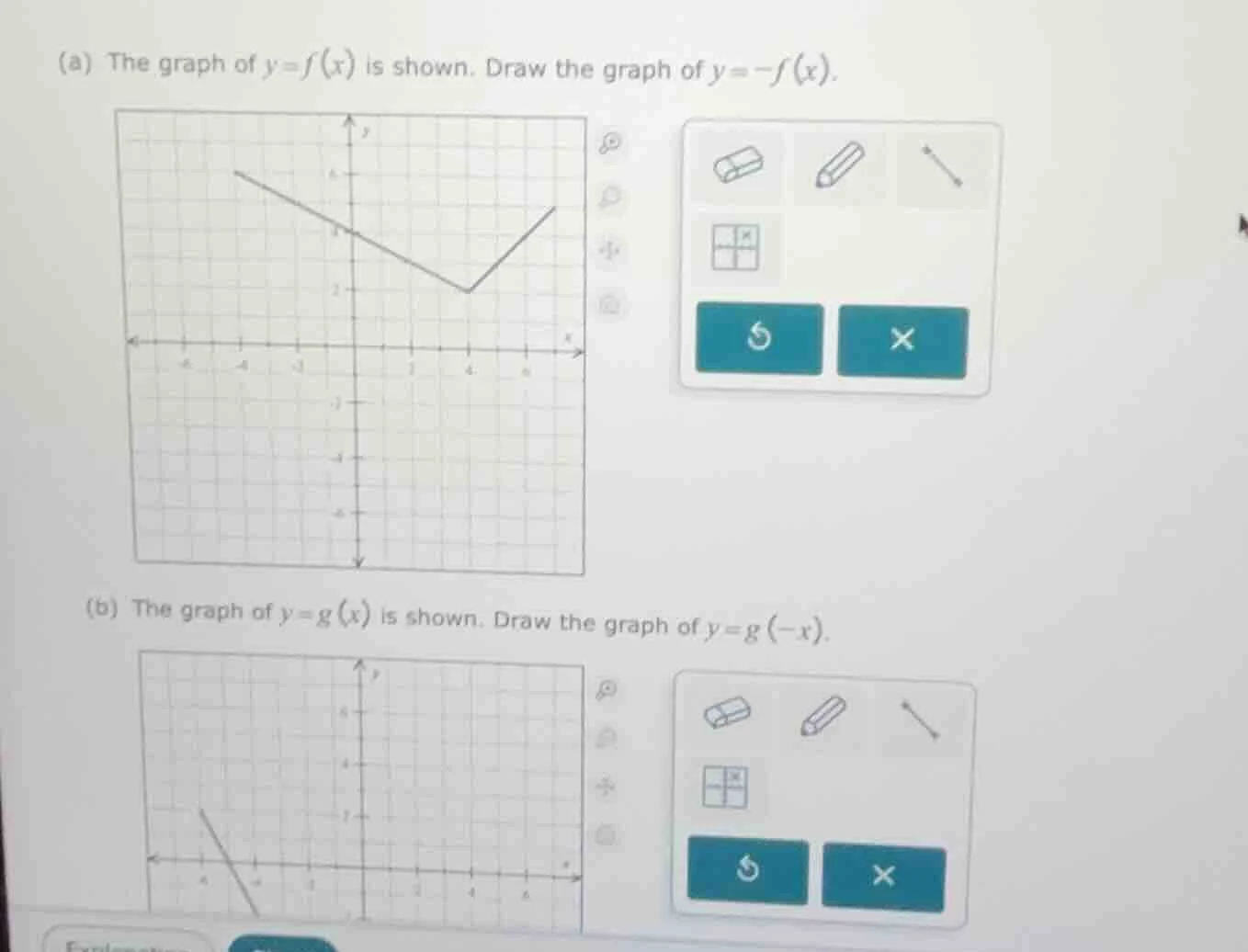
(a) the graph of $y = f(x)$ is shown. draw the graph of $y = -f(x)$.
(b) the graph of $y = g(x)$ is shown. draw the graph of $y = g(-x)$.
Part (a)
Step 1: Understand the Transformation
The transformation \( y = -f(x) \) is a reflection of the graph of \( y = f(x) \) over the \( x \)-axis. For every point \((x, y)\) on the graph of \( y = f(x) \), the corresponding point on \( y = -f(x) \) will be \((x, -y)\).
Step 2: Identify Key Points on \( y = f(x) \)
Looking at the graph of \( y = f(x) \):
- The left segment starts from a point (let's estimate) around \((-4, 6)\) and goes to \((0, 4)\).
- The vertex of the V - shape is at \((4, 2)\).
- The right segment goes from \((4, 2)\) to, say, \((8, 4)\) (estimating from the grid).
Step 3: Reflect Points Over the \( x \)-axis
- For \((-4, 6)\), the reflected point is \((-4, -6)\).
- For \((0, 4)\), the reflected point is \((0, -4)\).
- For \((4, 2)\), the reflected point is \((4, -2)\).
- For \((8, 4)\), the reflected point is \((8, -4)\).
Step 4: Draw the Reflected Graph
Connect the reflected points. The left segment of \( y=-f(x) \) will go from \((-4, -6)\) to \((0, -4)\), the vertex is at \((4, -2)\), and the right segment goes from \((4, -2)\) to \((8, -4)\), maintaining the same slope (since reflection over \( x \)-axis changes the sign of \( y \) but not the slope of the line segments).
Part (b)
Step 1: Understand the Transformation
The transformation \( y = g(-x) \) is a reflection of the graph of \( y = g(x) \) over the \( y \)-axis. For every point \((x, y)\) on the graph of \( y = g(x) \), the corresponding point on \( y = g(-x) \) will be \((-x, y)\).
Step 2: Identify Key Points on \( y = g(x) \)
Looking at the graph of \( y = g(x) \) (the line), let's identify two points. From the grid, it seems to pass through \((-6, 2)\) and \((-4, -2)\) (estimating from the slope and position).
Step 3: Reflect Points Over the \( y \)-axis
- For \((-6, 2)\), the reflected point is \((6, 2)\).
- For \((-4, -2)\), the reflected point is \((4, -2)\).
Step 4: Draw the Reflected Graph
Draw a line through the reflected points \((6, 2)\) and \((4, -2)\). The slope of the original line: the slope \( m \) of \( y = g(x) \) between \((-6, 2)\) and \((-4, -2)\) is \( m=\frac{-2 - 2}{-4-(-6)}=\frac{-4}{2}=-2 \). The slope of the reflected line (since reflection over \( y \)-axis changes \( x \) to \( -x \), the slope of \( y = g(-x) \) will be the negative of the slope of \( y = g(x) \) if the original function is linear? Wait, no. For a linear function \( g(x)=mx + b \), \( g(-x)=-mx + b \), so the slope is \( -m \). The original slope \( m=-2 \), so the slope of \( g(-x) \) is \( 2 \). Let's check with the reflected points: slope between \((4, -2)\) and \((6, 2)\) is \( \frac{2-(-2)}{6 - 4}=\frac{4}{2}=2 \), which matches. So draw the line with slope \( 2 \) passing through \((4, -2)\) and \((6, 2)\) (and other reflected points) to get the graph of \( y = g(-x) \).
Final Answer (Graph Drawing Instructions)
(a) To draw \( y=-f(x) \), reflect each point of \( y = f(x) \) over the \( x \)-axis and connect the reflected points.
(b) To draw \( y = g(-x) \), reflect each point of \( y = g(x) \) over the \( y \)-axis and connect the reflected points.
(Note: Since this is a graph - drawing problem, the final answer is the process of reflection as described, and the actual graph is drawn by plotting the reflected points and connecting them with appropriate line segments.)

Snap & solve any problem in the app
Get step-by-step solutions on Sovi AI
Photo-based solutions with guided steps
Explore more problems and detailed explanations
Step 1: Understand the Transformation
The transformation \( y = g(-x) \) is a reflection of the graph of \( y = g(x) \) over the \( y \)-axis. For every point \((x, y)\) on the graph of \( y = g(x) \), the corresponding point on \( y = g(-x) \) will be \((-x, y)\).
Step 2: Identify Key Points on \( y = g(x) \)
Looking at the graph of \( y = g(x) \) (the line), let's identify two points. From the grid, it seems to pass through \((-6, 2)\) and \((-4, -2)\) (estimating from the slope and position).
Step 3: Reflect Points Over the \( y \)-axis
- For \((-6, 2)\), the reflected point is \((6, 2)\).
- For \((-4, -2)\), the reflected point is \((4, -2)\).
Step 4: Draw the Reflected Graph
Draw a line through the reflected points \((6, 2)\) and \((4, -2)\). The slope of the original line: the slope \( m \) of \( y = g(x) \) between \((-6, 2)\) and \((-4, -2)\) is \( m=\frac{-2 - 2}{-4-(-6)}=\frac{-4}{2}=-2 \). The slope of the reflected line (since reflection over \( y \)-axis changes \( x \) to \( -x \), the slope of \( y = g(-x) \) will be the negative of the slope of \( y = g(x) \) if the original function is linear? Wait, no. For a linear function \( g(x)=mx + b \), \( g(-x)=-mx + b \), so the slope is \( -m \). The original slope \( m=-2 \), so the slope of \( g(-x) \) is \( 2 \). Let's check with the reflected points: slope between \((4, -2)\) and \((6, 2)\) is \( \frac{2-(-2)}{6 - 4}=\frac{4}{2}=2 \), which matches. So draw the line with slope \( 2 \) passing through \((4, -2)\) and \((6, 2)\) (and other reflected points) to get the graph of \( y = g(-x) \).
Final Answer (Graph Drawing Instructions)
(a) To draw \( y=-f(x) \), reflect each point of \( y = f(x) \) over the \( x \)-axis and connect the reflected points.
(b) To draw \( y = g(-x) \), reflect each point of \( y = g(x) \) over the \( y \)-axis and connect the reflected points.
(Note: Since this is a graph - drawing problem, the final answer is the process of reflection as described, and the actual graph is drawn by plotting the reflected points and connecting them with appropriate line segments.)