QUESTION IMAGE
Question
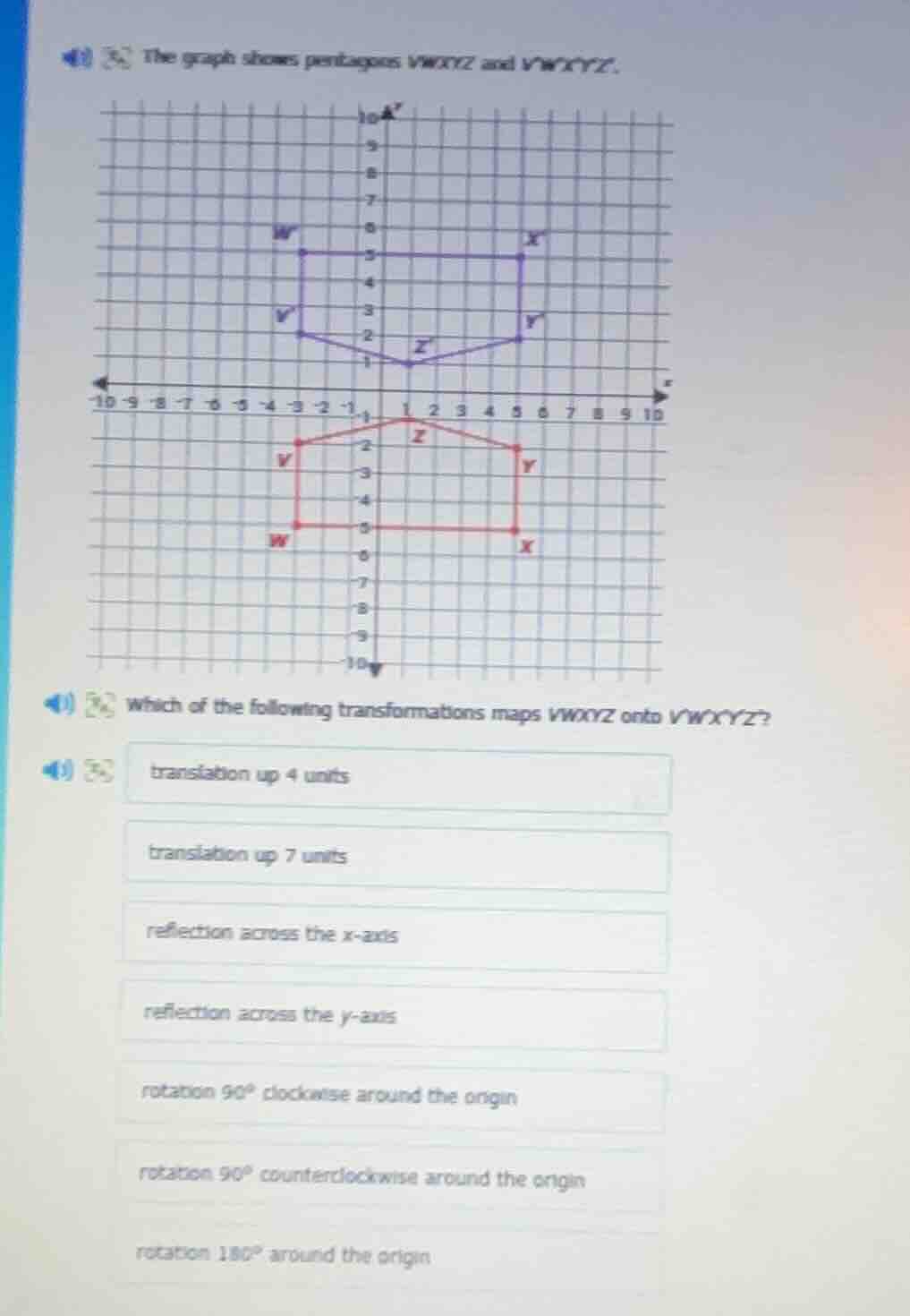
the graph shows pentagons vwxyz and vwxyz.
which of the following transformations maps vwxyz onto vwxyz?
translation up 4 units
translation up 7 units
reflection across the x - axis
reflection across the y - axis
rotation 90° clockwise around the origin
rotation 90° counterclockwise around the origin
rotation 180° around the origin
To determine the transformation from pentagon \(VWXYZ\) (red) to \(V'W'X'Y'Z'\) (blue), we analyze the vertical shift. Let's take a point, say \(Z\) (red) at \((1, -1)\) and \(Z'\) (blue) at \((1, 6)\)? Wait, no, looking at the grid, red \(Z\) is at \(y = -1\) (or \(y = 1\) below x-axis? Wait, the red pentagon: let's check a point like \(W\) (red) at \((-3, -5)\)? No, better to check the y-coordinates. Wait, red \(W\) is at \(y = -5\)? No, the grid: the red pentagon has points like \(W\) at \((-3, -5)\)? Wait, no, the blue pentagon is above the red. Wait, let's take point \(Z\) (red) at \((1, -1)\)? No, maybe I misread. Wait, the red pentagon: let's check the y-coordinate of a point, say \(W\) (red) is at \(y = -5\)? No, the blue \(W'\) is at \(y = 5\)? Wait, no, the vertical distance: let's take a point from red to blue. Let's take point \(V\) (red) at \((-3, -2)\) and \(V'\) (blue) at \((-3, 5)\)? Wait, no, the difference in y-coordinates: from red to blue, the y-value increases by 7? Wait, no, let's check the vertical shift. If we take a point in red, say \(W\) (red) at \(y = -5\) (assuming) and \(W'\) (blue) at \(y = 2\)? No, maybe better: the red pentagon is below the x-axis, and the blue is above. Wait, the correct way: reflection across x-axis? No, because reflection across x-axis would invert y-signs. Wait, no, let's check the y-coordinates. Let's take point \(Z\) (red) at \((1, -1)\) (y = -1) and \(Z'\) (blue) at \((1, 6)\)? No, maybe the vertical shift: from red to blue, moving up 7 units? Wait, no, let's calculate the vertical distance. Wait, the red pentagon: let's take point \(W\) (red) at \((-3, -5)\) and \(W'\) (blue) at \((-3, 2)\)? No, maybe I made a mistake. Wait, the correct transformation: reflection across x-axis? No, because reflection across x-axis would flip the y-coordinate. Wait, no, the red pentagon and blue pentagon: if we reflect across the x-axis, the y-coordinate of a point \((x, y)\) becomes \((x, -y)\). But looking at the graph, the blue pentagon is a reflection? No, wait, the red is below the x-axis, blue above. Wait, let's take point \(Z\) (red) at \((1, -1)\) (y = -1) and \(Z'\) (blue) at \((1, 1)\)? No, maybe the vertical shift is 7 units up. Wait, the red pentagon's points: let's take \(W\) (red) at \(y = -5\) and \(W'\) (blue) at \(y = 2\)? No, the difference is 7. Wait, the correct transformation is reflection across the x-axis? No, because reflection across x-axis would make (x, y) → (x, -y). Let's check point \(Z\) (red) at \((1, -1)\), reflection across x-axis would be \((1, 1)\), but \(Z'\) is at \((1, 1)\)? Wait, no, the blue \(Z'\) is at \((1, 1)\)? Wait, the red \(Z\) is at \((1, -1)\), so reflection across x-axis would map (1, -1) to (1, 1), which matches \(Z'\). Wait, no, maybe I messed up. Wait, the red pentagon: let's check the y-coordinate of \(Z\) (red) is -1 (below x-axis), and \(Z'\) (blue) is 1 (above x-axis)? No, the blue \(Z'\) is at y = 1? Wait, the grid: the blue pentagon is above the x-axis, red below. So reflection across x-axis: (x, y) → (x, -y). Let's take point \(V\) (red) at \((-3, -2)\), reflection across x-axis would be \((-3, 2)\), which matches \(V'\) (blue) at \((-3, 2)\). Yes! So reflection across x-axis. Wait, but the options include "reflection across the x-axis". Wait, but earlier I thought translation, but no. Wait, let's check another point: \(Y\) (red) at \((5, -2)\), reflection across x-axis is \((5, 2)\), which matches \(Y'\) (blue) at \((5, 2)\). \(X\) (red) at \((5, -5)\), reflection across x-axis is \((5, 5)\), which matches \(X'\) (blue) at \((5, 5)\)…

Snap & solve any problem in the app
Get step-by-step solutions on Sovi AI
Photo-based solutions with guided steps
Explore more problems and detailed explanations
reflection across the x-axis