QUESTION IMAGE
Question
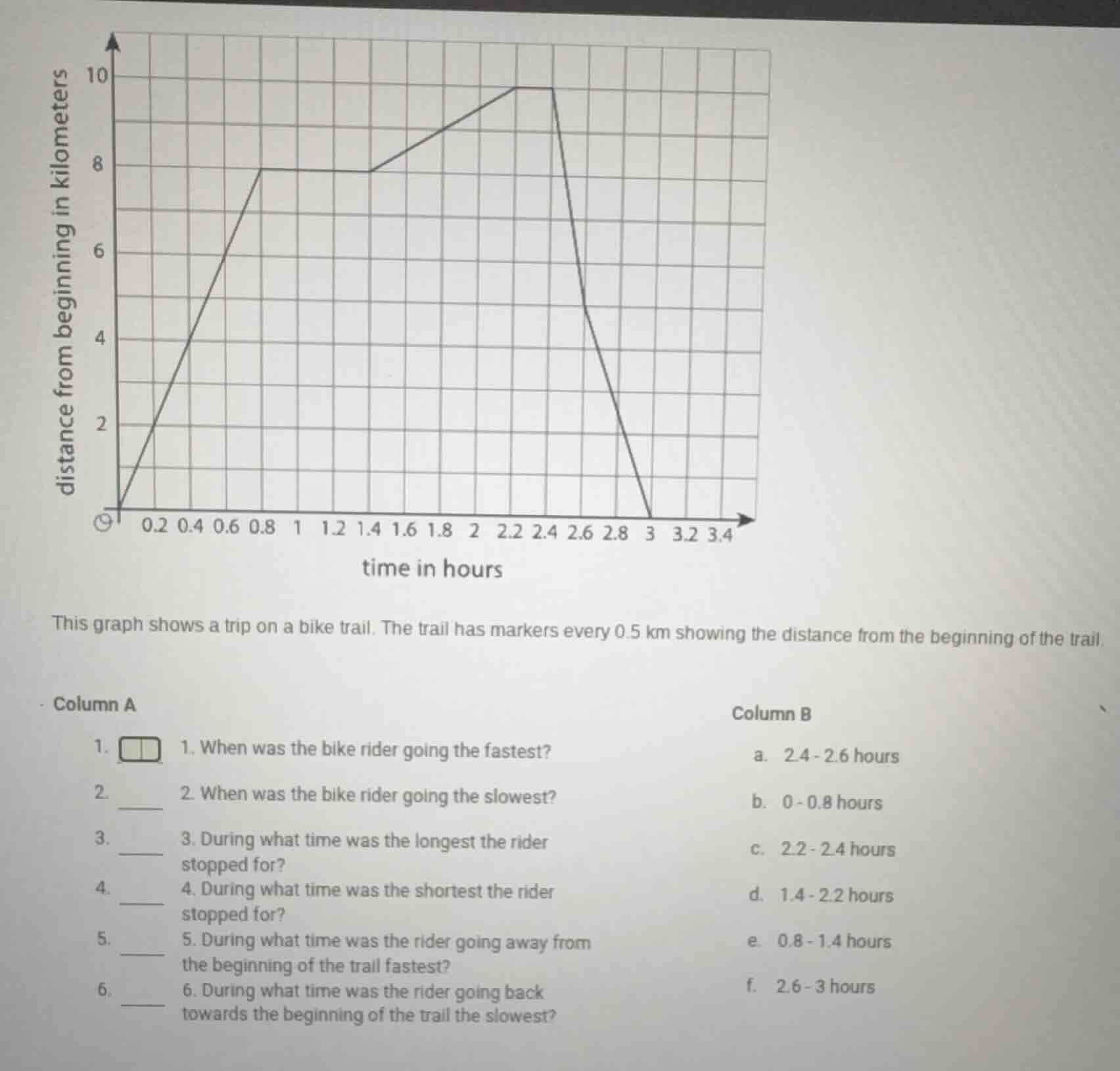
this graph shows a trip on a bike trail. the trail has markers every 0.5 km showing the distance from the beginning of the trail.
column a
- 1. when was the bike rider going the fastest?
- 2. when was the bike rider going the slowest?
- 3. during what time was the longest the rider stopped for?
- 4. during what time was the shortest the rider stopped for?
- 5. during what time was the rider going away from the beginning of the trail fastest?
- 6. during what time was the rider going back towards the beginning of the trail the slowest?
column b
a. 2.4 - 2.6 hours
b. 0 - 0.8 hours
c. 2.2 - 2.4 hours
d. 1.4 - 2.2 hours
e. 0.8 - 1.4 hours
f. 2.6 - 3 hours
Step1: Analyze speed from slope
Speed = $\frac{\text{Change in Distance}}{\text{Change in Time}}$, steeper slope = faster speed.
Step2: Match Q1 (fastest overall)
The steepest slope is 2.4-2.6 hours (distance drops from 9.5 to 5 km in 0.2h, speed = $\frac{9.5-5}{2.6-2.4}=22.5$ km/h). Match to a.
Step3: Match Q2 (slowest moving)
The shallowest positive/negative slope is 1.4-2.2 hours (distance rises from 8 to 9.5 km in 0.8h, speed = $\frac{9.5-8}{2.2-1.4}=1.875$ km/h). Match to d.
Step4: Match Q3 (longest stop)
Flat line (no distance change) 0.8-1.4 hours, duration = $1.4-0.8=0.6$ hours. Match to e.
Step5: Match Q4 (shortest stop)
Flat line 2.2-2.4 hours, duration = $2.4-2.2=0.2$ hours. Match to c.
Step6: Match Q5 (fastest away)
Steepest positive slope 0-0.8 hours (distance rises to 8 km in 0.8h, speed = $\frac{8-0}{0.8-0}=10$ km/h). Match to b.
Step7: Match Q6 (slowest back)
Shallowest negative slope 2.6-3 hours (distance drops from 5 to 0 km in 0.4h, speed = $\frac{5-0}{3-2.6}=12.5$ km/h, slower than 2.4-2.6h). Match to f.

Snap & solve any problem in the app
Get step-by-step solutions on Sovi AI
Photo-based solutions with guided steps
Explore more problems and detailed explanations
- a. 2.4 - 2.6 hours
- d. 1.4 - 2.2 hours
- e. 0.8 - 1.4 hours
- c. 2.2 - 2.4 hours
- b. 0 - 0.8 hours
- f. 2.6 - 3 hours