QUESTION IMAGE
Question
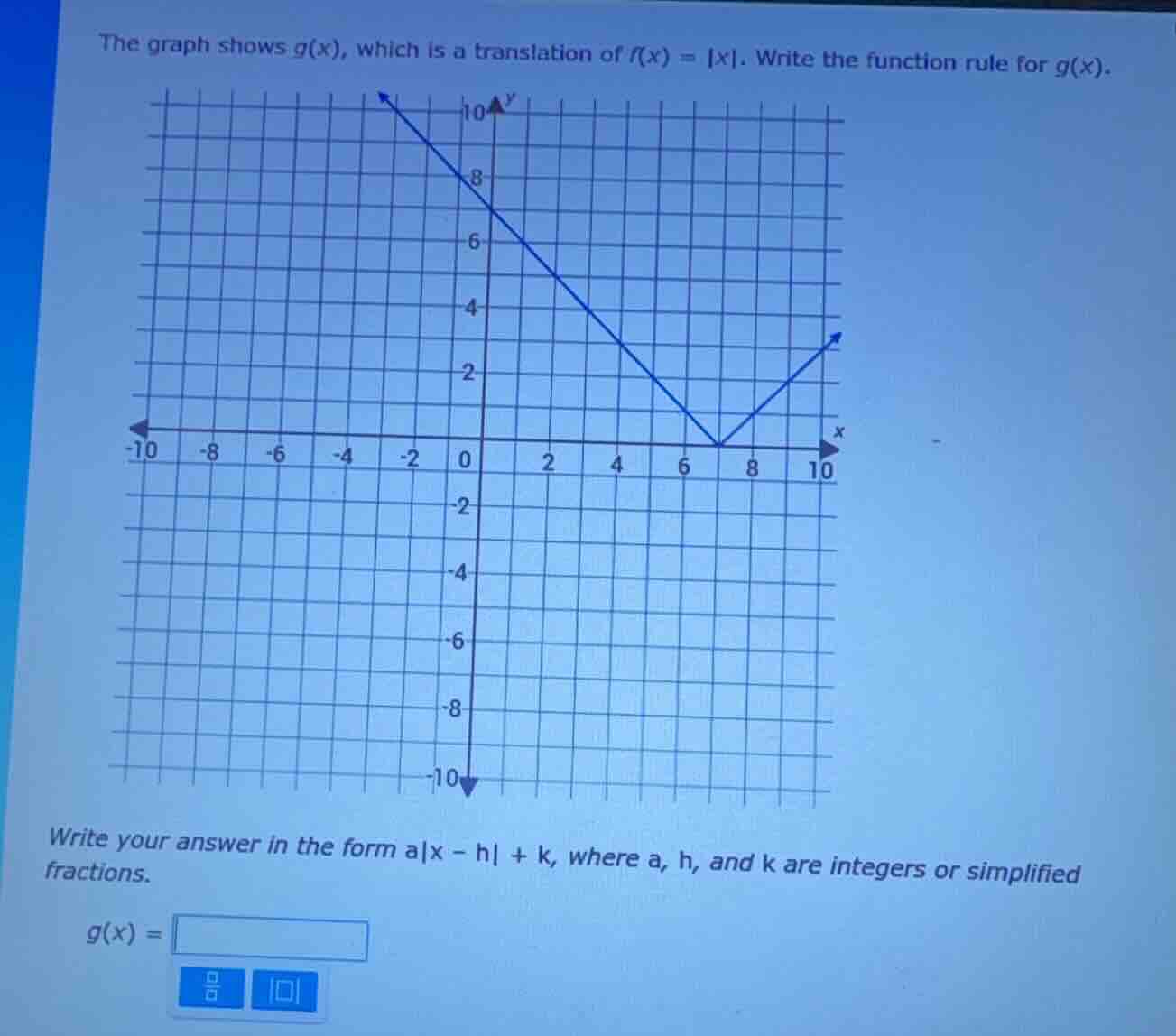
the graph shows g(x), which is a translation of f(x) = |x|. write the function rule for g(x).
write your answer in the form a|x - h| + k, where a, h, and k are integers or simplified fractions.
g(x) =
Step1: Identify the vertex of \( g(x) \)
The vertex of the absolute - value function \( y = a|x - h|+k \) is at \( (h,k) \). From the graph, the vertex of \( g(x) \) is at \( (7,0) \), so \( h = 7 \) and \( k = 0 \).
Step2: Determine the value of \( a \)
We know that the parent function is \( f(x)=|x| \), and we can use a point on \( g(x) \) to find \( a \). Let's use the y - intercept. When \( x = 0 \), from the graph, \( y=7 \)? Wait, no, looking at the graph, when \( x = 0 \), the value of \( g(x) \) is 7? Wait, no, let's recalculate. Wait, the vertex is at \( (7,0) \). Let's take another point. Let's take the point \( (0,7) \)? Wait, no, looking at the graph, when \( x = 0 \), the line passes through \( (0,7) \)? Wait, no, the graph of \( g(x) \): let's check the slope. The parent function \( f(x)=|x| \) has a slope of 1 for \( x\geq0 \) and - 1 for \( x < 0 \). For \( g(x) \), let's take two points. The vertex is \( (7,0) \), and when \( x = 0 \), let's see the value. From the graph, when \( x = 0 \), \( y = 7 \)? Wait, no, the graph: let's count the grid. The vertex is at \( (7,0) \). Let's take \( x=0 \), the point on the graph is \( (0,7) \)? Wait, no, the line from \( (7,0) \) to \( (0,7) \): the slope is \( \frac{7 - 0}{0 - 7}=\frac{7}{-7}=- 1 \). Wait, so the slope for \( x<7 \) is - 1, and for \( x\geq7 \) is 1. Wait, the general form of a translated absolute - value function is \( g(x)=a|x - h|+k \). Since the slope of the left - hand side ( \( x < h \)) is - a and the slope of the right - hand side ( \( x\geq h \)) is a. For the parent function \( f(x)=|x| \), \( a = 1 \), slope of right side is 1, left side is - 1. For \( g(x) \), let's find \( a \). Let's use the vertex \( (h,k)=(7,0) \). Let's take the point \( (0,7) \). Plug into \( g(x)=a|x - 7|+0 \). So \( 7=a|0 - 7| \), \( 7 = 7a \), so \( a = 1 \)? Wait, no, \( |0 - 7|=7 \), so \( 7=a\times7 \), so \( a = 1 \). Wait, but let's check the slope. The line from \( (7,0) \) to \( (0,7) \): the change in \( y \) is \( 7-0 = 7 \), change in \( x \) is \( 0 - 7=-7 \), so slope is \( \frac{7}{-7}=-1 \). Wait, but in the form \( g(x)=a|x - h|+k \), when \( x < h \), \( g(x)=a(h - x)+k \), so the slope is - a. When \( x\geq h \), \( g(x)=a(x - h)+k \), slope is a. So if the slope for \( x < 7 \) is - 1, then - a=-1, so \( a = 1 \). And \( k = 0 \), \( h = 7 \). So the function is \( g(x)=|x - 7|+0 \), which simplifies to \( g(x)=|x - 7| \)? Wait, no, when \( x = 0 \), \( g(0)=|0 - 7|=7 \), which matches the y - intercept (from the graph, when \( x = 0 \), \( y = 7 \)). Let's check another point. When \( x = 7 \), \( g(7)=|7 - 7|=0 \), which is the vertex. When \( x = 8 \), \( g(8)=|8 - 7|=1 \), and from the graph, at \( x = 8 \), the value is 1, which matches. So the function rule is \( g(x)=|x - 7|+0 \), or \( g(x)=|x - 7| \). Wait, but let's confirm the form \( a|x - h|+k \). Here, \( a = 1 \), \( h = 7 \), \( k = 0 \).
Wait, maybe I made a mistake earlier. Let's re - examine the graph. The parent function \( f(x)=|x| \) has its vertex at \( (0,0) \). The graph of \( g(x) \) has its vertex at \( (7,0) \), so it is a horizontal translation 7 units to the right. There is no vertical stretch or compression (since the slope is still 1 for \( x\geq7 \) and - 1 for \( x < 7 \)) and no vertical shift (since \( k = 0 \)). So the function \( g(x)=|x - 7|+0 \), which is \( g(x)=|x - 7| \).
Wait, but when \( x = 0 \), \( g(0)=|0 - 7|=7 \), which is correct as per the graph (the y - intercept is 7). When \( x = 7 \), \( g(7)=0 \), which is the vertex. When \( x = 8 \), \( g…

Snap & solve any problem in the app
Get step-by-step solutions on Sovi AI
Photo-based solutions with guided steps
Explore more problems and detailed explanations
\( g(x)=|x - 7| \) (or \( g(x)=1|x - 7|+0 \))