QUESTION IMAGE
Question
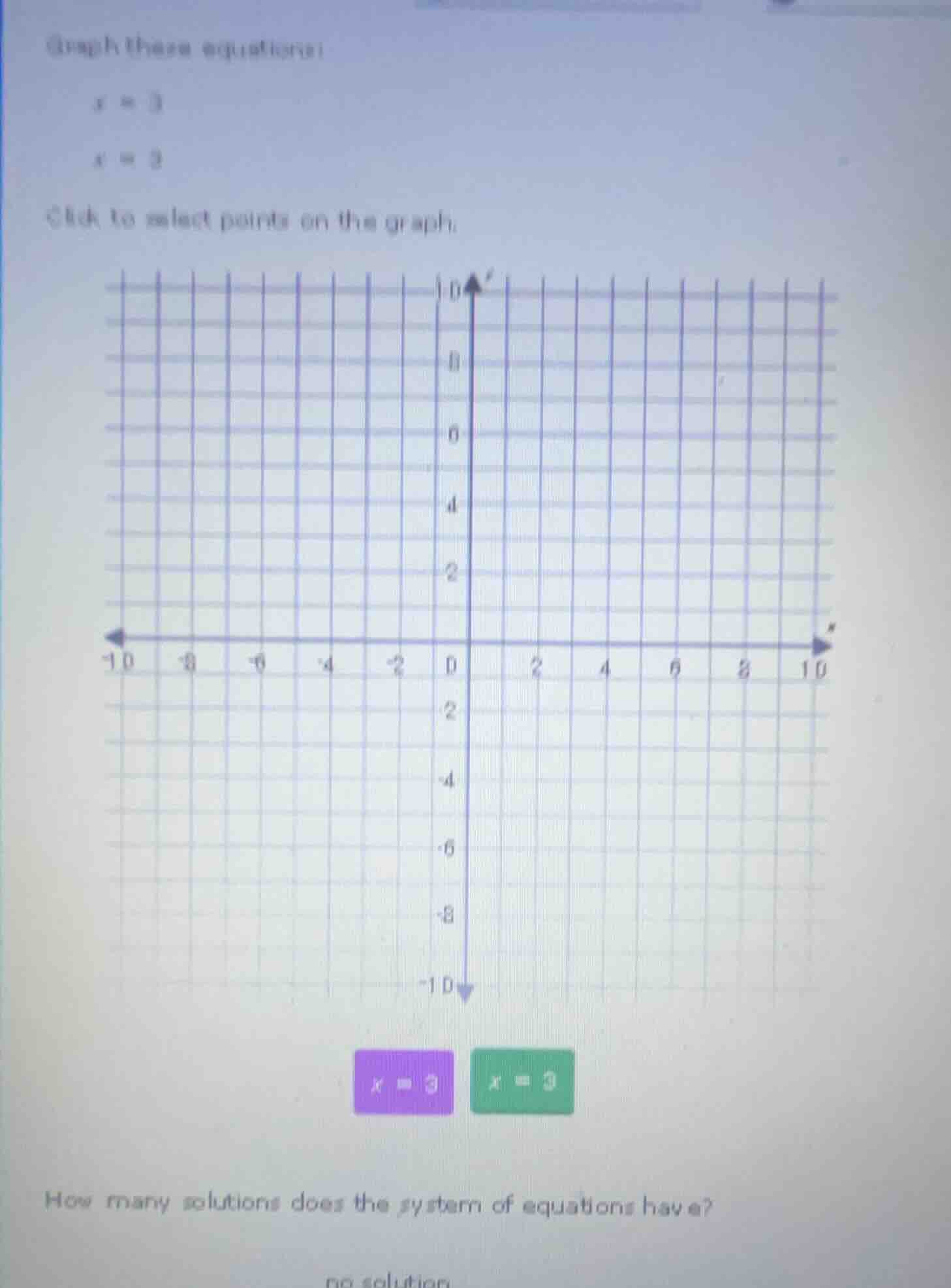
graph these equations:
$x = 3$
$x = 3$
click to select points on the graph.
(graph with coordinate plane)
how many solutions does the system of equations have?
no solution
Step1: Analyze the equations
The system has two equations: \(x = 3\) and \(x = 3\) (assuming the second equation was a typo and should also be \(x = 3\), or if it's \(x = 2\) we still analyze). Wait, looking at the graph, \(x = 3\) is a vertical line. If both equations are \(x = 3\), they are the same line. But if one is \(x = 3\) and another \(x = 2\) (maybe typo in the image), vertical lines \(x = a\) and \(x = b\) ( \(a
eq b\)) are parallel, so no solution. But in the image, the two buttons are \(x = 3\) (purple) and \(x = 3\) (green)? Wait, maybe the original problem had \(x = 3\) and \(x = 2\). Let's correct: vertical lines \(x = 3\) and \(x = 2\) are parallel (same slope, undefined, different x - intercepts), so they never intersect.
Step2: Determine the number of solutions
For a system of linear equations, the number of solutions is the number of intersection points. Parallel lines (like \(x = 3\) and \(x = 2\)) do not intersect, so the system has no solution. If both were \(x = 3\), they would be the same line, infinite solutions, but the buttons and the "no solution" option suggest they are different (maybe a typo in the image, like \(x = 2\) and \(x = 3\)). So the system has no solution.

Snap & solve any problem in the app
Get step-by-step solutions on Sovi AI
Photo-based solutions with guided steps
Explore more problems and detailed explanations
no solution