QUESTION IMAGE
Question
graphical interpretation of acceleration
wednesday, january 21, 2025 chemical sciences dept. uenr
37
verage and instantaneous acceleration: example
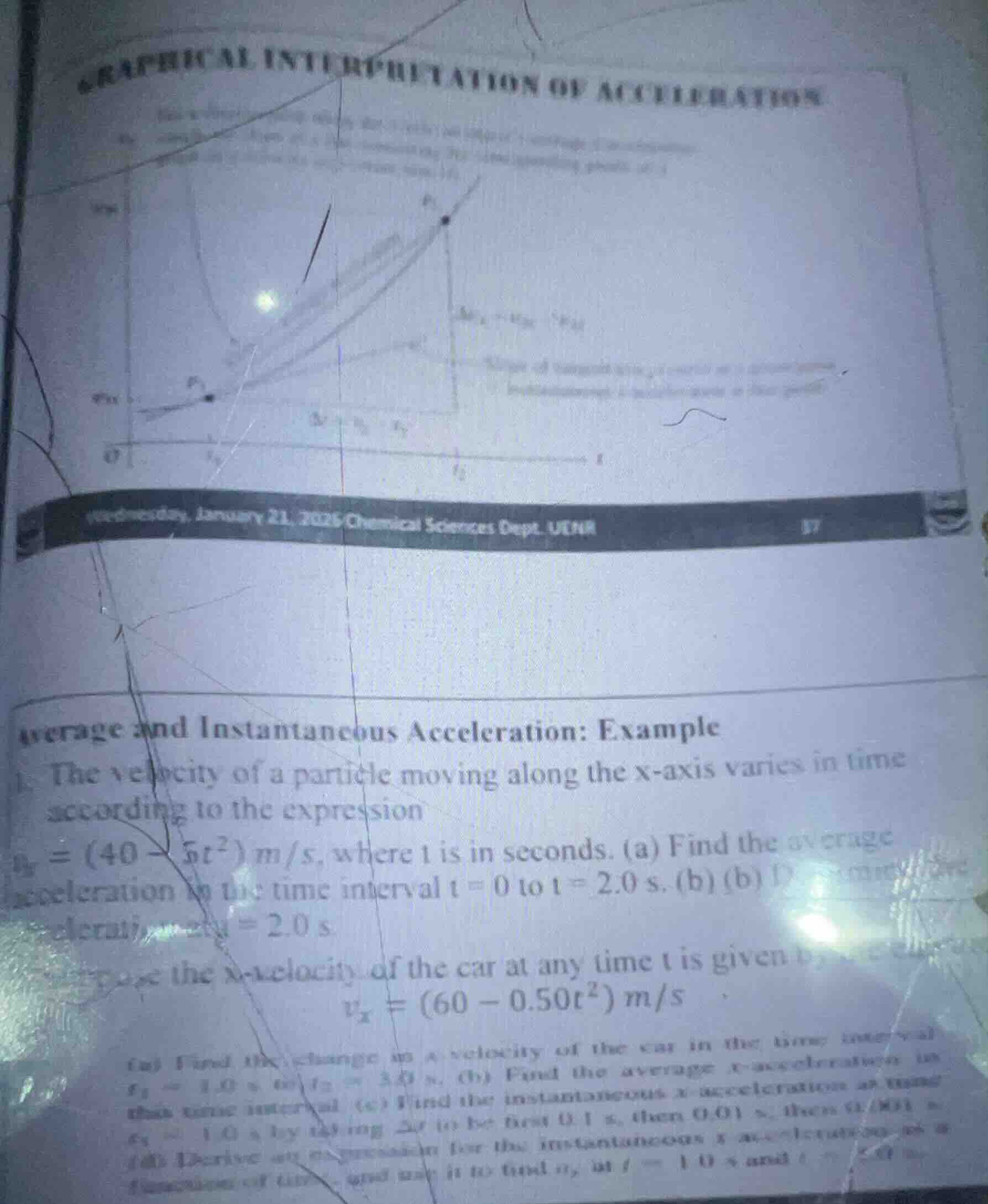
- the velocity of a particle moving along the x-axis varies in time according to the expression
$v_x=(40 - 5t^{2})\\ m/s$, where t is in seconds. (a) find the average acceleration in the time interval $t = 0$ to $t = 2.0\\ s$. (b) find the acceleration at $t = 2.0\\ s$
the x-velocity of the car at any time t is given by
$v_x=(60 - 0.50t^{2})\\ m/s$
(a) find the change in x-velocity of the car in the time interval $t_1 = 1.0\\ s$ to $t_2 = 3.0\\ s$. (b) find the average x-acceleration in this time interval. (c) find the instantaneous x-acceleration at time $t_1 = 1.0\\ s$ by taking $\delta t$ to be first $0.1\\ s$, then $0.01\\ s$, then $0.001\\ s$. (d) derive an expression for the instantaneous x-acceleration as a function of time, and use it to find $a_x$ at $t = 1.0\\ s$ and $t = 2.0\\ s$.
Step1: Find $v_x$ at $t=0$
Substitute $t=0$ into $v_x=(40-5t^2)\ \text{m/s}$:
$v_{x1}=40-5(0)^2=40\ \text{m/s}$
Step2: Find $v_x$ at $t=2.0\ \text{s}$
Substitute $t=2.0$ into $v_x=(40-5t^2)\ \text{m/s}$:
$v_{x2}=40-5(2.0)^2=40-20=20\ \text{m/s}$
Step3: Calculate average acceleration
Use $\bar{a}_x=\frac{\Delta v_x}{\Delta t}=\frac{v_{x2}-v_{x1}}{t_2-t_1}$:
$\bar{a}_x=\frac{20-40}{2.0-0}=\frac{-20}{2.0}=-10\ \text{m/s}^2$
Step4: Find instantaneous acceleration formula
Differentiate $v_x$ with respect to $t$:
$a_x=\frac{dv_x}{dt}=\frac{d}{dt}(40-5t^2)=-10t\ \text{m/s}^2$
Step5: Find $a_x$ at $t=2.0\ \text{s}$
Substitute $t=2.0$ into $a_x=-10t$:
$a_x=-10(2.0)=-20\ \text{m/s}^2$
---
For the car velocity function $v_x=(60-0.50t^2)\ \text{m/s}$:
Step6: Find $\Delta v_x$ for $t=1.0$ to $3.0\ \text{s}$
First, $v_{x1}=60-0.50(1.0)^2=59.5\ \text{m/s}$, $v_{x2}=60-0.50(3.0)^2=60-4.5=55.5\ \text{m/s}$
$\Delta v_x=55.5-59.5=-4.0\ \text{m/s}$
Step7: Calculate average $a_x$ for 1-3 s
Use $\bar{a}_x=\frac{\Delta v_x}{\Delta t}$:
$\bar{a}_x=\frac{-4.0}{3.0-1.0}=-2.0\ \text{m/s}^2$
Step8: Approximate $a_x$ at $t=1.0\ \text{s}$ (small $\Delta t$)
For $\Delta t=0.1\ \text{s}$, $t_2=1.1\ \text{s}$: $v_{x2}=60-0.50(1.1)^2=59.395\ \text{m/s}$
$\bar{a}_x=\frac{59.395-59.5}{0.1}=-1.05\ \text{m/s}^2$
For $\Delta t=0.01\ \text{s}$, $t_2=1.01\ \text{s}$: $v_{x2}=60-0.50(1.01)^2=59.48995\ \text{m/s}$
$\bar{a}_x=\frac{59.48995-59.5}{0.01}=-1.005\ \text{m/s}^2$
For $\Delta t=0.001\ \text{s}$, $t_2=1.001\ \text{s}$: $v_{x2}=60-0.50(1.001)^2=59.4989995\ \text{m/s}$
$\bar{a}_x=\frac{59.4989995-59.5}{0.001}=-1.0005\ \text{m/s}^2$
Step9: Derive instantaneous $a_x$ formula
Differentiate $v_x$:
$a_x=\frac{dv_x}{dt}=\frac{d}{dt}(60-0.50t^2)=-1.0t\ \text{m/s}^2$
Step10: Find $a_x$ at $t=1.0$ and $2.0\ \text{s}$
At $t=1.0\ \text{s}$: $a_x=-1.0(1.0)=-1.0\ \text{m/s}^2$
At $t=2.0\ \text{s}$: $a_x=-1.0(2.0)=-2.0\ \text{m/s}^2$

Snap & solve any problem in the app
Get step-by-step solutions on Sovi AI
Photo-based solutions with guided steps
Explore more problems and detailed explanations
For the particle $v_x=(40-5t^2)\ \text{m/s}$:
(a) Average acceleration: $\boldsymbol{-10\ \text{m/s}^2}$
(b) Instantaneous acceleration at $t=2.0\ \text{s}$: $\boldsymbol{-20\ \text{m/s}^2}$
For the car $v_x=(60-0.50t^2)\ \text{m/s}$:
(a) Change in velocity: $\boldsymbol{-4.0\ \text{m/s}}$
(b) Average acceleration: $\boldsymbol{-2.0\ \text{m/s}^2}$
(c) Approximations: $\boldsymbol{-1.05\ \text{m/s}^2}$ (for $\Delta t=0.1\ \text{s}$), $\boldsymbol{-1.005\ \text{m/s}^2}$ (for $\Delta t=0.01\ \text{s}$), $\boldsymbol{-1.0005\ \text{m/s}^2}$ (for $\Delta t=0.001\ \text{s}$)
(d) Instantaneous acceleration formula: $\boldsymbol{a_x=-1.0t\ \text{m/s}^2}$; at $t=1.0\ \text{s}$: $\boldsymbol{-1.0\ \text{m/s}^2}$, at $t=2.0\ \text{s}$: $\boldsymbol{-2.0\ \text{m/s}^2}$