QUESTION IMAGE
Question
graphing polynomial functions
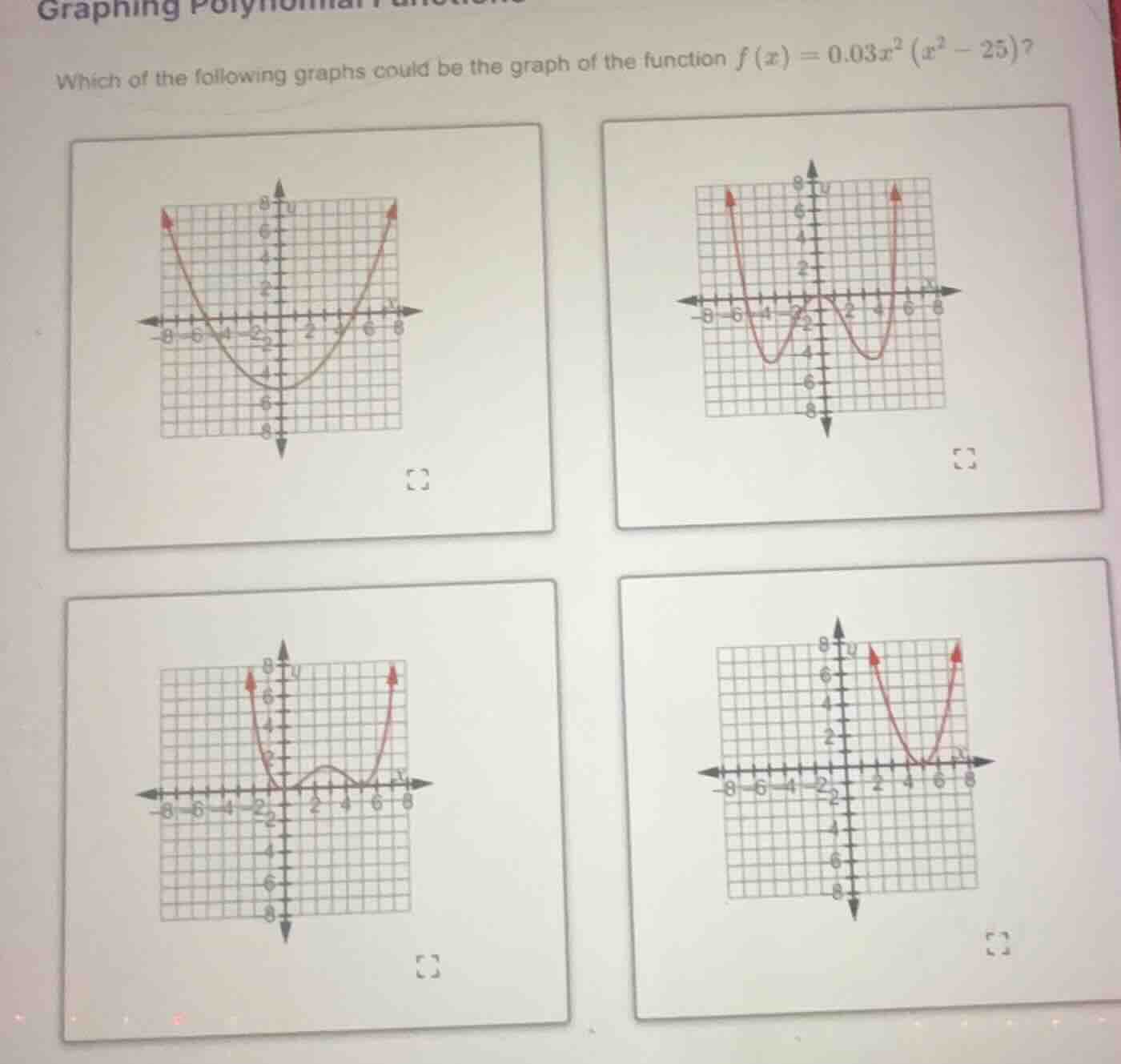
which of the following graphs could be the graph of the function $f(x) = 0.03x^2(x^2 - 25)$?
four graphs are shown here, omitted in ocr as per instruction
Step1: Find the roots of the function
To find the roots, set \( f(x) = 0 \):
\[
0.03x^2(x^2 - 25)=0
\]
Using the zero - product property (\(ab = 0\) implies \(a = 0\) or \(b = 0\)), we have two cases:
- Case 1: \(x^2=0\), which gives \(x = 0\) (a double root, so the graph touches the \(x\) - axis at \(x = 0\)).
- Case 2: \(x^2-25 = 0\), which can be factored as \((x - 5)(x + 5)=0\). So \(x=5\) or \(x=-5\).
So the roots of the function are \(x=-5\), \(x = 0\) (with multiplicity 2), and \(x = 5\).
Step2: Analyze the end - behavior
The function \(f(x)=0.03x^2(x^2 - 25)=0.03x^4-0.75x^2\) is a polynomial of degree 4 (even degree) with a positive leading coefficient (\(0.03>0\)). For a polynomial \(y = a_nx^n+\cdots+a_1x + a_0\) with \(n\) even and \(a_n>0\), as \(x
ightarrow\pm\infty\), \(y
ightarrow+\infty\).
Step3: Analyze the sign of the function in different intervals
- For \(x\in(-\infty,-5)\): Let's take \(x=-6\). Then \(x^2=36>0\) and \(x^2 - 25=36 - 25 = 11>0\), so \(f(-6)=0.03\times36\times11>0\).
- For \(x\in(-5,0)\): Let's take \(x=-1\). Then \(x^2 = 1>0\) and \(x^2-25=1 - 25=-24<0\), so \(f(-1)=0.03\times1\times(-24)<0\).
- For \(x\in(0,5)\): Let's take \(x = 1\). Then \(x^2=1>0\) and \(x^2 - 25=1 - 25=-24<0\), so \(f(1)=0.03\times1\times(-24)<0\).
- For \(x\in(5,+\infty)\): Let's take \(x = 6\). Then \(x^2=36>0\) and \(x^2 - 25=36 - 25 = 11>0\), so \(f(6)=0.03\times36\times11>0\).
Now let's analyze the graphs:
- The first graph: It does not have roots at \(x=\pm5\), so it can be eliminated.
- The second graph:
- It has roots at \(x=-5\), \(x = 0\), and \(x = 5\).
- As \(x
ightarrow\pm\infty\), the graph goes to \(+\infty\) (since the leading coefficient is positive and degree is even).
- In the interval \((-5,0)\) and \((0,5)\), the function is negative (the graph is below the \(x\) - axis), and in the intervals \((-\infty,-5)\) and \((5,+\infty)\), the function is positive (the graph is above the \(x\) - axis). Also, at \(x = 0\), the graph touches the \(x\) - axis (because of the double root at \(x = 0\)).
- The third graph: The behavior in the interval \((-5,0)\) and \((0,5)\) does not match the sign of the function (it has a positive part in \((0,5)\) which is incorrect), so it can be eliminated.
- The fourth graph: It does not have roots at \(x=\pm5\), so it can be eliminated.

Snap & solve any problem in the app
Get step-by-step solutions on Sovi AI
Photo-based solutions with guided steps
Explore more problems and detailed explanations
The second graph (the one with roots at \(x=-5\), \(x = 0\), \(x = 5\), opening upwards at the ends, and below the \(x\) - axis between \(-5\) and \(5\) except at \(x = 0\) where it touches the \(x\) - axis)