QUESTION IMAGE
Question
graphing rational functions: tutorial
the denominator of function g is equal to 0 when x = -1. since this point of discontinuity cant be removed by simplifying the rational expression, there is a vertical asymptote, not a hole, at x = -1. so the domain is (-∞, -1) ∪ (-1, ∞).
since the numerator of the function is a constant and the denominator is a linear expression, y = 0 is the horizontal asymptote of the graph of the function. so the range of function f is (-∞, 0) ∪ (0, ∞).
part b
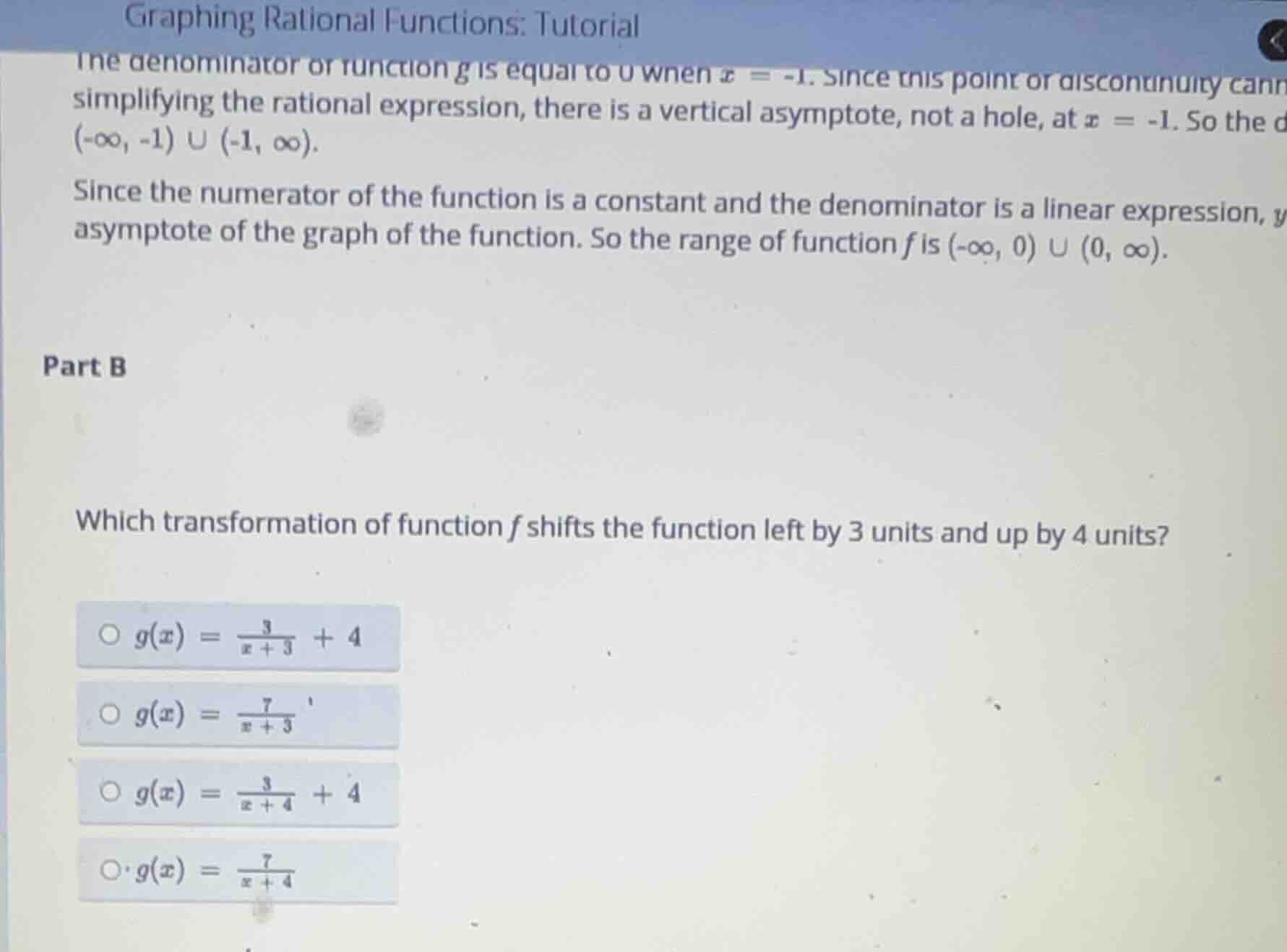
which transformation of function f shifts the function left by 3 units and up by 4 units?
○ $g(x) = \frac{3}{x + 3} + 4$
○ $g(x) = \frac{7}{x + 3}$
○ $g(x) = \frac{3}{x + 4} + 4$
○ $g(x) = \frac{7}{x + 4}$
Step1: Recall horizontal shift rule
For a function $f(x)$, a left shift by $h$ units gives $f(x+h)$.
Step2: Recall vertical shift rule
For a function $f(x)$, an up shift by $k$ units gives $f(x)+k$.
Step3: Apply shifts to base function
Assuming the base function $f(x)=\frac{3}{x}$ (matching the numerator in options), left 3 units: $f(x+3)=\frac{3}{x+3}$; up 4 units: $\frac{3}{x+3}+4$.

Snap & solve any problem in the app
Get step-by-step solutions on Sovi AI
Photo-based solutions with guided steps
Explore more problems and detailed explanations
A. $g(x) = \frac{3}{x+3} + 4$