QUESTION IMAGE
Question
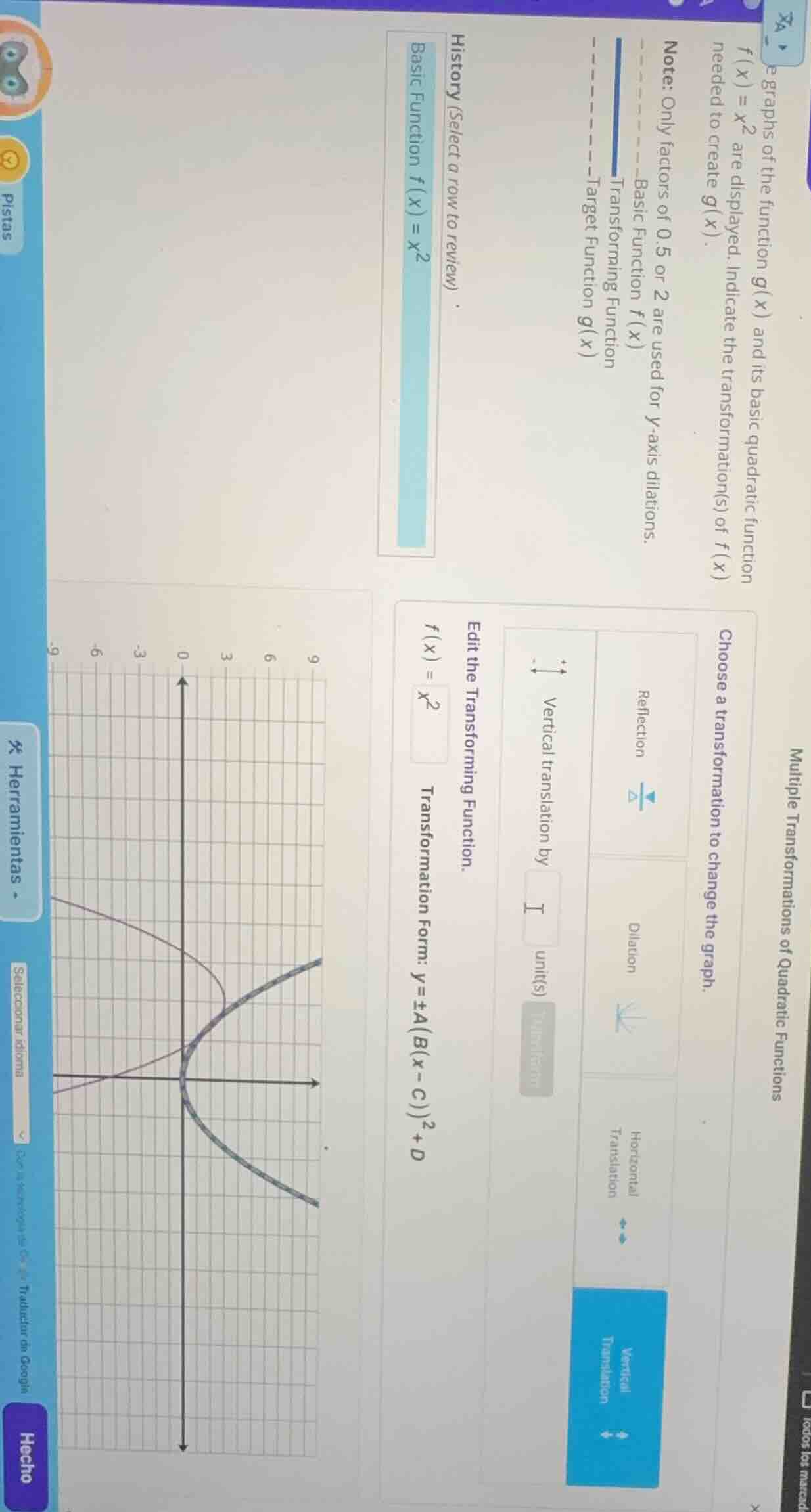
e graphs of the function ( g(x) ) and its basic quadratic function ( f(x) = x^2 ) are displayed. indicate the transformation(s) of ( f(x) ) needed to create ( g(x) ).
note: only factors of 0.5 or 2 are used for ( y )-axis dilations.
multiple transformations of quadratic functions
choose a transformation to change the graph.
reflection
dilation
horizontal translation
vertical translation
vertical translation by (square) units
edit the transforming function.
( f(x) = x^2 )
transformation form: ( y = pm a(b(x - c))^2 + d )
Step1: Identificar la dilatación vertical
La función básica $f(x)=x^2$ pasa por $(1,1)$, mientras que la función objetivo $g(x)$ pasa por $(1,0.5)$. Esto significa que hay una dilatación vertical por un factor de $\frac{1}{2}$. La forma intermedia es $y=\frac{1}{2}x^2$.
Step2: Identificar la traslación vertical
La vértice de $f(x)$ está en $(0,0)$, y la vértice de $g(x)$ está en $(0,2)$. Esto implica una traslación vertical hacia arriba de 2 unidades. Aplicamos esto a la función anterior:
$y=\frac{1}{2}x^2 + 2$

Snap & solve any problem in the app
Get step-by-step solutions on Sovi AI
Photo-based solutions with guided steps
Explore more problems and detailed explanations
La transformación es una dilatación vertical por un factor de $\frac{1}{2}$ y una traslación vertical hacia arriba de 2 unidades. La función objetivo es $g(x)=\frac{1}{2}x^2 + 2$