QUESTION IMAGE
Question
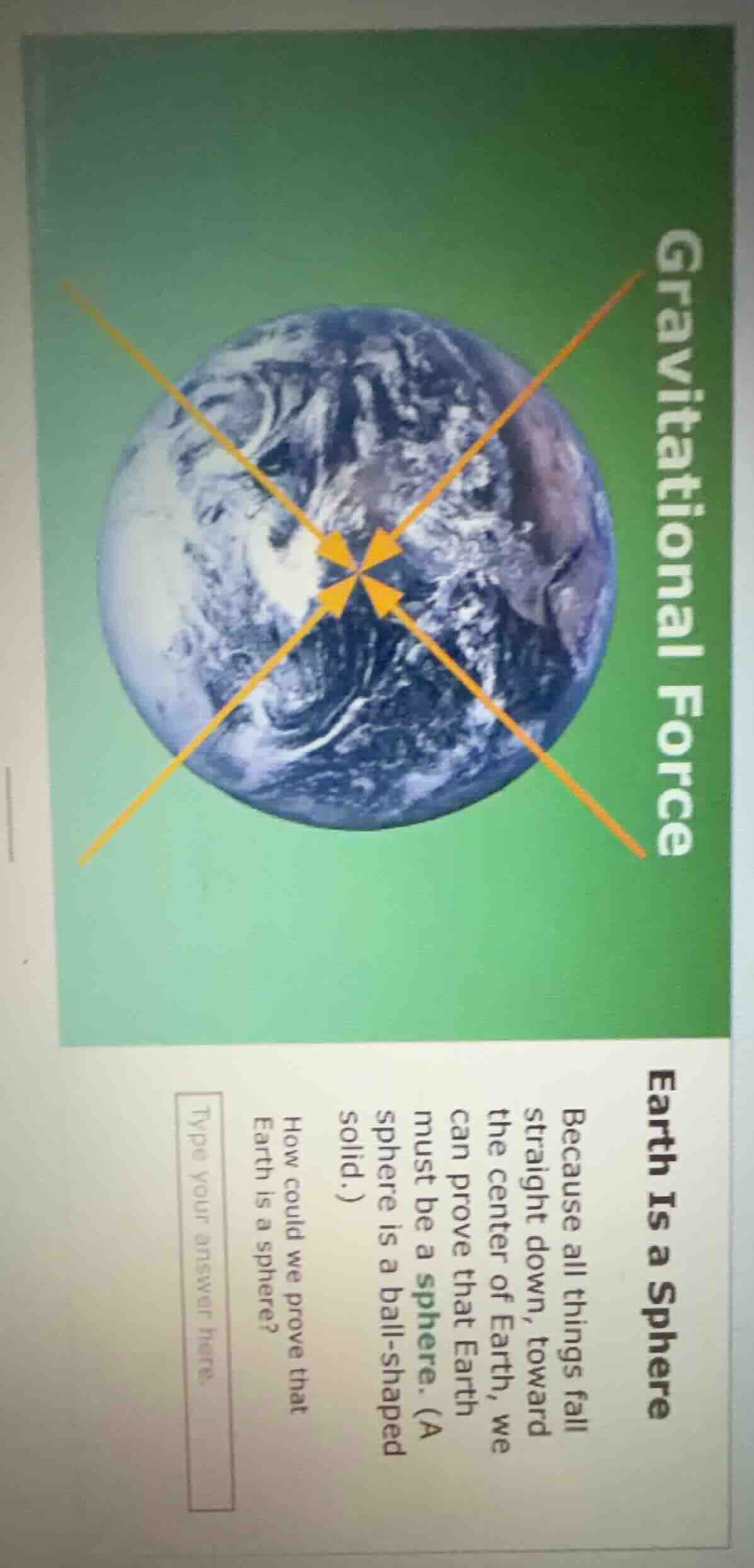
gravitational force
earth is a sphere
because all things fall straight down, toward the center of earth, we can prove that earth must be a sphere. (a sphere is a ball-shaped solid.)
how could we prove that earth is a sphere?
type your answer here.
Brief Explanations
There are several practical and observational ways to prove Earth is a sphere:
- Lunar Eclipses: When Earth passes between the Sun and Moon, Earth's shadow on the Moon is always curved, which is a characteristic shadow of a spherical object.
- Ships on the Horizon: As a ship sails away from shore, the bottom of the ship disappears first, followed by the top. This happens because the curved surface of Earth blocks the lower part of the ship from view.
- Stellar Observations: When traveling north or south, the constellations visible in the night sky change. For example, the North Star (Polaris) appears higher in the sky as you move north, and lower as you move south, which aligns with a spherical Earth.
- Satellite and Aerial Imagery: Modern satellites and high-altitude aircraft capture direct images of Earth as a sphere from space or high altitudes.
- Gravitational Consistency: As noted in the prompt, objects fall toward Earth's center uniformly in all directions, which is only possible if Earth is a sphere (gravity pulls toward the center of mass, and a sphere is the only shape where this pull is consistent from all surface points).

Snap & solve any problem in the app
Get step-by-step solutions on Sovi AI
Photo-based solutions with guided steps
Explore more problems and detailed explanations
We can prove Earth is a sphere through multiple methods:
- Observe that Earth's shadow on the Moon during a lunar eclipse is always curved.
- Notice that distant ships disappear hull-first over the horizon.
- See that visible constellations shift as you travel north or south.
- Use direct photographic evidence from satellites/aircraft showing Earth's spherical shape.
- Recognize that uniform gravitational pull toward a central point only works for a spherical planetary body.