QUESTION IMAGE
Question
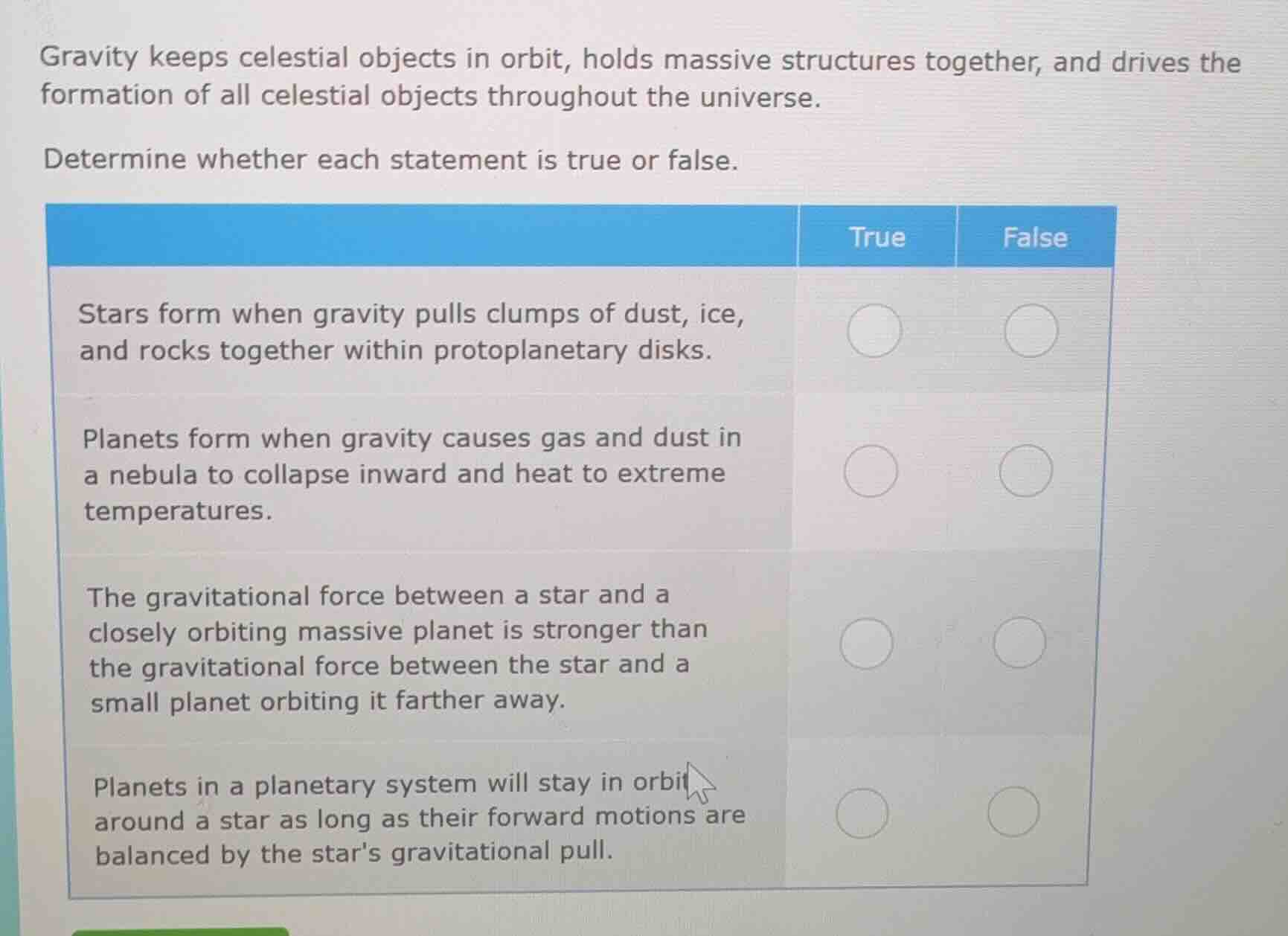
gravity keeps celestial objects in orbit, holds massive structures together, and drives the formation of all celestial objects throughout the universe.
determine whether each statement is true or false.
| true | false | |
|---|---|---|
| planets form when gravity causes gas and dust in a nebula to collapse inward and heat to extreme temperatures. | ||
| the gravitational force between a star and a closely orbiting massive planet is stronger than the gravitational force between the star and a small planet orbiting it farther away. | ||
| planets in a planetary system will stay in orbit around a star as long as their forward motions are balanced by the stars gravitational pull. |
Brief Explanations
- Stars form when gravity pulls together dense clumps of material (dust, ice, rocks) in protoplanetary disks, which then collapse and heat up to ignite nuclear fusion.
- Stars (not planets) form when a nebula's gas/dust collapses inward under gravity and heats to extreme temperatures; planets form from leftover material in protoplanetary disks around new stars.
- Gravitational force depends on mass and distance ($F=G\frac{m_1m_2}{r^2}$). A massive, close planet has a larger product of masses and smaller distance squared than a small, far planet, creating a stronger force.
- Planets stay in orbit because their forward inertial motion is balanced by the star's gravitational pull, which acts as a centripetal force.

Snap & solve any problem in the app
Get step-by-step solutions on Sovi AI
Photo-based solutions with guided steps
Explore more problems and detailed explanations
- Stars form when gravity pulls clumps of dust, ice, and rocks together within protoplanetary disks. → True
- Planets form when gravity causes gas and dust in a nebula to collapse inward and heat to extreme temperatures. → False
- The gravitational force between a star and a closely orbiting massive planet is stronger than the gravitational force between the star and a small planet orbiting it farther away. → True
- Planets in a planetary system will stay in orbit around a star as long as their forward motions are balanced by the star's gravitational pull. → True