QUESTION IMAGE
Question
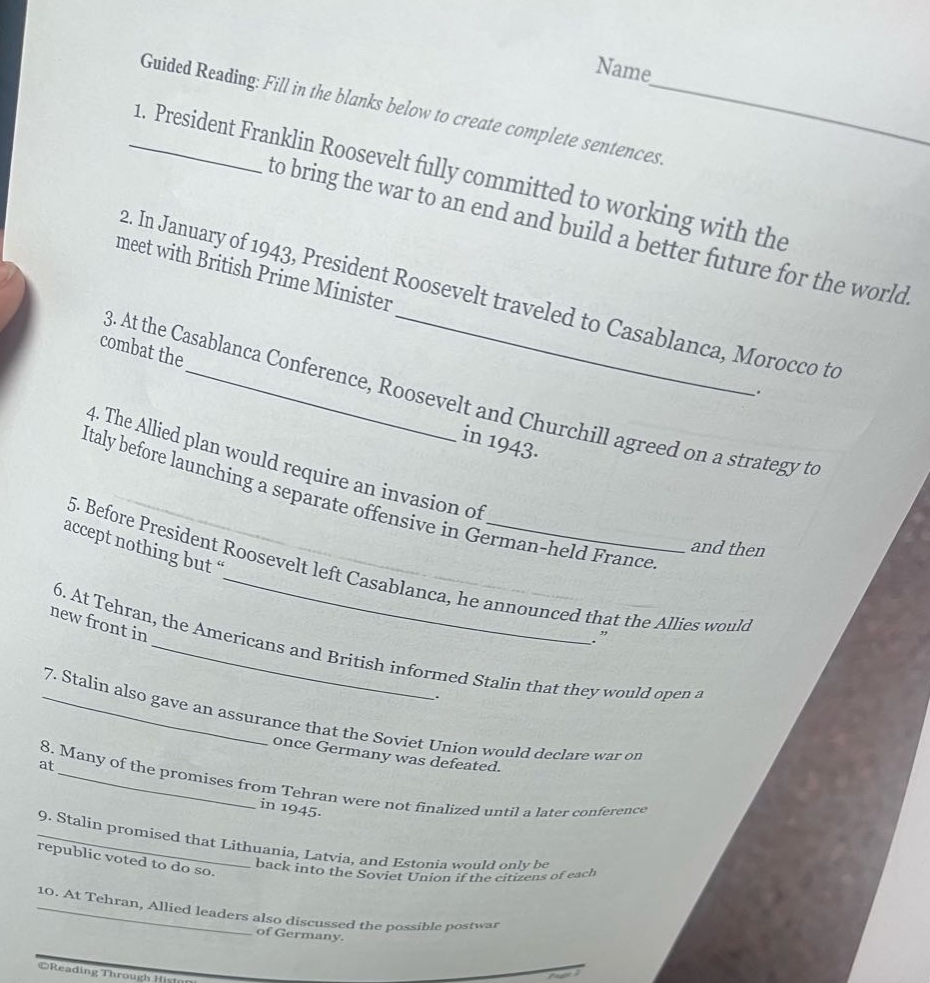
guided reading: fill in the blanks below to create complete sentences.
- president franklin roosevelt fully committed to working with the
______ to bring the war to an end and build a better future for the world.
- in january of 1943, president roosevelt traveled to casablanca, morocco to
meet with british prime minister ______.
- at the casablanca conference, roosevelt and churchill agreed on a strategy to
combat the ______ in 1943.
- the allied plan would require an invasion of ______ and then
italy before launching a separate offensive in german - held france.
- before president roosevelt left casablanca, he announced that the allies would
accept nothing but “______.”
- at tehran, the americans and british informed stalin that they would open a
new front in ______.
- stalin also gave an assurance that the soviet union would declare war on
______ once germany was defeated.
- many of the promises from tehran were not finalized until a later conference
at ______ in 1945.
- stalin promised that lithuania, latvia, and estonia would only be
______ back into the soviet union if the citizens of each
republic voted to do so.
- at tehran, allied leaders also discussed the possible postwar
______ of germany.
To solve these fill - in - the - blank questions, we need to recall historical facts about World War II and the conferences involving President Roosevelt, Winston Churchill, and Joseph Stalin.
Question 1
President Franklin Roosevelt fully committed to working with the Allies to bring the war to an end and build a better future for the world.
During World War II, the Allied powers (including the United States, the United Kingdom, the Soviet Union, etc.) were united in their fight against the Axis powers. Roosevelt was a key leader of the Allied forces and was dedicated to working with other Allied nations.
Question 2
In January of 1943, President Roosevelt traveled to Casablanca, Morocco to meet with British Prime Minister Winston Churchill.
Churchill was the Prime Minister of the United Kingdom during World War II, and he and Roosevelt had a series of important meetings to coordinate the Allied war effort.
Question 3
At the Casablanca Conference, Roosevelt and Churchill agreed on a strategy to combat the Axis powers in 1943.
The Axis powers consisted of Germany, Italy, and Japan. The Casablanca Conference was focused on formulating plans to defeat these Axis nations.
Question 4
The Allied plan would require an invasion of Italy and then Italy before launching a separate offensive in German - held France.
The Allied strategy in 1943 involved invading Italy as a way to weaken the Axis powers and move closer to the heart of Europe.
Question 5
Before President Roosevelt left Casablanca, he announced that the Allies would accept nothing but “unconditional surrender” from the Axis powers.
The policy of unconditional surrender meant that the Axis powers had to give up all their military capabilities and submit completely to the Allied demands. This was announced at the Casablanca Conference.
Question 6
At Tehran, the Americans and British informed Stalin that they would open a new front in France (specifically, the D - Day invasion of Normandy in 1944 was the opening of this front).
The Tehran Conference was where the Allies coordinated their plans, and the promise to open a second front in France was a key part of the discussions with Stalin.
Question 7
Stalin also gave an assurance that the Soviet Union would declare war on Japan once Germany was defeated.
After Germany's defeat, the Soviet Union fulfilled this promise and declared war on Japan, which contributed to Japan's decision to surrender.
Question 8
Many of the promises from Tehran were not finalized until a later conference at Yalta in 1945.
The Yalta Conference was a crucial meeting where the Allies made final arrangements for the post - war world, including issues related to Germany, Eastern Europe, and the United Nations.
Question 9
Stalin promised that Lithuania, Latvia, and Estonia would only be incorporated back into the Soviet Union if the citizens of each republic voted to do so. (In reality, the Soviet Union annexed these Baltic states, and the "vote" was more of a formality under Soviet control.)
Question 10
At Tehran, Allied leaders also discussed the possible postwar division (or "treatment") of Germany.
The Allies were concerned with how Germany would be governed, disarmed, and rebuilt after the war, and the Tehran Conference was the start of these discussions.

Snap & solve any problem in the app
Get step-by-step solutions on Sovi AI
Photo-based solutions with guided steps
Explore more problems and detailed explanations
s:
- Allies
- Winston Churchill
- Axis powers
- Italy
- unconditional surrender
- France
- Japan
- Yalta
- incorporated
- division (or "treatment")