QUESTION IMAGE
Question
guiding question: how does a balanced equation demonstrate the law of conservation of mass?
claim:
(answers the question)
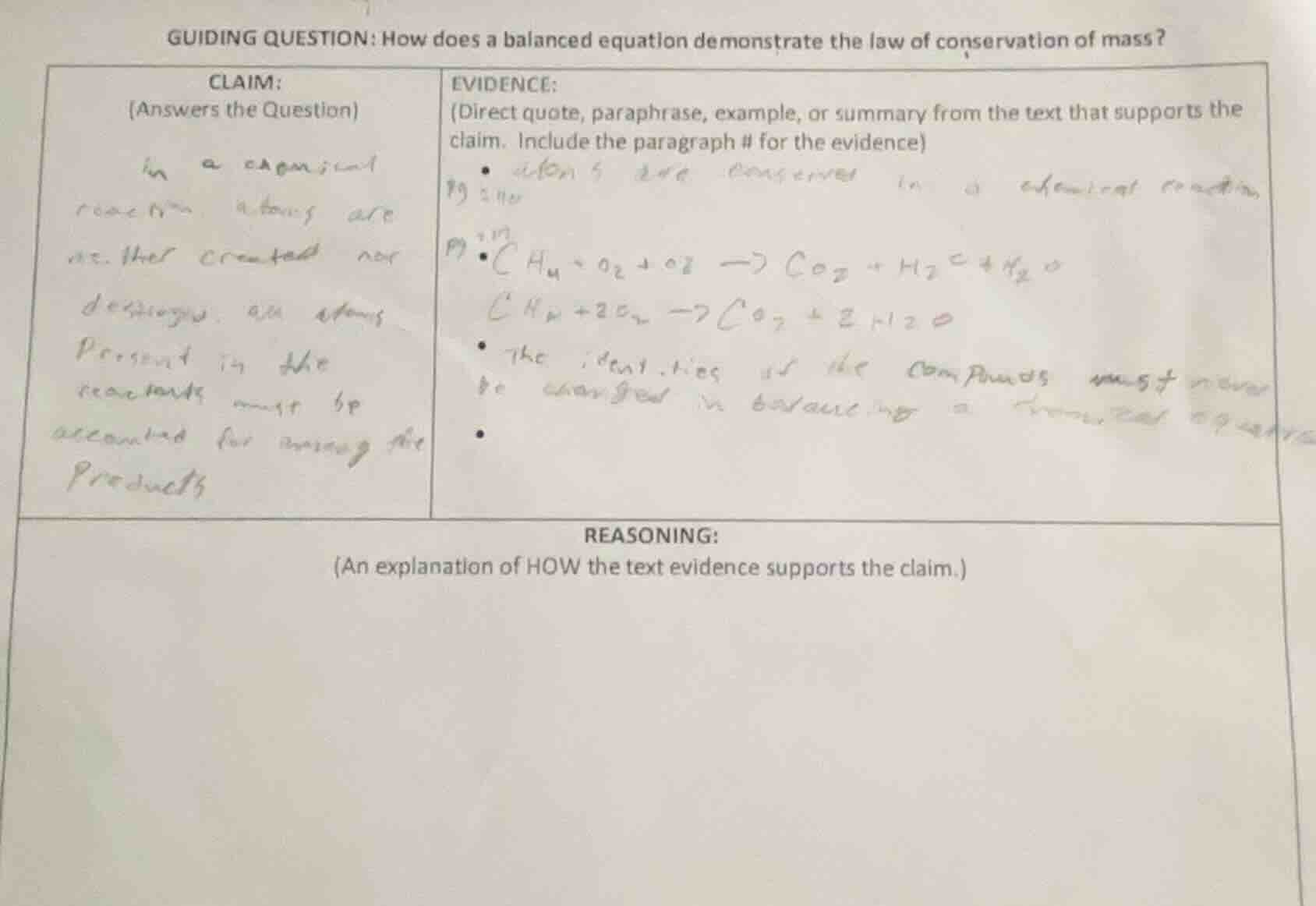
in a chemical reaction, atoms are neither created nor destroyed. all atoms present in the reactants must be accounted for in the products
evidence:
(direct quote, paraphrase, example, or summary from the text that supports the claim. include the paragraph # for the evidence)
- handwritten text, partially legible in a chemical reaction by handwritten text, partially legible
- $ch_4 + o_2 + o_2 \
ightarrow co_2 + h_2o + h_2o$
$ch_4 + 2o_2 \
ightarrow co_2 + 2h_2o$
- the identities of the compounds must never be changed in balancing a chemical equation
reasoning:
(an explanation of how the text evidence supports the claim.)
- Claim Clarification: The claim restates the law of conservation of mass for chemical reactions: atoms are neither created nor destroyed, so all reactant atoms must appear in products.
- Evidence Connection:
- The first evidence point directly states the conservation of atoms, which is the core of the law of conservation of mass.
- The balanced equation example ($\text{CH}_4 + 2\text{O}_2
ightarrow \text{CO}_2 + 2\text{H}_2\text{O}$) shows equal numbers of each type of atom on both sides: 1 C, 4 H, and 4 O atoms are present in both reactants and products. This matches the claim that all reactant atoms are accounted for in products.
- The rule that compound identities are unchanged confirms we are only rearranging atoms, not creating/destroying or altering them, which aligns with the claim.
- Reasoning Link: The evidence directly demonstrates that balanced equations enforce the law: by ensuring equal numbers of each atom on both sides, they visually and mathematically prove no mass is gained or lost, as atoms (and thus mass) are conserved and only rearranged.

Snap & solve any problem in the app
Get step-by-step solutions on Sovi AI
Photo-based solutions with guided steps
Explore more problems and detailed explanations
Reasoning:
A balanced chemical equation demonstrates the law of conservation of mass by ensuring the total number of each type of atom is identical on both the reactant and product sides. The evidence confirms atoms are conserved in reactions, and the balanced $\text{CH}_4 + 2\text{O}_2
ightarrow \text{CO}_2 + 2\text{H}_2\text{O}$ example shows 1 carbon, 4 hydrogen, and 4 oxygen atoms on both sides. Since atoms have fixed mass, equal numbers of identical atoms mean the total mass of reactants equals the total mass of products, proving mass is conserved (not created or destroyed, only rearranged).