QUESTION IMAGE
Question
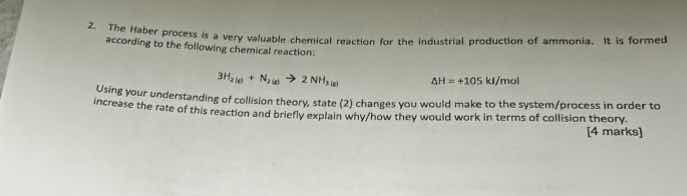
- the haber process is a very valuable chemical reaction for the industrial production of ammonia. it is formed according to the following chemical reaction: \\( 3h_{2(g)} + n_{2(g)} \
ightleftharpoons 2nh_{3(g)} \quad \delta h = +105 \\, \text{kj/mol} \\) using your understanding of collision theory, state (2) changes you would make to the system/process in order to increase the rate of this reaction and briefly explain why/how they would work in terms of collision theory. 4 marks
Brief Explanations
To increase the reaction rate using collision theory:
- Increase Temperature: Raising temperature increases the kinetic energy of reactant molecules ($\ce{H_{2}}$ and $\ce{N_{2}}$). This means molecules move faster, leading to more frequent collisions and a higher proportion of collisions with energy ≥ activation energy (effective collisions).
- Increase Pressure (or Concentration): Increasing pressure (e.g., by reducing volume) increases the concentration of gaseous reactants. With more molecules per unit volume, the frequency of collisions between $\ce{H_{2}}$ and $\ce{N_{2}}$ molecules rises, increasing the chance of effective collisions.

Snap & solve any problem in the app
Get step-by-step solutions on Sovi AI
Photo-based solutions with guided steps
Explore more problems and detailed explanations
- Increase Temperature: Higher temperature increases reactant molecules’ kinetic energy, causing more frequent and energetic (effective) collisions.
- Increase Pressure (or Concentration): More reactant molecules per volume increase collision frequency, boosting effective collisions.