QUESTION IMAGE
Question
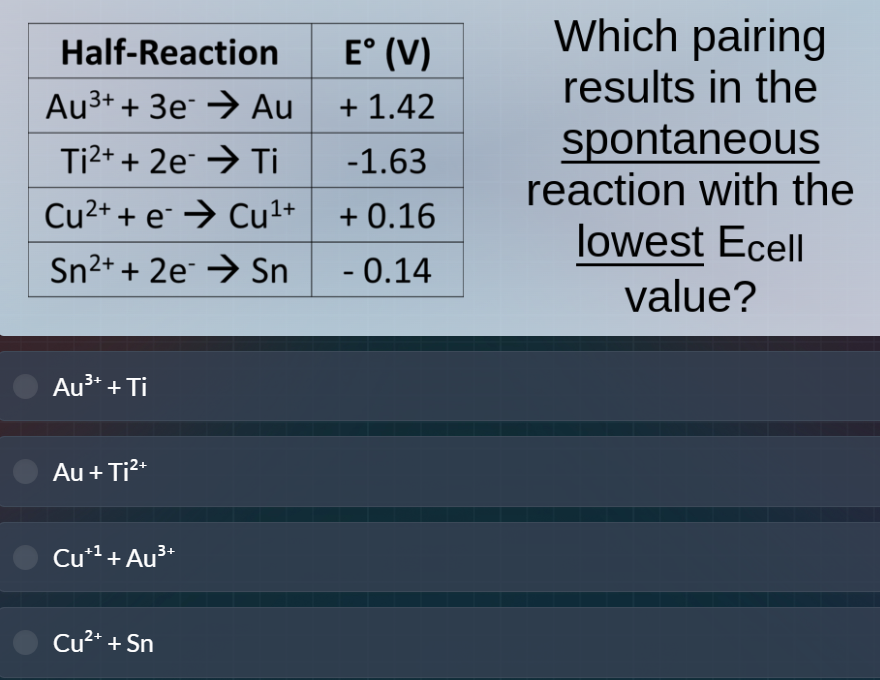
| half-reaction | e° (v) |
|---|---|
| ti²⁺ + 2e⁻ → ti | -1.63 |
| cu²⁺ + e⁻ → cu¹⁺ | + 0.16 |
| sn²⁺ + 2e⁻ → sn | - 0.14 |
which pairing results in the spontaneous reaction with the lowest ecell value?
- au³⁺ + ti
- au + ti²⁺
- cu¹⁺ + au³⁺
- cu²⁺ + sn
To determine the spontaneous reaction with the lowest \( E_{\text{cell}}^\circ \), we use the formula \( E_{\text{cell}}^\circ = E_{\text{cathode}}^\circ - E_{\text{anode}}^\circ \) (or \( E_{\text{cathode}}^\circ + |E_{\text{anode}}^\circ| \) for oxidation, since oxidation is reverse of reduction). A spontaneous reaction has \( E_{\text{cell}}^\circ > 0 \), so the cathode (reduction) must have a higher \( E^\circ \) than the anode (oxidation, reverse of its reduction half - reaction).
Option 1: \( \text{Au}^{3+}+\text{Ti} \)
- Reduction: \( \text{Au}^{3+}+ 3e^-
ightarrow\text{Au} \), \( E_{\text{cathode}}^\circ = + 1.42\space V \)
- Oxidation: \( \text{Ti}
ightarrow\text{Ti}^{2+}+2e^- \) (reverse of \( \text{Ti}^{2+}+2e^-
ightarrow\text{Ti} \)), so \( E_{\text{anode}}^\circ=- 1.63\space V \) (oxidation potential is the negative of reduction potential)
- \( E_{\text{cell}}^\circ=E_{\text{cathode}}^\circ - E_{\text{anode}}^\circ=1.42-(- 1.63)=1.42 + 1.63 = 3.05\space V \)
Option 2: \( \text{Au}+\text{Ti}^{2+} \)
- For a reaction to be spontaneous, the reduction potential of the species being reduced should be higher than that of the species being oxidized. Here, \( E^\circ(\text{Au}^{3+}/\text{Au}) = 1.42\space V \) and \( E^\circ(\text{Ti}^{2+}/\text{Ti})=-1.63\space V \). If we consider \( \text{Au} \) as the species being oxidized (to \( \text{Au}^{3+} \)) and \( \text{Ti}^{2+} \) as the species being reduced (to \( \text{Ti} \)), \( E_{\text{cathode}}^\circ=-1.63\space V \) and \( E_{\text{anode}}^\circ = 1.42\space V \). Then \( E_{\text{cell}}^\circ=-1.63 - 1.42=-3.05\space V<0 \), non - spontaneous. So this reaction is not spontaneous.
Option 3: \( \text{Cu}^{+}+\text{Au}^{3+} \)
- Reduction: \( \text{Au}^{3+}+3e^-
ightarrow\text{Au} \), \( E_{\text{cathode}}^\circ = 1.42\space V \)
- Oxidation: \( \text{Cu}^+
ightarrow\text{Cu}^{2+}+e^- \) (reverse of \( \text{Cu}^{2+}+e^-
ightarrow\text{Cu}^+ \)), \( E_{\text{anode}}^\circ = 0.16\space V \) (oxidation potential is negative of reduction potential, so \( E_{\text{anode}}^\circ=- 0.16\space V \) in terms of the formula? Wait, no. Wait, the reduction potential of \( \text{Cu}^{2+}/\text{Cu}^+ \) is \( + 0.16\space V \), so oxidation of \( \text{Cu}^+ \) is \( \text{Cu}^+
ightarrow\text{Cu}^{2+}+e^- \), so \( E_{\text{anode}}^\circ=- 0.16\space V \) (since oxidation potential is - reduction potential)
- \( E_{\text{cell}}^\circ=1.42-(-0.16)=1.42 + 0.16 = 1.58\space V \)
Option 4: \( \text{Cu}^{2+}+\text{Sn} \)
- Reduction: \( \text{Cu}^{2+}+e^-
ightarrow\text{Cu}^+ \), \( E_{\text{cathode}}^\circ = + 0.16\space V \)
- Oxidation: \( \text{Sn}
ightarrow\text{Sn}^{2+}+2e^- \) (reverse of \( \text{Sn}^{2+}+2e^-
ightarrow\text{Sn} \)), so \( E_{\text{anode}}^\circ=-0.14\space V \)
- \( E_{\text{cell}}^\circ=0.16-(-0.14)=0.16 + 0.14 = 0.30\space V \)
Now we compare the spontaneous reactions ( \( E_{\text{cell}}^\circ>0 \)):
- \( \text{Au}^{3+}+\text{Ti} \): \( E_{\text{cell}}^\circ = 3.05\space V \)
- \( \text{Cu}^{2+}+\text{Sn} \): \( E_{\text{cell}}^\circ = 0.30\space V \)
- \( \text{Cu}^++\text{Au}^{3+} \): \( E_{\text{cell}}^\circ = 1.58\space V \)
Among these, \( \text{Cu}^{2+}+\text{Sn} \) has the lowest \( E_{\text{cell}}^\circ \) value.

Snap & solve any problem in the app
Get step-by-step solutions on Sovi AI
Photo-based solutions with guided steps
Explore more problems and detailed explanations
\( \text{Cu}^{2+}+\text{Sn} \) (the option with \( \text{Cu}^{2+}+\text{Sn} \))