QUESTION IMAGE
Question
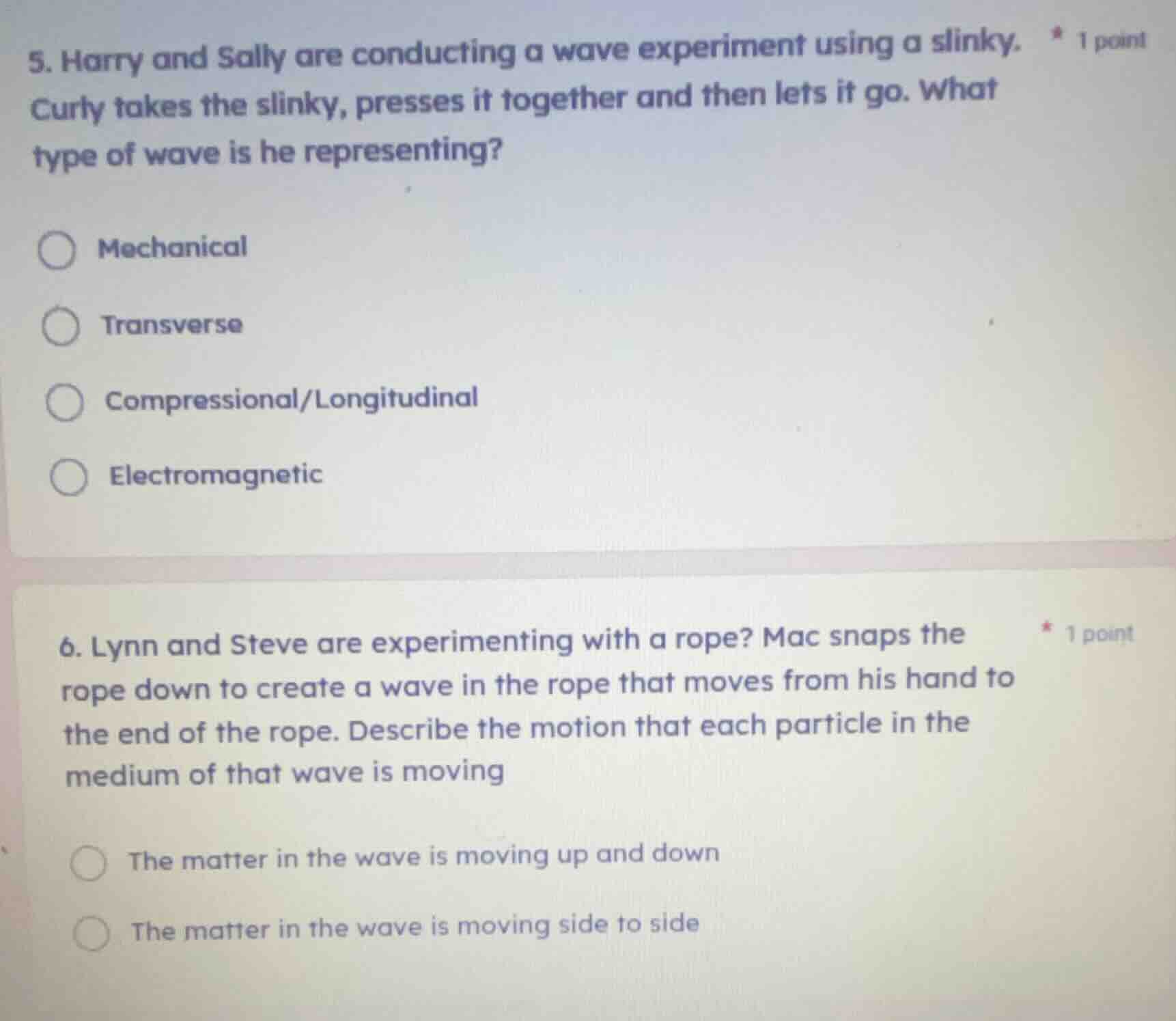
- harry and sally are conducting a wave experiment using a slinky. curly takes the slinky, presses it together and then lets it go. what type of wave is he representing?
mechanical
transverse
compressional/longitudinal
electromagnetic
- lynn and steve are experimenting with a rope? mac snaps the rope down to create a wave in the rope that moves from his hand to the end of the rope. describe the motion that each particle in the medium of that wave is moving
the matter in the wave is moving up and down
the matter in the wave is moving side to side
Question 5
To determine the wave type, we analyze the action: pressing the slinky together (compression) and letting it go. Longitudinal (compressional) waves involve particle motion parallel to the wave's direction, like compressions and rarefactions in a slinky. Mechanical waves need a medium, but the action here specifically shows compression, matching longitudinal. Transverse waves have perpendicular particle motion (like a rope wave), and electromagnetic waves don't need a medium (slinky is a medium, so not electromagnetic). Mechanical is a broad category, but the specific action is compressional/longitudinal.
When a wave is created in a rope by snapping it down, it's a transverse wave. In transverse waves, the medium's particles (rope segments) move perpendicular to the wave's direction (up - down motion) while the wave travels along the rope (horizontal direction). The "side - to - side" motion doesn't match transverse; transverse is perpendicular (up - down for a vertical snap on a horizontal rope).

Snap & solve any problem in the app
Get step-by-step solutions on Sovi AI
Photo-based solutions with guided steps
Explore more problems and detailed explanations
C. Compressional/Longitudinal