QUESTION IMAGE
Question
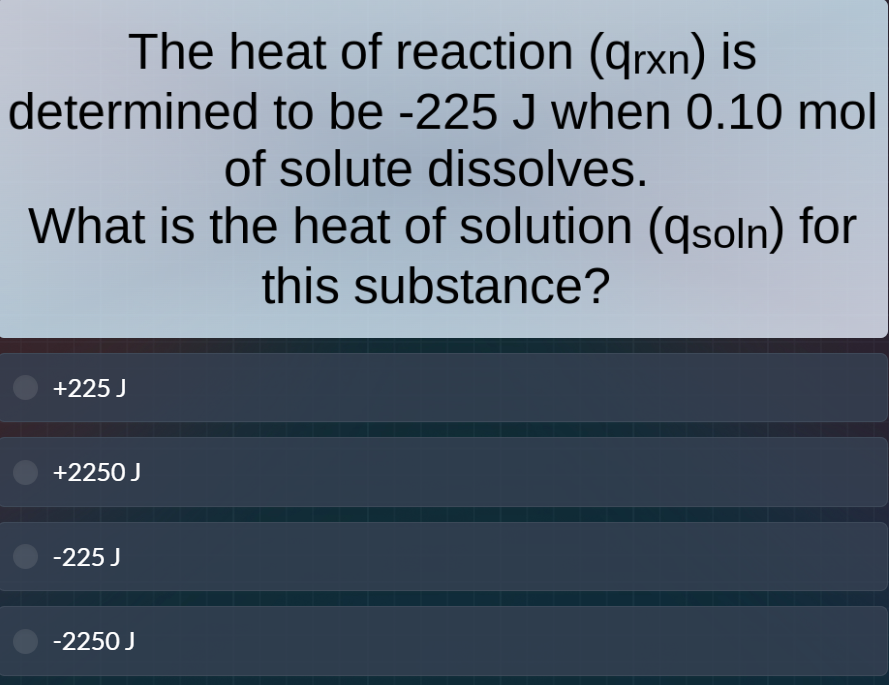
the heat of reaction (qₓₙ) is determined to be -225 j when 0.10 mol of solute dissolves. what is the heat of solution (qₛₒₗₙ) for this substance? +225 j +2250 j -225 j -2250 j
Step1: Recall the relationship between \( q_{\text{rxn}} \) and \( q_{\text{soln}} \)
When a solute dissolves, the heat of the reaction (\( q_{\text{rxn}} \)) and the heat of the solution (\( q_{\text{soln}} \)) are related by \( q_{\text{soln}} = -q_{\text{rxn}} \) (based on the principle of energy conservation, the heat lost by the reaction is gained by the solution and vice versa, but here we first consider the sign relationship for the amount per mole? Wait, no, wait. Wait, actually, the heat of solution is the heat associated with dissolving the solute. But also, we need to consider the moles? Wait, no, wait the question: Wait, the heat of reaction is -225 J when 0.10 mol dissolves. Wait, no, maybe I misread. Wait, the heat of solution is the heat per mole? Wait, no, the question is: What is the heat of solution (\( q_{\text{soln}} \)) for this substance? Wait, maybe the heat of solution here is the total heat for the dissolution of 0.10 mol? No, that can't be. Wait, no, the key is the relationship between \( q_{\text{rxn}} \) and \( q_{\text{soln}} \). The reaction here is the dissolution, so \( q_{\text{rxn}} \) (the heat of the dissolution reaction) and \( q_{\text{soln}} \) (the heat gained or lost by the solution) are related by \( q_{\text{soln}} = -q_{\text{rxn}} \) when considering the system and surroundings. But also, we need to find the heat of solution per mole? Wait, no, the question is: when 0.10 mol dissolves, \( q_{\text{rxn}} = -225 \) J. Wait, maybe the heat of solution is the heat per mole, so we need to calculate the heat per mole. Wait, let's re-express:
The heat of reaction (dissolution) for 0.10 mol is \( q_{\text{rxn}} = -225 \) J. The heat of solution (\( \Delta H_{\text{soln}} \)) is the heat per mole of solute dissolved. But also, the heat of the solution (the solution's heat change) is \( q_{\text{soln}} = -q_{\text{rxn}} \) for the process, but if we want the heat of solution (the enthalpy of solution), we need to find the heat per mole. Wait, no, maybe the question is using \( q_{\text{soln}} \) as the total heat for the solution, but that doesn't make sense. Wait, no, perhaps I made a mistake. Wait, let's check the options. The options are +225 J, +2250 J, -225 J, -2250 J. So let's think again.
Wait, the heat of reaction is -225 J when 0.10 mol dissolves. So the heat of solution (the heat per mole) would be \( \frac{-q_{\text{rxn}}}{\text{moles}} \)? Wait, no. Wait, the heat of solution is the heat associated with dissolving the solute. The reaction (dissolution) releases or absorbs heat. If \( q_{\text{rxn}} = -225 \) J for 0.10 mol, that means the reaction (dissolution) is exothermic (since \( q_{\text{rxn}} \) is negative, meaning the system loses heat). Then the solution would gain heat, so \( q_{\text{soln}} = +225 \) J for 0.10 mol? But that's not one of the options. Wait, the options include +2250 J. Ah! Wait, maybe I missed that the heat of solution is per mole, so we need to calculate the heat for 1 mole. So:
For 0.10 mol, \( q_{\text{rxn}} = -225 \) J. So for 1 mole, the heat of reaction would be \( \frac{-225 \text{ J}}{0.10 \text{ mol}} = -2250 \) J/mol. But the heat of solution is the negative of the heat of reaction (because the heat of solution is the heat absorbed or released by the solution, so if the reaction releases heat (negative \( q_{\text{rxn}} \)), the solution absorbs heat (positive \( q_{\text{soln}} \)) per mole? Wait, no. Let's recall: The enthalpy of solution (\( \Delta H_{\text{soln}} \)) is the enthalpy change when 1 mole of solute dissolves in a solvent. The r…

Snap & solve any problem in the app
Get step-by-step solutions on Sovi AI
Photo-based solutions with guided steps
Explore more problems and detailed explanations
+2250 J