QUESTION IMAGE
Question
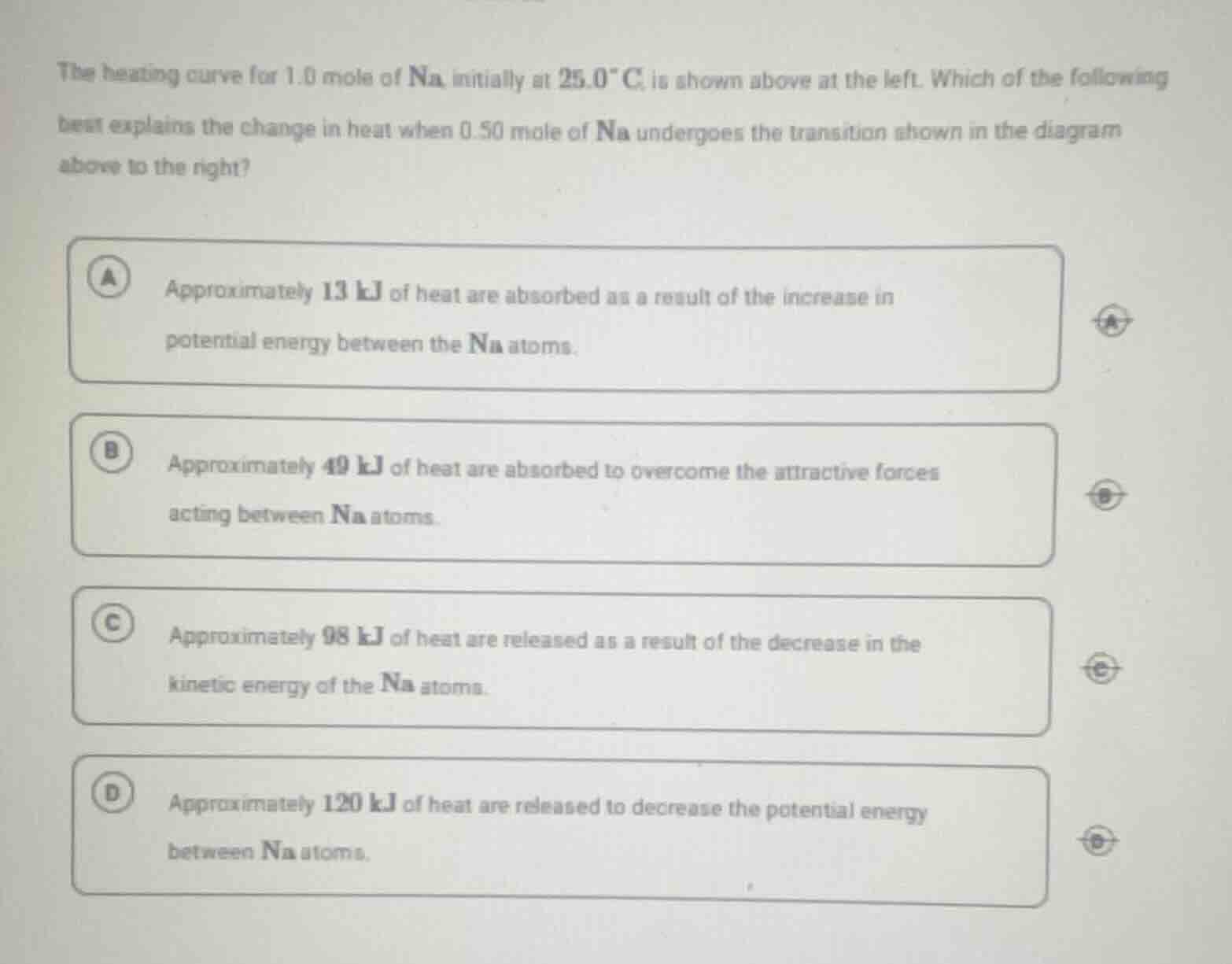
the heating curve for 1.0 mole of na initially at 25.0°c is shown above at the left. which of the following best explains the change in heat when 0.50 mole of na undergoes the transition shown in the diagram above to the right?
a approximately 13 kj of heat are absorbed as a result of the increase in
potential energy between the na atoms.
b approximately 49 kj of heat are absorbed to overcome the attractive forces
acting between na atoms.
c approximately 98 kj of heat are released as a result of the decrease in the
kinetic energy of the na atoms.
d approximately 120 kj of heat are released to decrease the potential energy
between na atoms.
- First, recall the heating curve for a substance (like Na here). The transition shown (probably melting or vaporization, but from the options, it's about overcoming intermolecular forces, which involves potential energy changes).
- For 1 mole of Na, the heat required for the phase transition (where potential energy between atoms increases, like melting or vaporizing) – but here we have 0.50 moles.
- Let's analyze each option:
- Option A: If the transition is about overcoming forces (increasing potential energy), and for 1 mole, the heat absorbed (enthalpy of transition, like fusion or vaporization) – if 1 mole absorbs ~26 kJ (since 0.5 mole would be half, ~13 kJ), this matches. The key is that phase transitions (like melting) involve absorbing heat to increase potential energy between atoms (overcome attractive forces).
- Option B: 49 kJ for 0.5 mole would imply 98 kJ for 1 mole, which is too high for Na's typical phase transition enthalpies.
- Option C: Releasing heat and decreasing kinetic energy doesn't make sense for a phase transition that's probably melting/vaporization (which absorb heat, and kinetic energy change is about temperature, but phase change is constant temp, so kinetic energy constant; potential energy changes).
- Option D: Releasing heat to decrease potential energy would be condensation or freezing, but the diagram (left to right) is likely heating, so absorbing heat, not releasing. So D is wrong.
So A is correct as it explains absorbing heat to increase potential energy (overcome attractive forces) and the amount (0.5 mole, so half of the 1 mole value, ~13 kJ).

Snap & solve any problem in the app
Get step-by-step solutions on Sovi AI
Photo-based solutions with guided steps
Explore more problems and detailed explanations
A. Approximately 13 kJ of heat are absorbed as a result of the increase in potential energy between the Na atoms.