QUESTION IMAGE
Question
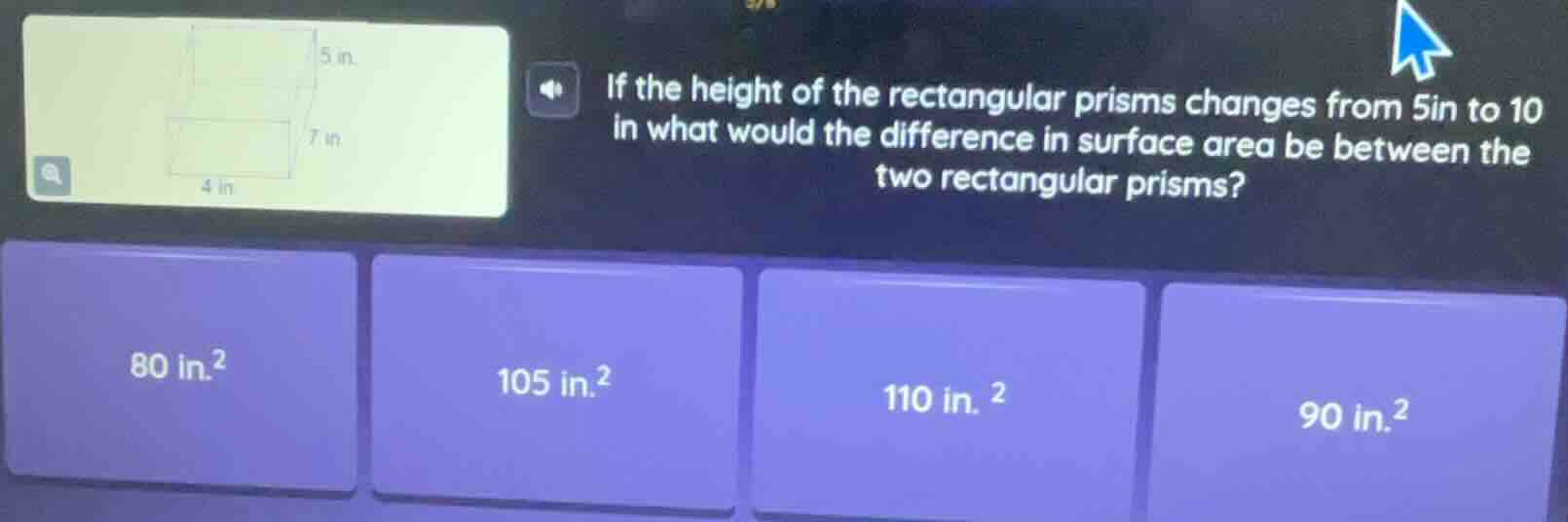
if the height of the rectangular prisms changes from 5in to 10 in what would the difference in surface area be between the two rectangular prisms? 80 in.² 105 in.² 110 in.² 90 in.²
Step1: Recall surface area formula for rectangular prism
The surface area \( S \) of a rectangular prism with length \( l \), width \( w \), and height \( h \) is given by \( S = 2(lw + lh + wh) \). From the diagram, we can assume the length \( l = 4 \) in, width \( w = 7 \) in (since the base has dimensions 4 in and 7 in, and the height is changing). Let's denote the initial height as \( h_1 = 5 \) in and the new height as \( h_2 = 10 \) in.
Step2: Calculate surface area for \( h_1 = 5 \) in
Substitute \( l = 4 \), \( w = 7 \), \( h_1 = 5 \) into the formula:
\[
\]
Step3: Calculate surface area for \( h_2 = 10 \) in
Substitute \( l = 4 \), \( w = 7 \), \( h_2 = 10 \) into the formula:
\[
\]
Step4: Find the difference in surface areas
The difference \( \Delta S=S_2 - S_1 \). So, \( \Delta S=276 - 166 = 110 \text{ in}^2 \)? Wait, no, wait. Wait, maybe I misread the width. Wait, maybe the base is length 4, width 4? No, the diagram shows 4 in, 7 in, and 5 in. Wait, maybe the width is 4? Wait, no, let's re - examine. Wait, maybe the length is 4, width is 4? No, the problem says rectangular prisms. Wait, maybe the initial dimensions: from the diagram, the first prism (upper) has height 5 in, and the lower one has height 7 in, and base 4 in. Wait, maybe the length \( l = 4 \), width \( w = 4 \)? No, that can't be. Wait, maybe the correct dimensions: let's assume that the length \( l = 4 \), width \( w = 7 \) (the base of the lower prism is 4 in and 7 in), and the height is the vertical side. Wait, maybe I made a mistake in the width. Wait, let's re - derive the formula for the difference in surface area.
The surface area formula is \( S = 2(lw+lh + wh)=2lw + 2lh+2wh \). When the height changes from \( h_1 \) to \( h_2 \), the change in surface area comes from the terms involving \( h \). The terms with \( lw \) are constant (since \( l \) and \( w \) don't change). So the difference in surface area \( \Delta S=2l(h_2 - h_1)+2w(h_2 - h_1)=2(l + w)(h_2 - h_1) \).
Given \( l = 4 \), \( w = 7 \), \( h_2 - h_1=10 - 5 = 5 \).
Then \( \Delta S=2(4 + 7)\times5=2\times11\times5 = 110 \text{ in}^2 \)? Wait, but let's check again. Wait, if \( l = 4 \), \( w = 4 \)? No, the diagram shows 4 in, 7 in, 5 in. Wait, maybe the length is 4, width is 7, height changes. Let's recalculate the difference using the formula for the change.
The surface area of a rectangular prism is \( S = 2(lw+lh + wh) \). The difference between the two surface areas when height changes from \( h_1 \) to \( h_2 \) is:
\( \Delta S=2(lw+lh_2 + wh_2)-2(lw+lh_1 + wh_1)=2l(h_2 - h_1)+2w(h_2 - h_1)=2(l + w)(h_2 - h_1) \)
We know that \( h_2 - h_1=10 - 5 = 5 \), \( l = 4 \), \( w = 7 \) (from the diagram, the base has length 4 and width 7, as the lower prism has height 7 and base 4). Then:
\( \Delta S=2(4 + 7)\times5=2\times11\times5 = 110 \text{ in}^2 \)

Snap & solve any problem in the app
Get step-by-step solutions on Sovi AI
Photo-based solutions with guided steps
Explore more problems and detailed explanations
\( 110 \text{ in}^2 \) (corresponding to the option "110 in.²")