QUESTION IMAGE
Question
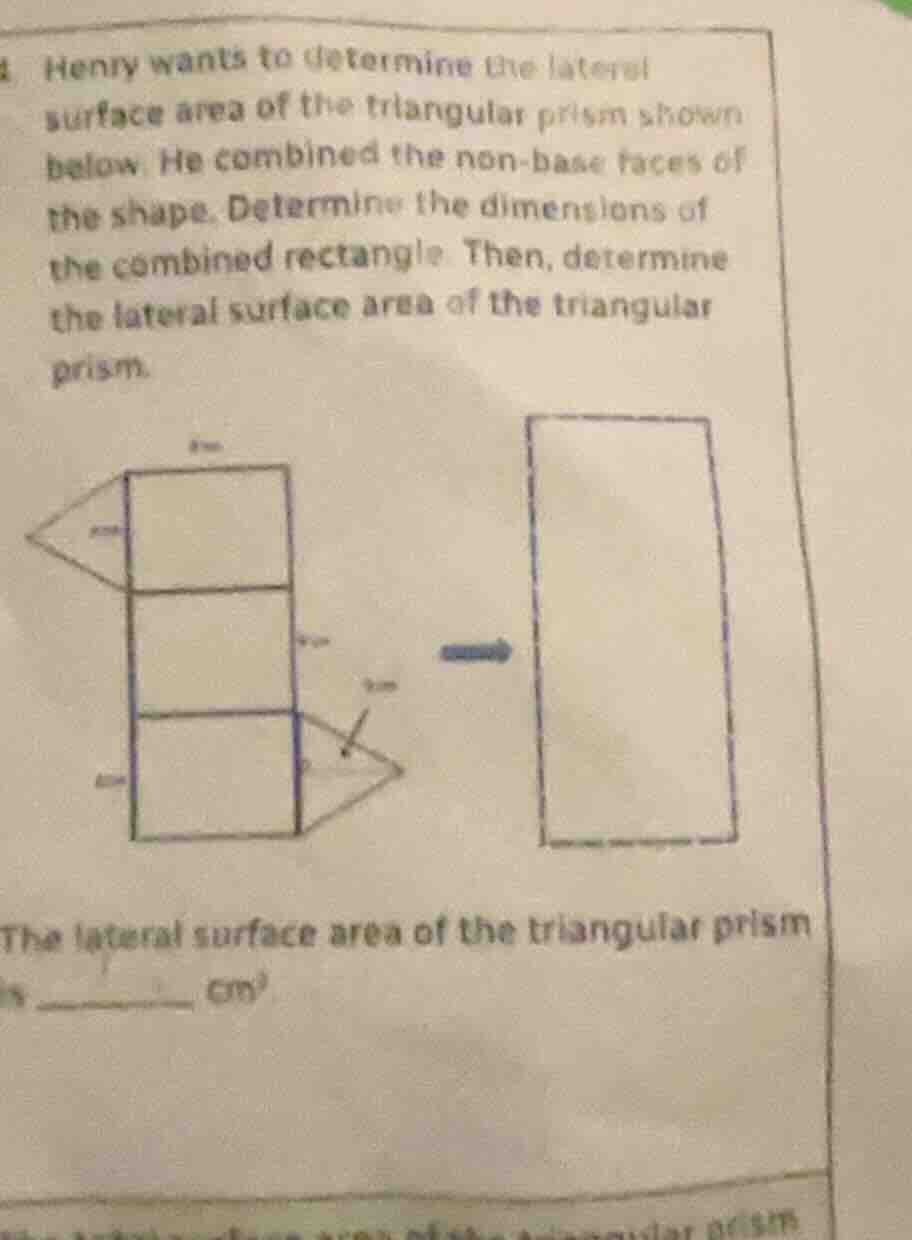
henry wants to determine the lateral surface area of the triangular prism shown below. he combined the non - base faces of the shape. determine the dimensions of the combined rectangle. then, determine the lateral surface area of the triangular prism. the lateral surface area of the triangular prism is ______ $cm^{2}$
Step1: Find the perimeter of the triangular base
Assuming the triangular base has sides \(5\) cm, \(5\) cm, and \(8\) cm (from the diagram, the triangle's sides: two equal sides and a base). Wait, actually, the lateral faces of a triangular prism are rectangles, and when combined, the length of the combined rectangle is the perimeter of the triangular base, and the width is the height (length) of the prism. Wait, looking at the diagram, the triangular base has sides (let's check the given lengths: the triangle has sides, maybe the base of the triangle is \(8\) cm, and the other two sides? Wait, the non - base faces: the three rectangles. Wait, maybe the triangular base has a perimeter. Let's re - examine. The triangular prism has a triangular base. The lateral surface area is the sum of the areas of the three rectangular faces. When we combine the non - base faces (the three rectangles), they form a large rectangle. The length of this large rectangle is the perimeter of the triangular base, and the width is the length of the prism (the distance between the two triangular bases).
From the diagram, the triangular base: let's assume the triangle has sides \(5\) cm, \(5\) cm, and \(8\) cm? Wait, no, maybe the triangle has sides (the sides of the triangle: looking at the left - hand diagram, the triangle has a base of \(8\) cm? Wait, no, the rectangles: one rectangle has dimensions \(8\) cm (length) and \(4\) cm (width)? Wait, maybe the triangular base has a perimeter of \(5 + 5+8=18\)? No, wait, the combined rectangle: let's see the right - hand diagram. Wait, maybe the triangular base has sides \(5\) cm, \(5\) cm, and \(8\) cm? Wait, no, let's think again. The lateral surface area of a triangular prism is given by \(LSA = perimeter\ of\ triangular\ base\times height\ of\ prism\) (where height of prism is the distance between the two triangular bases).
Wait, from the diagram, the triangular base: let's assume the triangle has sides \(5\) cm, \(5\) cm, and \(8\) cm? No, maybe the triangle has sides (the lengths on the triangle: one side is \(5\) cm, another \(5\) cm, and the base \(8\) cm? Wait, the rectangles: the three rectangles. Let's say the triangular base has a perimeter \(P=5 + 5+8 = 18\) cm? No, wait, maybe the triangle has sides \(4\) cm? Wait, no, the diagram shows some numbers. Wait, maybe the triangular base has a perimeter of \(5 + 5+8=18\)? No, wait, the combined rectangle: let's look at the right - hand side. The height of the combined rectangle (the width) is \(4\) cm (from the diagram, the vertical side of the rectangles is \(4\) cm). The length of the combined rectangle is the perimeter of the triangular base. Wait, no, maybe the triangular base has a perimeter of \(5 + 5+8 = 18\)? No, wait, let's calculate the perimeter of the triangular base. If the triangle has sides \(5\) cm, \(5\) cm, and \(8\) cm, then the perimeter \(P=5 + 5+8=18\) cm. Then the lateral surface area is \(P\times h\), where \(h\) is the length of the prism (the distance between the two triangular bases). From the diagram, the length of the prism (the side of the rectangles) is \(4\) cm? Wait, no, maybe I got it wrong. Wait, the lateral surface area of a triangular prism is \(LSA=\sum_{i = 1}^{3}(side_{i}\times length)\), where \(side_{i}\) are the sides of the triangular base and \(length\) is the length of the prism.
Wait, looking at the diagram, the three rectangles: one with dimensions \(8\) cm (length) and \(4\) cm (width), one with \(5\) cm (length) and \(4\) cm (width), and another with \(5\) cm (length) and \(4\) cm (width). So the are…

Snap & solve any problem in the app
Get step-by-step solutions on Sovi AI
Photo-based solutions with guided steps
Explore more problems and detailed explanations
\(72\)