QUESTION IMAGE
Question
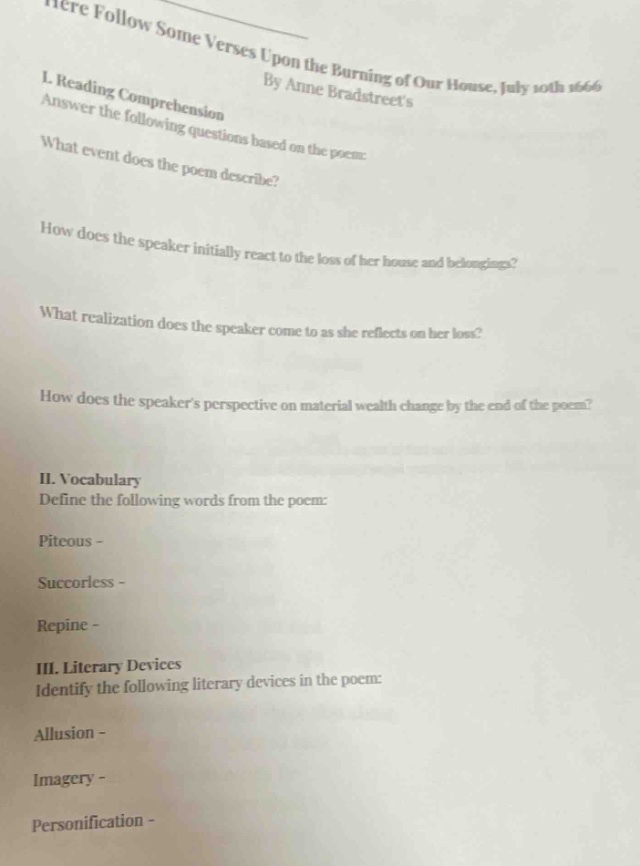
here follow some verses upon the burning of our house, july 10th 1666
by anne bradstreets
i. reading comprehension
answer the following questions based on the poem:
what event does the poem describe?
how does the speaker initially react to the loss of her house and belongings?
what realization does the speaker come to as she reflects on her loss?
how does the speakers perspective on material wealth change by the end of the poem?
ii. vocabulary
define the following words from the poem:
piteous -
succorless -
repine -
iii. literary devices
identify the following literary devices in the poem:
allusion -
imagery -
personification -
I. Reading Comprehension
- The poem is explicitly titled with the event and date, so it describes the 1666 fire that burned the speaker's (Anne Bradstreet's) house.
- The speaker's opening lines show immediate, personal grief over the loss of her home and possessions.
- As she reflects, she turns to her religious faith, realizing her true "treasure" is in heaven, not earthly things.
- By the end, she rejects attachment to material wealth, viewing earthly goods as temporary and focusing on eternal rewards.
II. Vocabulary
- "Piteous" as used in the poem relates to evoking sympathy, often for a sad or pitiful situation.
- "Succorless" means without help, aid, or support during a time of need.
- "Repine" means to feel or express discontent, resentment, or sorrow over one's circumstances.
III. Literary Devices
- Allusion: The poem references biblical ideas (e.g., heaven as a permanent home, God's providence) which are allusions to Christian scripture.
- Imagery: Bradstreet uses sensory details, like the sound of "fire and fire" and the sight of her burning home, to vividly depict the event.
- Personification: She gives human traits to inanimate things, such as referring to her burning house as crying out, or framing her possessions as having "departed" her.

Snap & solve any problem in the app
Get step-by-step solutions on Sovi AI
Photo-based solutions with guided steps
Explore more problems and detailed explanations
I. Reading Comprehension
- The 1666 burning of the speaker's house.
- She feels deep, personal grief and sorrow.
- She realizes her true treasure is in heaven, not earthly possessions.
- She shifts from grieving material loss to rejecting attachment to earthly wealth, prioritizing eternal, heavenly rewards instead.
II. Vocabulary
- Piteous: Deserving or evoking pity; sad or pathetic.
- Succorless: Without help, assistance, or relief in a time of need.
- Repine: To feel or express discontent, regret, or sorrow over one's situation.
III. Literary Devices
- Allusion: References to Christian biblical concepts (e.g., the idea of a permanent, heavenly home and God's control over earthly events).
- Imagery: Sensory details like "the flame consume my dwelling place" that create a vivid mental picture of the burning house.
- Personification: Giving human qualities to non-human things, such as describing the burning house as a loss that causes a "mournful" reaction, or framing earthly goods as transient beings that leave the speaker.