QUESTION IMAGE
Question
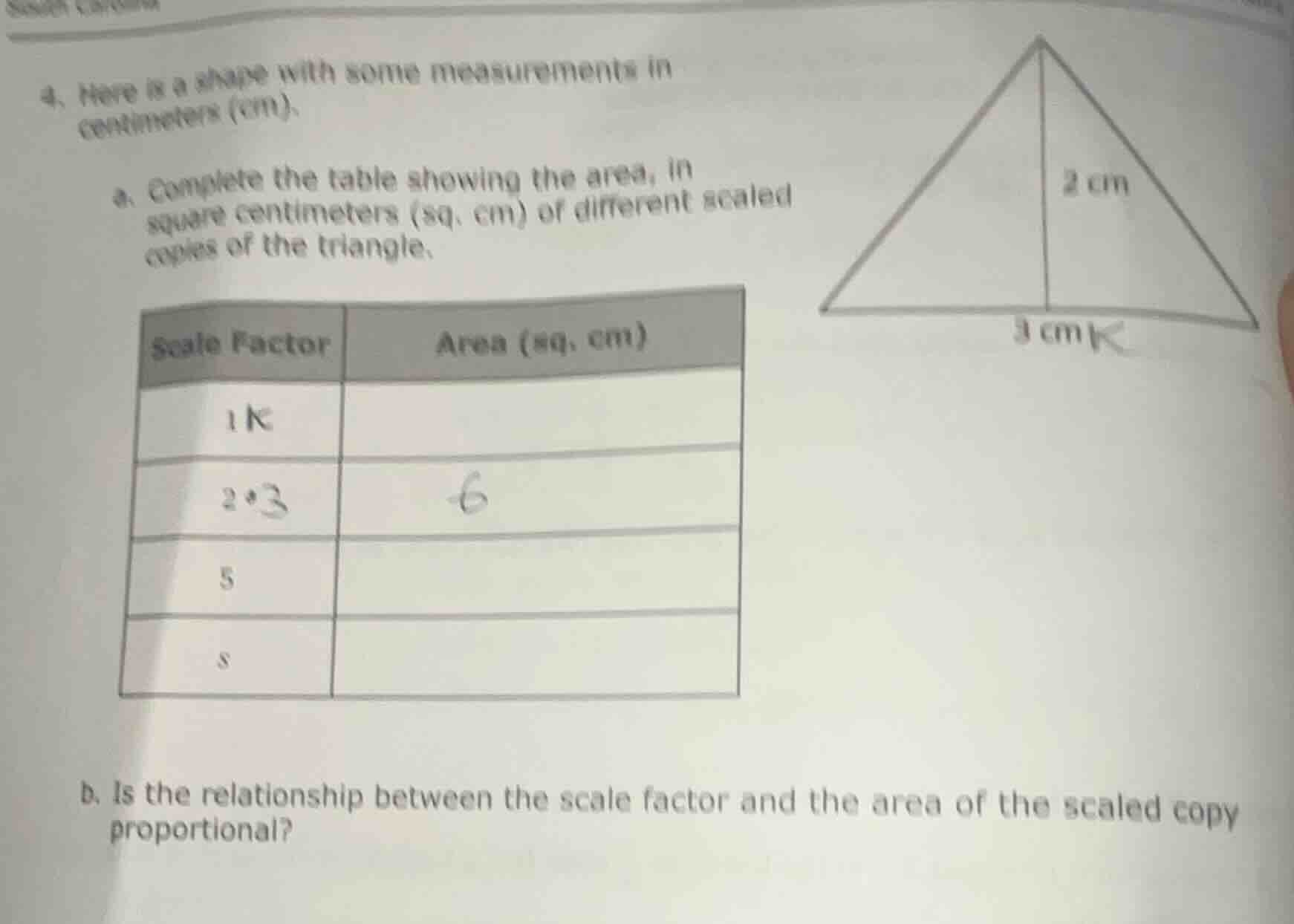
- here is a shape with some measurements in centimeters (cm).
a. complete the table showing the area, in square centimeters (sq. cm) of different scaled copies of the triangle.
table with scale factor and area (sq. cm) columns, rows for scale factors 1, 2, 3, 5, s
b. is the relationship between the scale factor and the area of the scaled copy proportional?
triangle image with height 2 cm, base 3 cm (total base 6 cm?)
Part (a)
Step 1: Find the area of the original triangle
The formula for the area of a triangle is \( A = \frac{1}{2} \times base \times height \). For the original triangle, base \( = 3 \) cm and height \( = 2 \) cm. So, \( A=\frac{1}{2}\times3\times2 = 3 \) sq. cm. When the scale factor is \( 1 \), the area is the same as the original, so area \( = 3 \) sq. cm.
Step 2: Scale factor \( 2 \)
When the scale factor is \( k \), the area of the scaled triangle is \( k^{2} \times \) original area. For \( k = 2 \), area \( = 2^{2}\times3=4\times3 = 12 \) sq. cm? Wait, wait, maybe I misread the scale factor. Wait, the table has scale factor \( 1 \), then maybe a typo? Wait, the original triangle area: \( \frac{1}{2}\times3\times2 = 3 \). If scale factor is \( s \), area is \( 3s^{2} \). Wait, let's re - check.
Wait, original triangle: base \( b = 3 \), height \( h = 2 \), area \( A=\frac{1}{2}bh=\frac{1}{2}\times3\times2 = 3 \) sq. cm.
For scale factor \( k \), the new base is \( 3k \), new height is \( 2k \). Then new area \( A'=\frac{1}{2}\times(3k)\times(2k)=\frac{1}{2}\times6k^{2}=3k^{2} \).
- Scale factor \( 1 \): \( A = 3\times1^{2}=3 \) sq. cm.
- Scale factor \( 2 \): Wait, the table has "2•3"? Maybe it's a typo, maybe scale factor \( 2 \). Then \( A = 3\times2^{2}=12 \) sq. cm. But the table has 6 written? Wait, maybe the original triangle's base is 3 and height is 2, but maybe the base is 3 (the whole base, since the line is 3 cm, so the base of the triangle is 3 cm? Wait, no, the diagram: the base is split into two parts? Wait, no, the triangle has a height of 2 cm and the base (the whole base) is 3 cm? Wait, no, the diagram shows a triangle with a height of 2 cm and the base (the length of the base) is 3 cm? Wait, no, maybe the base is 3 cm (the horizontal line) and height 2 cm. Then area is \( \frac{1}{2}\times3\times2 = 3 \). If scale factor is \( s \), area is \( 3s^{2} \).
Wait, the table has scale factor 1, then maybe "2" (instead of 2•3), then 5, then \( s \).
So:
- Scale factor 1: Area \( = 3\times1^{2}=3 \)
- Scale factor 2: Area \( = 3\times2^{2}=12 \)? But the table has 6 written. Wait, maybe the base is 3 (the half - base), so the whole base is 6? Wait, the diagram: the line at the bottom is 3 cm, maybe it's the half - base. So the whole base is \( 3\times2 = 6 \) cm, height 2 cm. Then original area \( \frac{1}{2}\times6\times2=6 \) sq. cm. Ah, that makes sense. So if the base is 6 cm (since the 3 cm is half of the base) and height 2 cm. Then area \( A=\frac{1}{2}\times6\times2 = 6 \) sq. cm.
Then the formula for area with scale factor \( k \): new base \( = 6k \), new height \( = 2k \), area \( A'=\frac{1}{2}\times(6k)\times(2k)=\frac{1}{2}\times12k^{2}=6k^{2} \). Wait, no, if the base is 3 cm (the whole base), then area is 3. But the table has 6 for scale factor 2? Wait, maybe the original triangle has base 3 cm and height 2 cm, but the area is \( \frac{1}{2}\times3\times2 = 3 \), but the table has 6 for scale factor 2. So maybe the scale factor is applied to both base and height, and the area scales by \( k^{2} \). Let's recast:
Let original area \( A_0=\frac{1}{2}\times b\times h \). For scaled triangle, \( b' = k\times b \), \( h'=k\times h \), so \( A'=\frac{1}{2}\times(kb)\times(kh)=\frac{1}{2}\times b\times h\times k^{2}=A_0k^{2} \).
If for scale factor \( k = 2 \), \( A' = 6 \), and \( A_0 = 3 \) (since \( 3\times2^{2}=12
eq6 \)), so \( A_0=\frac{6}{2^{2}}=\frac{6}{4}=1.5 \)? No, that doesn't make sense. Wait, maybe the base is 3 cm (the length of the base) and height 2 cm, but the area is \( \frac{1}{2}…
To check if the relationship between scale factor \( k \) and area \( A \) is proportional, we check if \( \frac{A}{k} \) is constant. From the formula \( A = 3k^{2} \), \( \frac{A}{k}=3k \), which is not constant (it depends on \( k \)). For two quantities to be proportional, \( y = mx \) where \( m \) is a constant. Here, \( A = 3k^{2} \), which is a quadratic relationship, not a linear one. So the relationship between scale factor and area is not proportional.
Part (a) Answer (assuming original area is 3):
| Scale Factor | Area (sq. cm) |
|---|---|
| 2 | 12 |
| 5 | 75 |
| s | \( 3s^{2} \) |
Part (b) Answer:
The relationship between the scale factor and the area of the scaled copy is not proportional.
(Note: There might be a misinterpretation of the diagram. If the base of the triangle is 3 cm (the length of the base) and height is 2 cm, the original area is 3. If the table has 6 for scale factor 2, maybe the base is 3 cm (the length of the base) and height is 2 cm, but the area is calculated as \( 3\times2 = 6 \) (wrong formula, but if we assume that, then original area \( A_0 = 6 \), and the formula for area with scale factor \( k \) is \( A = 6k^{2} \). Then:
| Scale Factor | Area (sq. cm) |
|---|---|
| 2 | 6×2² = 24 |
| 5 | 6×5² = 150 |
| s | \( 6s^{2} \) |
And for part (b), the relationship is still not proportional since \( A = 6k^{2} \), \( \frac{A}{k}=6k \) is not constant.)

Snap & solve any problem in the app
Get step-by-step solutions on Sovi AI
Photo-based solutions with guided steps
Explore more problems and detailed explanations
To check if the relationship between scale factor \( k \) and area \( A \) is proportional, we check if \( \frac{A}{k} \) is constant. From the formula \( A = 3k^{2} \), \( \frac{A}{k}=3k \), which is not constant (it depends on \( k \)). For two quantities to be proportional, \( y = mx \) where \( m \) is a constant. Here, \( A = 3k^{2} \), which is a quadratic relationship, not a linear one. So the relationship between scale factor and area is not proportional.
Part (a) Answer (assuming original area is 3):
| Scale Factor | Area (sq. cm) |
|---|---|
| 2 | 12 |
| 5 | 75 |
| s | \( 3s^{2} \) |
Part (b) Answer:
The relationship between the scale factor and the area of the scaled copy is not proportional.
(Note: There might be a misinterpretation of the diagram. If the base of the triangle is 3 cm (the length of the base) and height is 2 cm, the original area is 3. If the table has 6 for scale factor 2, maybe the base is 3 cm (the length of the base) and height is 2 cm, but the area is calculated as \( 3\times2 = 6 \) (wrong formula, but if we assume that, then original area \( A_0 = 6 \), and the formula for area with scale factor \( k \) is \( A = 6k^{2} \). Then:
| Scale Factor | Area (sq. cm) |
|---|---|
| 2 | 6×2² = 24 |
| 5 | 6×5² = 150 |
| s | \( 6s^{2} \) |
And for part (b), the relationship is still not proportional since \( A = 6k^{2} \), \( \frac{A}{k}=6k \) is not constant.)