QUESTION IMAGE
Question
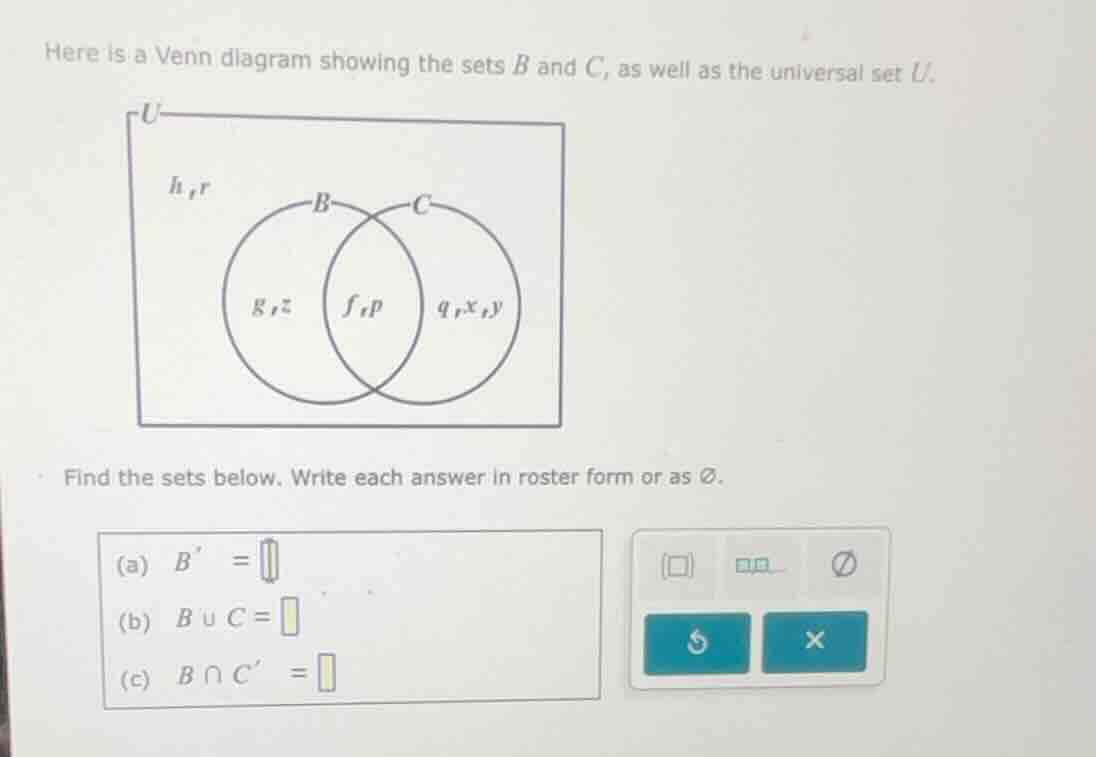
here is a venn diagram showing the sets b and c, as well as the universal set u. find the sets below. write each answer in roster form or as \\( \varnothing \\). (a) \\( b^{\prime} = \\) (b) \\( b \cup c = \\) (c) \\( b \cap c^{\prime} = \\)
Part (a): Finding \( B' \)
Step 1: Recall the definition of complement
The complement of a set \( B \), denoted \( B' \), consists of all elements in the universal set \( U \) that are not in \( B \).
First, identify the universal set \( U \) from the Venn diagram. The elements in \( U \) are \( h, r, g, z, f, p, q, x, y \) (all elements inside the rectangle).
The elements in \( B \) are the elements inside the circle labeled \( B \), which are \( g, z, f, p \).
Step 2: Find elements not in \( B \)
To find \( B' \), we take all elements in \( U \) and remove those in \( B \). So we remove \( g, z, f, p \) from \( U \). The remaining elements are \( h, r, q, x, y \).
Step 1: Recall the definition of union
The union of two sets \( B \) and \( C \), denoted \( B \cup C \), consists of all elements that are in \( B \) or in \( C \) (or in both).
The elements in \( B \) are \( g, z, f, p \), and the elements in \( C \) are \( f, p, q, x, y \).
Step 2: Combine the elements (without duplication)
Combining these elements, we get \( g, z, f, p, q, x, y \) (since \( f \) and \( p \) are already in \( B \), we don't list them twice).
Step 1: Recall the definitions of intersection and complement
First, find \( C' \) (the complement of \( C \)), which is all elements in \( U \) not in \( C \). Then, find the intersection of \( B \) and \( C' \), which is elements in both \( B \) and \( C' \).
Step 2: Find \( C' \)
The elements in \( C \) are \( f, p, q, x, y \). The universal set \( U \) has elements \( h, r, g, z, f, p, q, x, y \). So \( C' \) (elements in \( U \) not in \( C \)) is \( \{h, r, g, z\} \).
Step 3: Find the intersection of \( B \) and \( C' \)
The elements in \( B \) are \( \{g, z, f, p\} \). The elements in \( C' \) are \( \{h, r, g, z\} \). The intersection \( B \cap C' \) is the elements common to both, which are \( g, z \).

Snap & solve any problem in the app
Get step-by-step solutions on Sovi AI
Photo-based solutions with guided steps
Explore more problems and detailed explanations
\( B' = \{h, r, q, x, y\} \)