QUESTION IMAGE
Question
heres an exponential function.
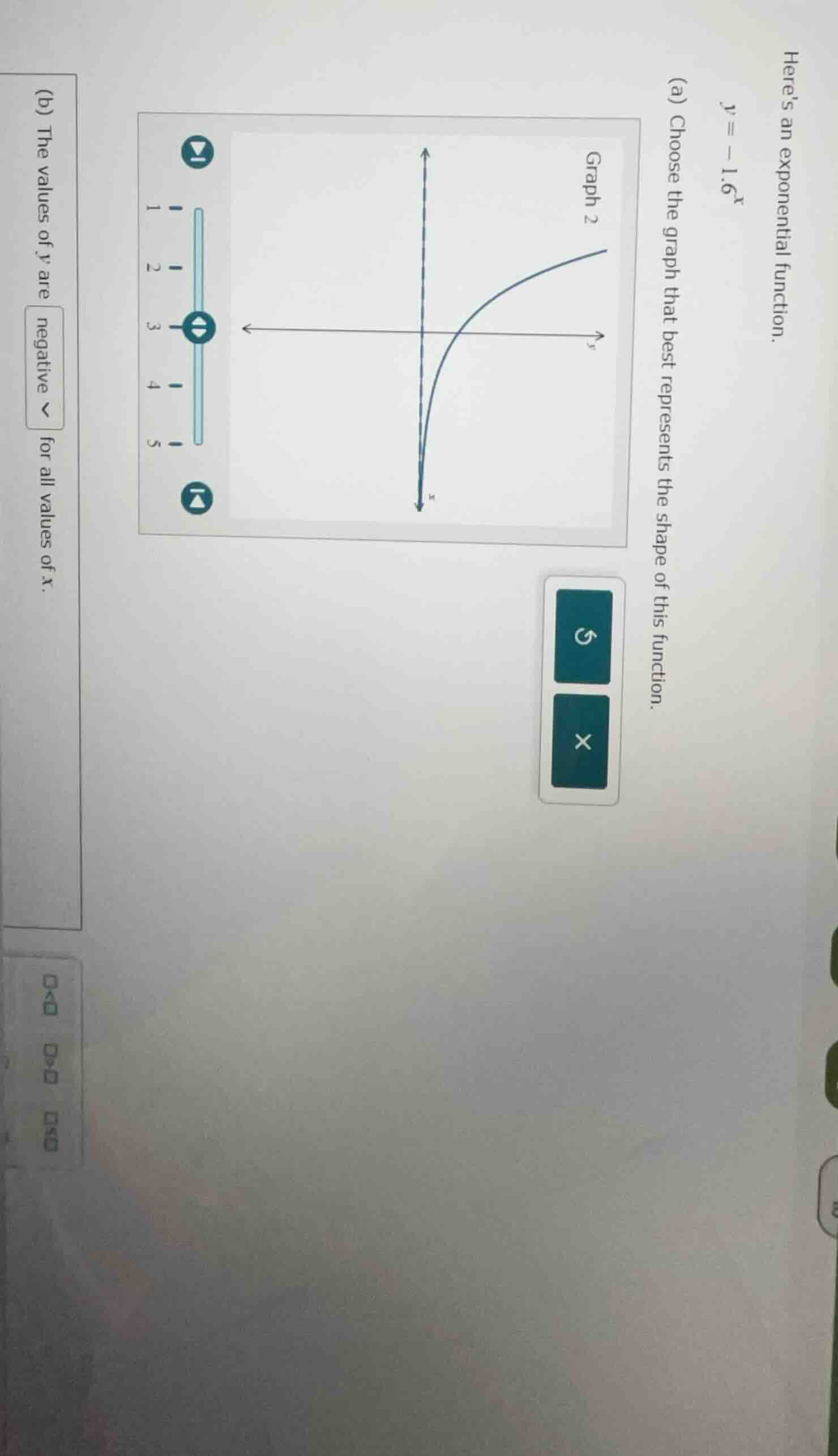
( y = -1.6^x )
(a) choose the graph that best represents the shape of this function.
(b) the values of ( y ) are
negative
for all values of ( x ).
Part (a)
Step 1: Analyze the function \( y = -1.6^x \)
The function is an exponential function with base \( 1.6>1 \), but there is a negative sign. For \( y = a^x \) ( \( a>1 \) ), it's an increasing exponential curve above the x - axis. When we have \( y=-a^x \) ( \( a > 1 \) ), the graph is a reflection of \( y = a^x \) over the x - axis. So the graph should be a decreasing curve (since as \( x\) increases, \( 1.6^x \) increases, and multiplying by - 1 makes \( y\) decrease) and below the x - axis. The given Graph 2 (from the image) seems to have a curve that is decreasing and below the x - axis (assuming the axes are labeled with x and y, and the curve is in the lower half for positive x - direction and approaching 0 as \( x\) goes to \( -\infty \) and going to \( -\infty \) as \( x\) goes to \( +\infty \) ), so we choose Graph 2.
Step 2: Confirm the choice
The general form of \( y=-b^x \) ( \( b > 1 \)) has a domain of all real numbers, range \( y<0 \), and is a decreasing function. The graph in the problem (Graph 2) matches this description.
Part (b)
Step 1: Analyze the range of \( y=-1.6^x \)
For any real number \( x \), \( 1.6^x>0 \) (by the property of exponential functions with base \( a>0,a
eq1 \), \( a^x>0 \) for all real \( x \) ). When we multiply \( 1.6^x \) by - 1, we get \( y=-1.6^x<0 \) for all real \( x \). So the values of \( y \) are negative for all values of \( x \).

Snap & solve any problem in the app
Get step-by-step solutions on Sovi AI
Photo-based solutions with guided steps
Explore more problems and detailed explanations
s:
(a) Graph 2 (the graph provided in the problem with the curve that is a reflection of the increasing exponential curve over the x - axis, decreasing and below the x - axis)
(b) negative