QUESTION IMAGE
Question
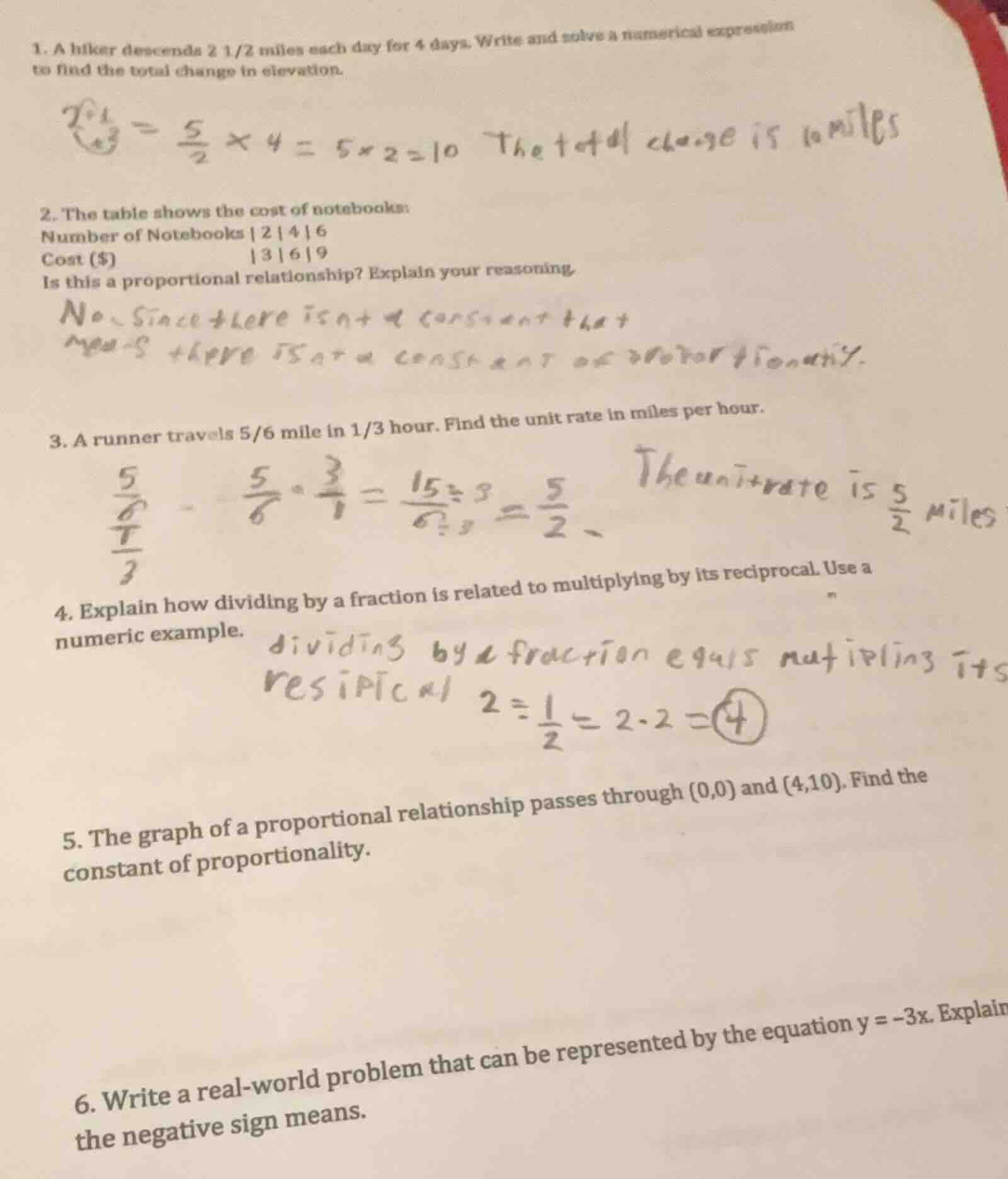
- a hiker descends $2\frac{1}{2}$ miles each day for 4 days. write and solve a numerical expression to find the total change in elevation.
- the table shows the cost of notebooks:
number of notebooks | 2 | 4 | 6
cost ($) | 3 | 6 | 9
is this a proportional relationship? explain your reasoning.
- a runner travels $\frac{5}{6}$ mile in $\frac{1}{3}$ hour. find the unit rate in miles per hour.
- explain how dividing by a fraction is related to multiplying by its reciprocal. use a numeric example.
- the graph of a proportional relationship passes through (0,0) and (4,10). find the constant of proportionality.
- write a real - world problem that can be represented by the equation $y = - 3x$. explain the negative sign means.
Problem 1
Step1: Convert mixed number to improper fraction
The daily descent is \(2\frac{1}{2}\) miles, which is \(\frac{5}{2}\) miles.
Step2: Multiply by number of days
To find total change, multiply daily descent by 4 days: \(\frac{5}{2} \times 4\)
Step3: Simplify the expression
\(\frac{5}{2} \times 4 = 5\times2 = 10\)
For a proportional relationship, \(\frac{\text{Cost}}{\text{Number of Notebooks}}\) should be constant. Calculate ratios: \(\frac{3}{2} = 1.5\), \(\frac{6}{4} = 1.5\), \(\frac{9}{6} = 1.5\). Since the ratio (unit rate) is constant and the graph passes through \((0,0)\) (implied by proportionality), it is proportional.
Step1: Recall unit rate formula
Unit rate (miles per hour) is distance divided by time, so \(\frac{\frac{5}{6}}{\frac{1}{3}}\)
Step2: Divide by multiplying by reciprocal
Dividing by \(\frac{1}{3}\) is multiplying by 3: \(\frac{5}{6} \times 3\)
Step3: Simplify the expression
\(\frac{5}{6} \times 3=\frac{5}{2} = 2.5\)

Snap & solve any problem in the app
Get step-by-step solutions on Sovi AI
Photo-based solutions with guided steps
Explore more problems and detailed explanations
The total change in elevation is 10 miles.