QUESTION IMAGE
Question
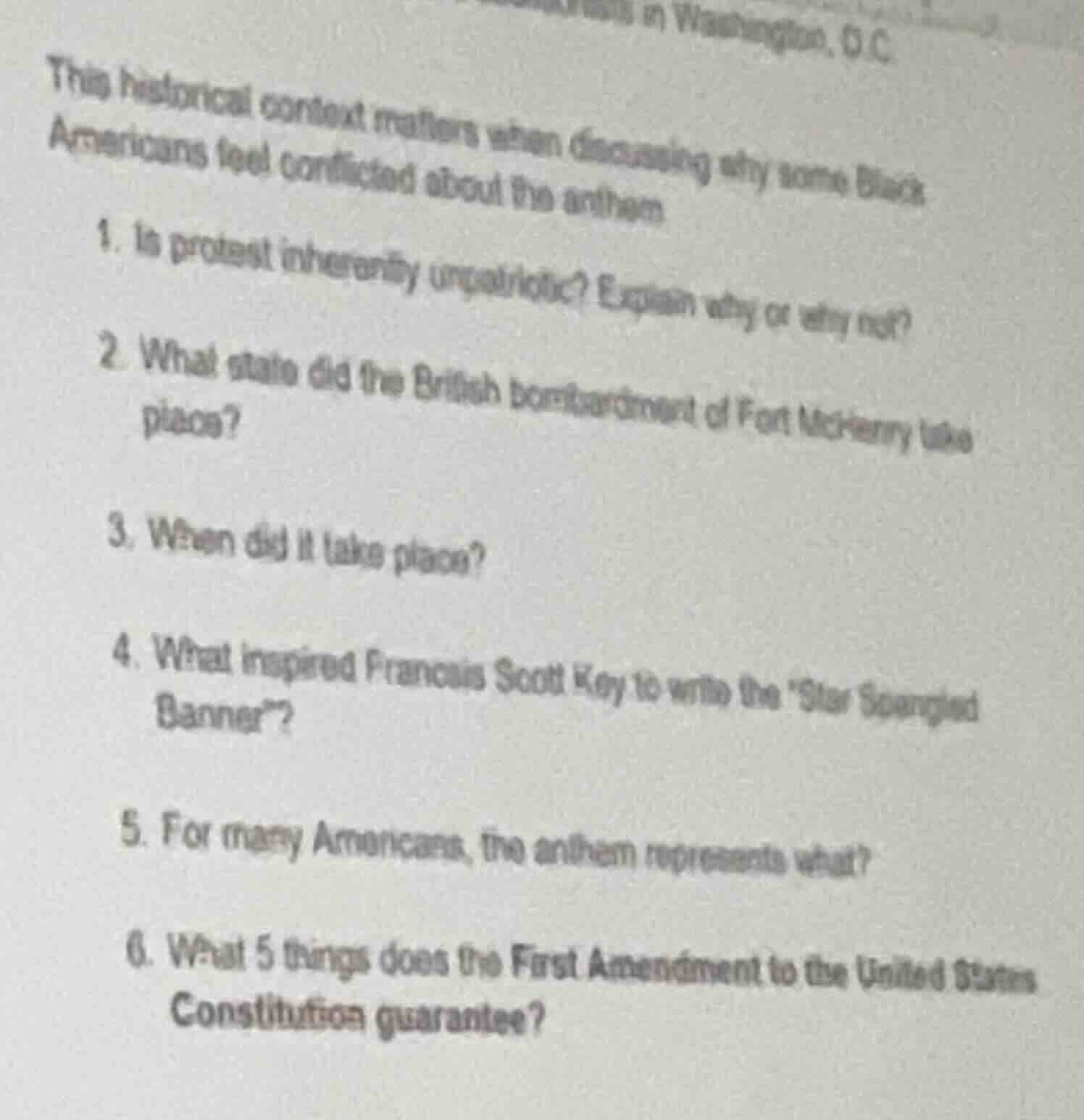
this historical context matters when discussing why some black americans feel conflicted about the anthem.
- is protest inherently unpatriotic? explain why or why not?
- what state did the british bombardment of fort mchenry take place?
- when did it take place?
- what inspired francis scott key to write the \star spangled banner\?
- for many americans, the anthem represents what?
- what 5 things does the first amendment to the united states constitution guarantee?
Brief Explanations
- Protest is not inherently unpatriotic. Many forms of protest in U.S. history aimed to fix flaws in the nation to uphold its stated ideals, which aligns with patriotic commitment to improving the country.
- Fort McHenry is located in Maryland, so the bombardment occurred there.
- The British bombardment of Fort McHenry happened during the War of 1812, specifically in September 1814.
- Francis Scott Key witnessed the British bombardment of Fort McHenry and saw the U.S. flag still flying over the fort the next morning, which inspired him to write the poem that became the "Star Spangled Banner".
- For many Americans, the anthem represents national unity, resilience, and the sacrifices made to defend the nation's independence and values.
- The First Amendment guarantees five core freedoms: religion, speech, press, assembly, and petitioning the government for redress of grievances.

Snap & solve any problem in the app
Get step-by-step solutions on Sovi AI
Photo-based solutions with guided steps
Explore more problems and detailed explanations
- No, protest is not inherently unpatriotic. Protest often stems from a desire to hold the nation accountable to its founding ideals of justice and equality, which is an act of commitment to improving the country rather than rejecting it.
- Maryland
- September 13–14, 1814
- His observation of the American flag still flying over Fort McHenry after a night of heavy British bombardment during the War of 1812.
- National pride, resilience, the sacrifices made for U.S. independence, and the unity of the American nation.
- 1. Freedom of religion
- Freedom of speech
- Freedom of the press
- Right to peaceably assemble
- Right to petition the government for a redress of grievances