QUESTION IMAGE
Question
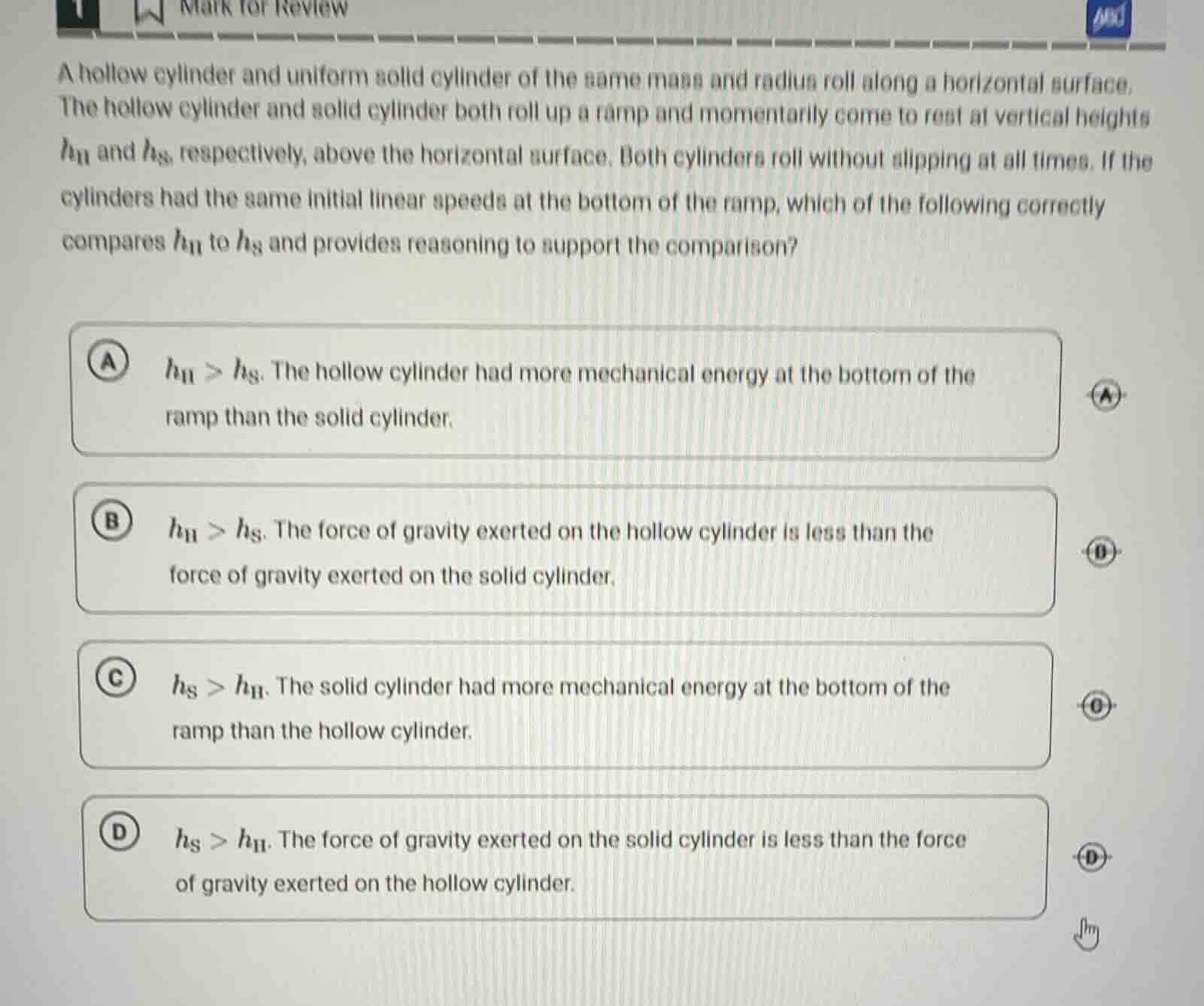
a hollow cylinder and uniform solid cylinder of the same mass and radius roll along a horizontal surface. the hollow cylinder and solid cylinder both roll up a ramp and momentarily come to rest at vertical heights ( h_{\text{h}} ) and ( h_{\text{s}} ), respectively, above the horizontal surface. both cylinders roll without slipping at all times. if the cylinders had the same initial linear speeds at the bottom of the ramp, which of the following correctly compares ( h_{\text{h}} ) to ( h_{\text{s}} ) and provides reasoning to support the comparison?
a ( h_{\text{h}} > h_{\text{s}} ). the hollow cylinder had more mechanical energy at the bottom of the ramp than the solid cylinder.
b ( h_{\text{h}} > h_{\text{s}} ). the force of gravity exerted on the hollow cylinder is less than the force of gravity exerted on the solid cylinder.
c ( h_{\text{s}} > h_{\text{h}} ). the solid cylinder had more mechanical energy at the bottom of the ramp than the hollow cylinder.
d ( h_{\text{s}} > h_{\text{h}} ). the force of gravity exerted on the solid cylinder is less than the force of gravity exerted on the hollow cylinder.
- First, recall the formula for the moment of inertia (\(I\)) of a solid cylinder: \(I_{s}=\frac{1}{2}MR^{2}\) and for a hollow cylinder: \(I_{h}=MR^{2}\) (where \(M\) is mass and \(R\) is radius).
- The total mechanical energy (kinetic + potential) at the bottom of the ramp for a rolling - without - slipping object is \(E = K_{trans}+K_{rot}=\frac{1}{2}Mv^{2}+\frac{1}{2}I\omega^{2}\). Since \(\omega=\frac{v}{R}\) (no - slipping condition), we can substitute \(\omega\) into the rotational kinetic energy formula.
- For the solid cylinder: \(E_{s}=\frac{1}{2}Mv^{2}+\frac{1}{2}(\frac{1}{2}MR^{2})(\frac{v}{R})^{2}=\frac{1}{2}Mv^{2}+\frac{1}{4}Mv^{2}=\frac{3}{4}Mv^{2}\).
- For the hollow cylinder: \(E_{h}=\frac{1}{2}Mv^{2}+\frac{1}{2}(MR^{2})(\frac{v}{R})^{2}=\frac{1}{2}Mv^{2}+\frac{1}{2}Mv^{2}=Mv^{2}\).
- Both cylinders have the same mass \(M\) and initial linear speed \(v\). So, \(E_{h}>E_{s}\) (the hollow cylinder has more mechanical energy at the bottom of the ramp).
- As they roll up the ramp, mechanical energy is conserved (assuming no non - conservative forces like friction doing work, and since they roll without slipping, the work done by friction is zero for the purpose of energy conservation of the center - of - mass motion). At the maximum height, all the mechanical energy is converted into gravitational potential energy \(U = Mgh\).
- For the solid cylinder: \(E_{s}=Mgh_{s}\), so \(h_{s}=\frac{E_{s}}{Mg}\).
- For the hollow cylinder: \(E_{h}=Mgh_{h}\), so \(h_{h}=\frac{E_{h}}{Mg}\).
- Since \(E_{h}>E_{s}\), then \(h_{h}>h_{s}\).
- Now let's analyze the options:
- Option A: Says \(h_{H}>h_{S}\) and the reasoning is that the hollow cylinder had more mechanical energy at the bottom. This matches our analysis.
- Option B: The force of gravity on both cylinders is \(F = Mg\). Since they have the same mass, the force of gravity is the same. So this option is wrong.
- Option C: We found that the hollow cylinder has more mechanical energy, so this option is wrong.
- Option D: The force of gravity on both cylinders is the same (same mass), so this option is wrong.

Snap & solve any problem in the app
Get step-by-step solutions on Sovi AI
Photo-based solutions with guided steps
Explore more problems and detailed explanations
A. \(h_{\text{H}}>h_{\text{S}}\). The hollow cylinder had more mechanical energy at the bottom of the ramp than the solid cylinder.