QUESTION IMAGE
Question
homework #3
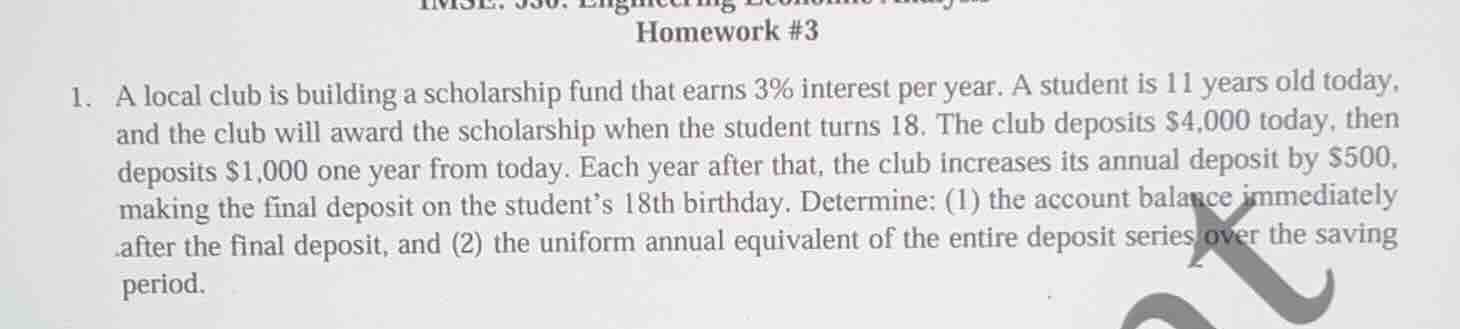
- a local club is building a scholarship fund that earns 3% interest per year. a student is 11 years old today, and the club will award the scholarship when the student turns 18. the club deposits $4,000 today, then deposits $1,000 one year from today. each year after that, the club increases its annual deposit by $500, making the final deposit on the students 18th birthday. determine: (1) the account balance immediately after the final deposit, and (2) the uniform annual equivalent of the entire deposit series over the saving period.
First, calculate the number of years from today to the student's 18th birthday: $18 - 11 = 7$ years. So there are 7 deposits in total.
Step1: List all deposit amounts
- Deposit 0 (today): $P_0 = \$4000$
- Deposit 1 (1 year from now): $P_1 = \$1000$
- Deposit 2: $P_2 = \$1000 + \$500 = \$1500$
- Deposit 3: $P_3 = \$1500 + \$500 = \$2000$
- Deposit 4: $P_4 = \$2000 + \$500 = \$2500$
- Deposit 5: $P_5 = \$2500 + \$500 = \$3000$
- Deposit 6 (final, 6 years from now/18th birthday): $P_6 = \$3000 + \$500 = \$3500$
Step2: Calculate future value of each deposit
Use future value formula $FV = P \times (1 + r)^n$, where $r = 0.03$, $n$ is years until final deposit.
- $FV_0 = 4000 \times (1+0.03)^6 = 4000 \times 1.194052 = \$4776.21$
- $FV_1 = 1000 \times (1+0.03)^5 = 1000 \times 1.159274 = \$1159.27$
- $FV_2 = 1500 \times (1+0.03)^4 = 1500 \times 1.125509 = \$1688.26$
- $FV_3 = 2000 \times (1+0.03)^3 = 2000 \times 1.092727 = \$2185.45$
- $FV_4 = 2500 \times (1+0.03)^2 = 2500 \times 1.0609 = \$2652.25$
- $FV_5 = 3000 \times (1+0.03)^1 = 3000 \times 1.03 = \$3090$
- $FV_6 = 3500 \times (1+0.03)^0 = \$3500$
Step3: Sum future values for part (1)
Add all $FV$ values:
$$4776.21 + 1159.27 + 1688.26 + 2185.45 + 2652.25 + 3090 + 3500$$
$$= 4776.21+1159.27=5935.48; 5935.48+1688.26=7623.74;$$
$$7623.74+2185.45=9809.19; 9809.19+2652.25=12461.44;$$
$$12461.44+3090=15551.44; 15551.44+3500=19051.44$$
Step4: Calculate present value of all deposits
Use present value formula $PV = P \times (1 + r)^{-n}$:
- $PV_0 = 4000$
- $PV_1 = 1000 \times (1.03)^{-1} = 970.87$
- $PV_2 = 1500 \times (1.03)^{-2} = 1500 \times 0.9426 = 1413.90$
- $PV_3 = 2000 \times (1.03)^{-3} = 2000 \times 0.9151 = 1830.20$
- $PV_4 = 2500 \times (1.03)^{-4} = 2500 \times 0.8885 = 2221.25$
- $PV_5 = 3000 \times (1.03)^{-5} = 3000 \times 0.8626 = 2587.80$
- $PV_6 = 3500 \times (1.03)^{-6} = 3500 \times 0.8375 = 2931.25$
Sum all PV values:
$$4000 + 970.87 + 1413.90 + 1830.20 + 2221.25 + 2587.80 + 2931.25 = 15955.27$$
Step5: Find uniform annual equivalent (A)
Use capital recovery formula $A = PV \times \frac{r(1+r)^n}{(1+r)^n - 1}$, where $n=6$ (annual deposits start at year 1, 6 annual payments)
$$A = 15955.27 \times \frac{0.03(1.03)^6}{(1.03)^6 - 1}$$
First calculate $(1.03)^6 = 1.194052$
$$\frac{0.03 \times 1.194052}{1.194052 - 1} = \frac{0.0358216}{0.194052} = 0.1846$$
$$A = 15955.27 \times 0.1846 \approx 2945.34$$

Snap & solve any problem in the app
Get step-by-step solutions on Sovi AI
Photo-based solutions with guided steps
Explore more problems and detailed explanations
(1) The account balance immediately after the final deposit is $\$19051.44$
(2) The uniform annual equivalent of the deposit series is $\$2945.34$