QUESTION IMAGE
Question
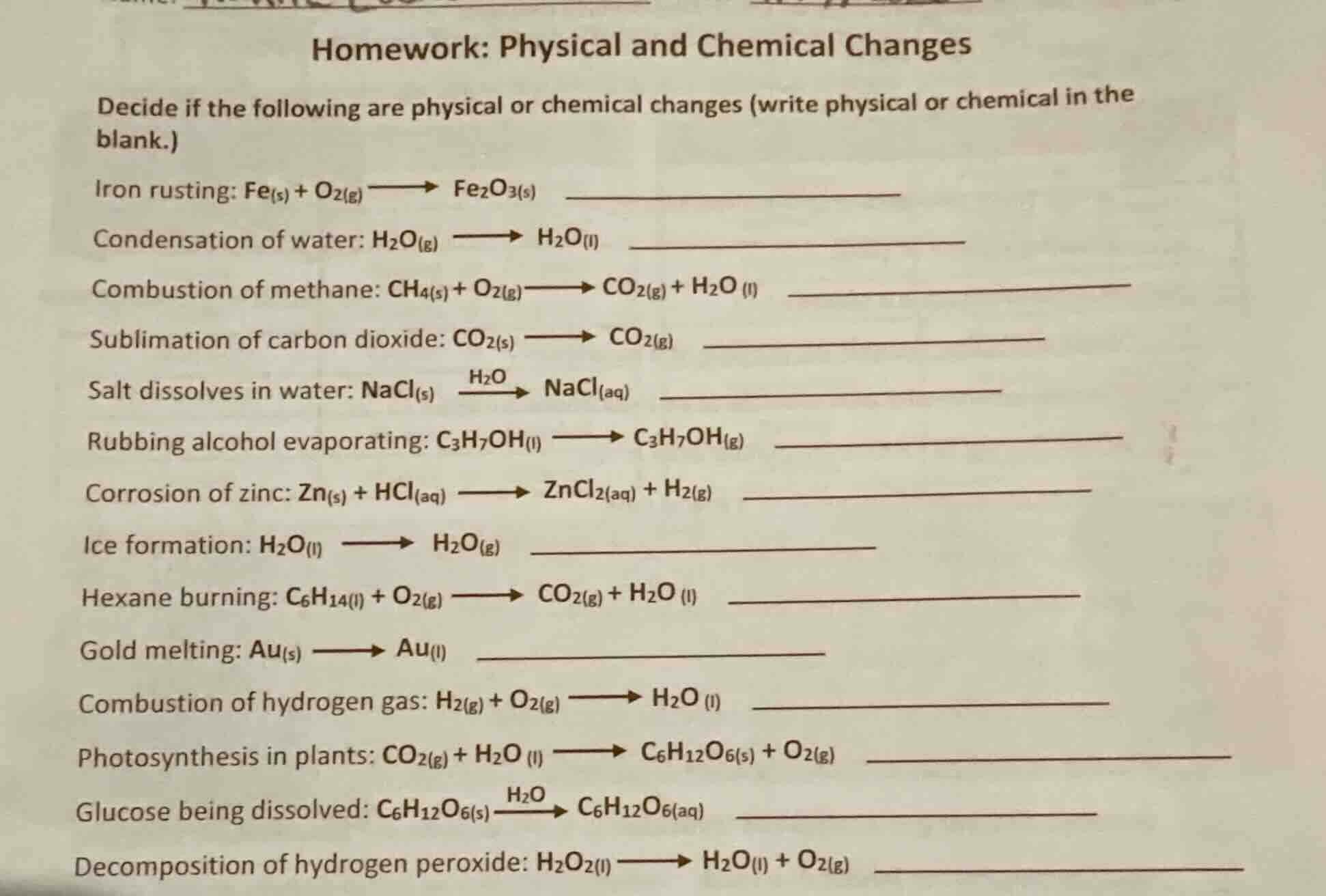
homework: physical and chemical changes
decide if the following are physical or chemical changes (write physical or chemical in the blank.)
iron rusting: fe₍ₛ₎ + o₂₍₉₎ ⟶ fe₂o₃₍ₛ₎
condensation of water: h₂o₍₉₎ ⟶ h₂o₍ₗ₎
combustion of methane: ch₄₍ₛ₎ + o₂₍₉₎ ⟶ co₂₍₉₎ + h₂o ₍ₗ₎
sublimation of carbon dioxide: co₂₍ₛ₎ ⟶ co₂₍₉₎
salt dissolves in water: nacl₍ₛ₎ stackrel{h₂o}{⟶} nacl₍ₐq₎
rubbing alcohol evaporating: c₃h₇oh₍ₗ₎ ⟶ c₃h₇oh₍₉₎
corrosion of zinc: zn₍ₛ₎ + hcl₍ₐq₎ ⟶ zncl₂₍ₐq₎ + h₂₍₉₎
ice formation: h₂o₍ₗ₎ ⟶ h₂o₍₉₎
hexane burning: c₆h₁₄₍ₗ₎ + o₂₍₉₎ ⟶ co₂₍₉₎ + h₂o ₍ₗ₎
gold melting: au₍ₛ₎ ⟶ au₍ₗ₎
combustion of hydrogen gas: h₂₍₉₎ + o₂₍₉₎ ⟶ h₂o ₍ₗ₎
photosynthesis in plants: co₂₍₉₎ + h₂o ₍ₗ₎ ⟶ c₆h₁₂o₆₍ₛ₎ + o₂₍₉₎
glucose being dissolved: c₆h₁₂o₆₍ₛ₎ stackrel{h₂o}{⟶} c₆h₁₂o₆₍ₐq₎
decomposition of hydrogen peroxide: h₂o₂₍ₗ₎ ⟶ h₂o₍ₗ₎ + o₂₍₉₎
To solve this, we determine if a change is physical (no new substance, just state/shape change) or chemical (new substance formed, often with a reaction equation).
1. Iron rusting: $\ce{Fe_{(s)} + O_{2(g)} -> Fe_{2}O_{3(s)}}$
A new substance ($\ce{Fe_{2}O_{3}}$) is formed.

Snap & solve any problem in the app
Get step-by-step solutions on Sovi AI
Photo-based solutions with guided steps
Explore more problems and detailed explanations
chemical
2. Condensation of water: $\ce{H_{2}O_{(g)} -> H_{2}O_{(l)}}$
Only state (gas to liquid) changes, no new substance.