QUESTION IMAGE
Question
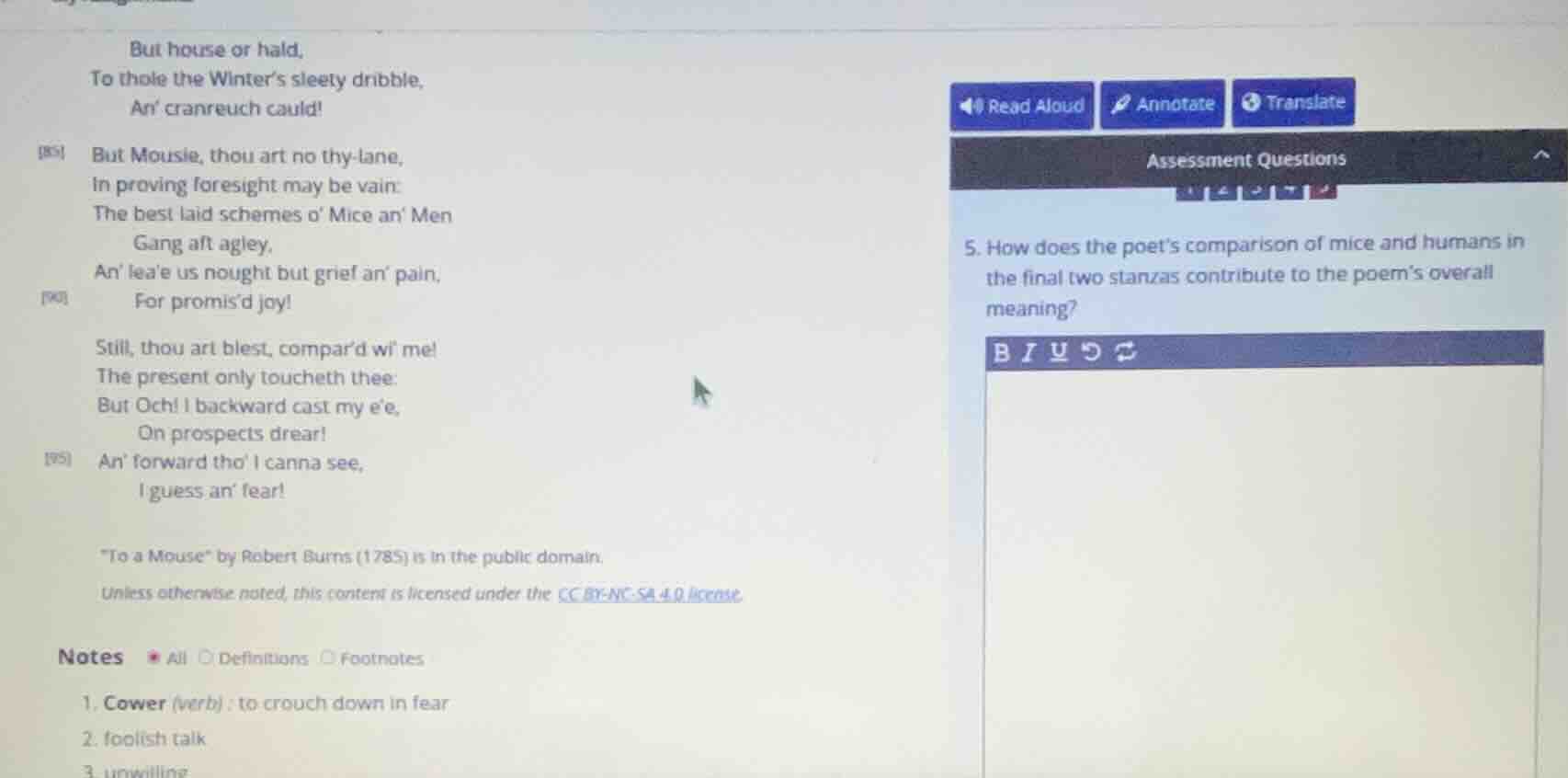
but house or hald, to thole the winter’s sleety dribble, an’ cranreuch cauld! but mousie, thou art no thy-lane, in proving foresight may be vain: the best laid schemes o’ mice an’ men gang aft agley, an’ lea’e us nought but grief an’ pain, for promis’d joy! still, thou art blest, compar’d wi’ me! the present only toucheth thee: but och! i backward cast my e’e, on prospects drear! an’ forward tho’ i canna see, i guess an’ fear! \to a mouse\ by robert burns (1785) is in the public domain. unless otherwise noted, this content is licensed under the cc by-nc-sa 4.0 license. notes all definitions footnotes 1. cower (verb) : to crouch down in fear 2. foolish talk 3. unwilling assessment questions 5. how does the poet’s comparison of mice and humans in the final two stanzas contribute to the poem’s overall meaning?
In the final two stanzas of "To a Mouse," the poet compares mice and humans. Mice live in the present ("The present only toucheth thee"), while humans (the speaker) look back with regret and forward with fear/guessing ("I backward cast my e'e, On prospects drear! An' forward tho' I canna see, I guess an' fear!"). The comparison shows that humans, unlike mice, have the burden of reflecting on the past and worrying about the future, while mice are free from such anxieties. This contributes to the poem's overall meaning about the fragility of plans (from earlier stanzas, "The best laid schemes o' Mice an' Men Gang aft agley") and the human condition of dealing with uncertainty, regret, and the inability to fully control or foresee outcomes, contrasting with the mouse's simpler, present - focused existence.

Snap & solve any problem in the app
Get step-by-step solutions on Sovi AI
Photo-based solutions with guided steps
Explore more problems and detailed explanations
The poet's comparison of mice and humans in the final two stanzas shows that mice live only in the present, while humans (the speaker) are burdened by reflecting on the past and fearing/guessing about the future. This contributes to the poem's meaning about the fragility of plans (from "the best laid schemes o' Mice an' Men gang aft agley") and the human condition of dealing with uncertainty, regret, and the inability to fully control or foresee outcomes, contrasting with the mouse's simpler, present - focused existence.