QUESTION IMAGE
Question
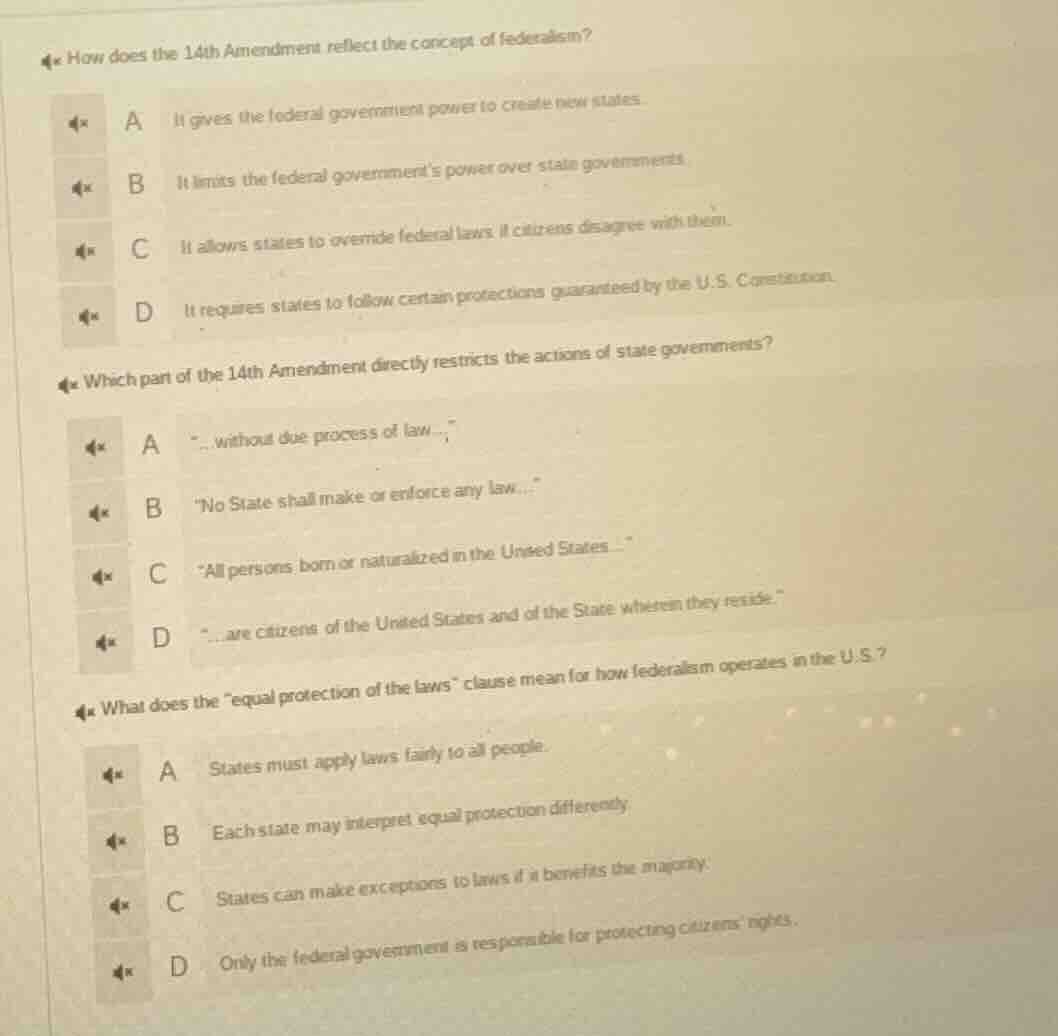
- how does the 14th amendment reflect the concept of federalism?a it gives the federal government power to create new states.b it limits the federal governments power over state governments.c it allows states to override federal laws if citizens disagree with them.d it requires states to follow certain protections guaranteed by the u.s. constitution.2. which part of the 14th amendment directly restricts the actions of state governments?a \...without due process of law...\b
o state shall make or enforce any law...\c \all persons born or naturalized in the united states...\d \...are citizens of the united states and of the state wherein they reside.\3. what does the \equal protection of the laws\ clause mean for how federalism operates in the u.s.?a states must apply laws fairly to all people.b each state may interpret equal protection differently.c states can make exceptions to laws if it benefits the majority.d only the federal government is responsible for protecting citizens rights.
First Question:
Federalism balances state and federal power. The 14th Amendment imposes federal constitutional protections on states, ensuring they uphold core rights. Option A is incorrect (state creation power is in Article IV), B is wrong (it expands federal oversight of states, not limits it), C is incorrect (states cannot override federal law per supremacy clause).
Second Question:
The 14th Amendment's Section 1 directly restricts states via the clause that prohibits states from making/enforcing laws that abridge federal rights. Options A, C, D address due process, citizenship definition, not direct state action restriction.
Third Question:
The equal protection clause requires states to apply laws uniformly to all groups. Option B is incorrect (the clause constrains inconsistent interpretation), C is wrong (it forbids unfair exceptions), D is incorrect (states also have a duty to protect rights).

Snap & solve any problem in the app
Get step-by-step solutions on Sovi AI
Photo-based solutions with guided steps
Explore more problems and detailed explanations
- D. It requires states to follow certain protections guaranteed by the U.S. Constitution.
- B. "No State shall make or enforce any law..."
- A. States must apply laws fairly to all people.