QUESTION IMAGE
Question
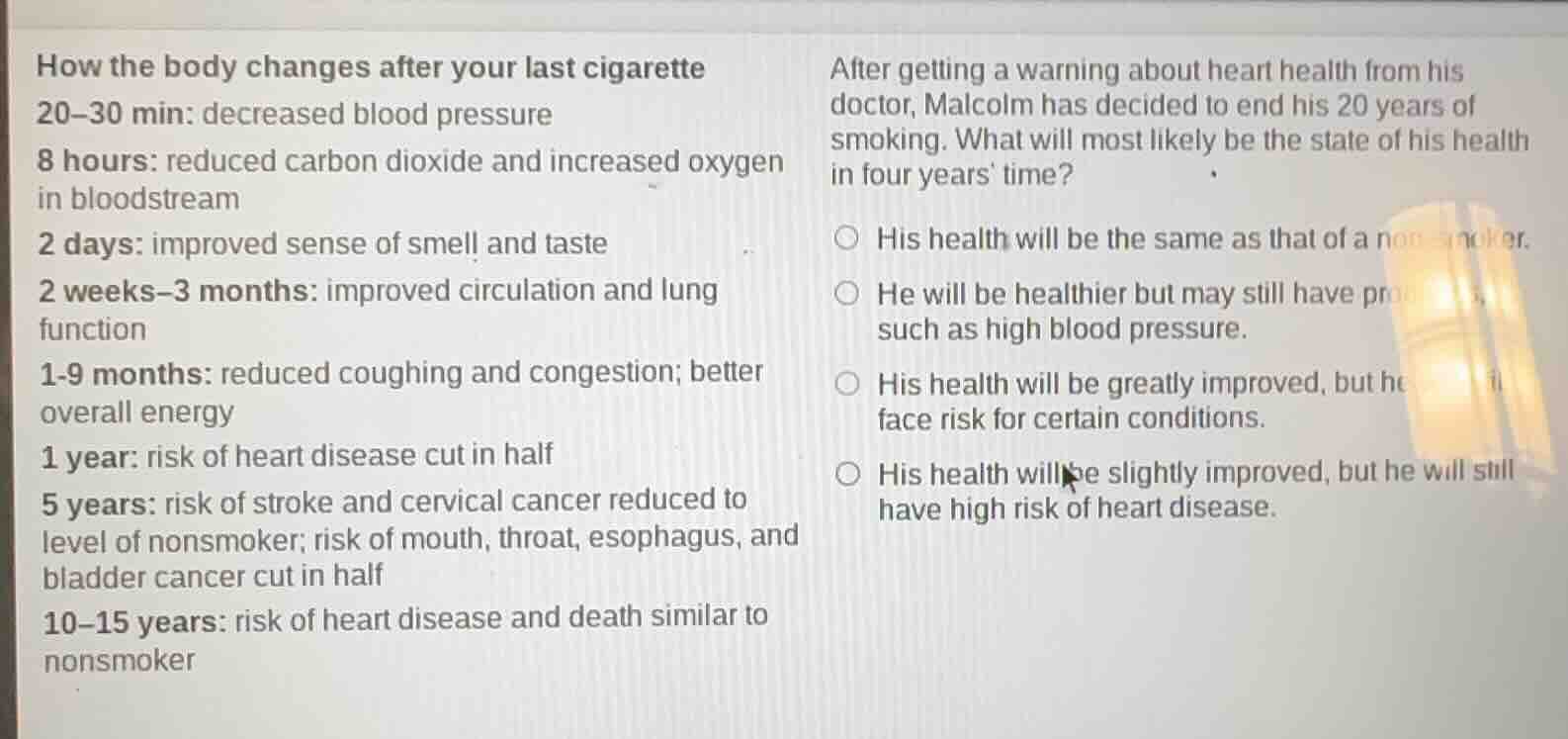
how the body changes after your last cigarette
20–30 min: decreased blood pressure
8 hours: reduced carbon dioxide and increased oxygen in bloodstream
2 days: improved sense of smell and taste
2 weeks–3 months: improved circulation and lung function
1-9 months: reduced coughing and congestion; better overall energy
1 year: risk of heart disease cut in half
5 years: risk of stroke and cervical cancer reduced to level of nonsmoker; risk of mouth, throat, esophagus, and bladder cancer cut in half
10–15 years: risk of heart disease and death similar to nonsmoker
after getting a warning about heart health from his doctor, malcolm has decided to end his 20 years of smoking. what will most likely be the state of his health in four years time?
○ his health will be the same as that of a nonsmoker.
○ he will be healthier but may still have problems such as high blood pressure.
○ his health will be greatly improved, but he will still face risk for certain conditions.
○ his health will be slightly improved, but he will still have high risk of heart disease.
To determine Malcolm's health in four years, we analyze the timeline:
- After 1 year, his heart disease risk is halved.
- After 5 years, risks of stroke, cervical cancer match a nonsmoker, and some cancer risks are halved.
- Four years is between 1 and 5 years. So his health will be greatly improved (from reduced risks over time) but he still faces some risks (since 5 - year milestones show full reduction, so at 4 years, not all risks are eliminated yet).
Let's evaluate the options:
- Option 1: By 4 years, he hasn't reached the 5 - 15 year mark for heart disease risk to match a nonsmoker, so this is incorrect.
- Option 2: After 20 - 30 minutes blood pressure decreases, and over time circulation and lung function improve. By 4 years, high blood pressure is unlikely as improvements occur, so this is incorrect.
- Option 3: This matches the analysis - health is greatly improved (due to years of quitting - 1 year heart risk halved, ongoing improvements) but still has some risk (since 5 years is needed for some risks to reach nonsmoker levels, so at 4 years, not all risks are gone).
- Option 4: After 1 year heart disease risk is halved, so high heart disease risk is incorrect.

Snap & solve any problem in the app
Get step-by-step solutions on Sovi AI
Photo-based solutions with guided steps
Explore more problems and detailed explanations
His health will be greatly improved, but he will face risk for certain conditions.