QUESTION IMAGE
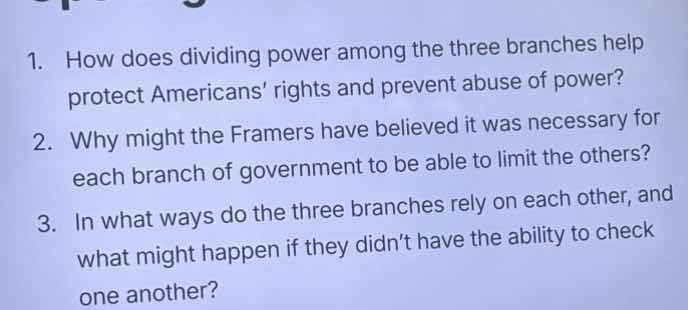
Question
- how does dividing power among the three branches help protect americans’ rights and prevent abuse of power?
- why might the framers have believed it was necessary for each branch of government to be able to limit the others?
- in what ways do the three branches rely on each other, and what might happen if they didn’t have the ability to check one another?
Sub - question 1
Dividing power among the three branches (legislative, executive, judicial) is based on the principle of checks and balances. The legislative branch makes laws, the executive enforces them, and the judicial interprets them. For example, the legislative branch can override a presidential veto, the executive can appoint judges, and the judicial can declare laws unconstitutional. This system prevents any one branch from becoming too powerful and violating citizens' rights. If one branch had all the power, it could potentially pass laws, enforce them, and interpret them in a way that oppresses the people, like a tyrannical government. By having each branch check the others, the rights of Americans, such as freedom of speech, due process, etc., are protected as no single entity can unilaterally violate them.
The Framers were familiar with the problems of concentrated power, like the British monarchy's abuse of power over the colonies. They believed that if one branch of government could not limit the others, that branch could become tyrannical. For instance, if the executive branch had no checks, a president could act like a king, making and enforcing laws without regard for the people's rights. The system of checks and balances was designed to create a self - correcting system where each branch's power is limited by the others, ensuring that the government remains a republic and not a dictatorship. They wanted to create a stable government that would last and protect the new nation from the problems of unchecked power that they had experienced under British rule.
The three branches rely on each other in several ways. The legislative branch relies on the executive to enforce the laws it makes, and the executive relies on the legislative to create the laws to enforce. The judicial branch relies on the executive to enforce its rulings and on the legislative to create the laws it interprets. For example, the legislative passes a law on environmental protection, the executive's agencies (like the EPA) enforce it, and the judicial may rule on legal challenges to the law. If they didn't have the ability to check one another, one branch could become dominant. If the executive had no checks, it could enforce laws in a biased or oppressive way (e.g., targeting certain groups). If the legislative had no checks, it could pass unjust laws (e.g., laws restricting minority rights) and the executive would have to enforce them. If the judicial had no checks, it could misinterpret laws in a way that undermines the system. Overall, without checks, the government could become corrupt, tyrannical, and fail to protect citizens' rights, leading to a breakdown of the democratic system.

Snap & solve any problem in the app
Get step-by-step solutions on Sovi AI
Photo-based solutions with guided steps
Explore more problems and detailed explanations
Dividing power via checks and balances (legislative, executive, judicial each with distinct powers and abilities to check others) prevents one branch from monopolizing power. For example, the judiciary can strike down unconstitutional laws (protecting rights like due process), the legislature can override executive vetoes, and the executive can ensure laws are enforced fairly. This stops abuse (e.g., a tyrannical branch violating rights like freedom of speech) as no branch can act without oversight, safeguarding Americans’ rights.