QUESTION IMAGE
Question
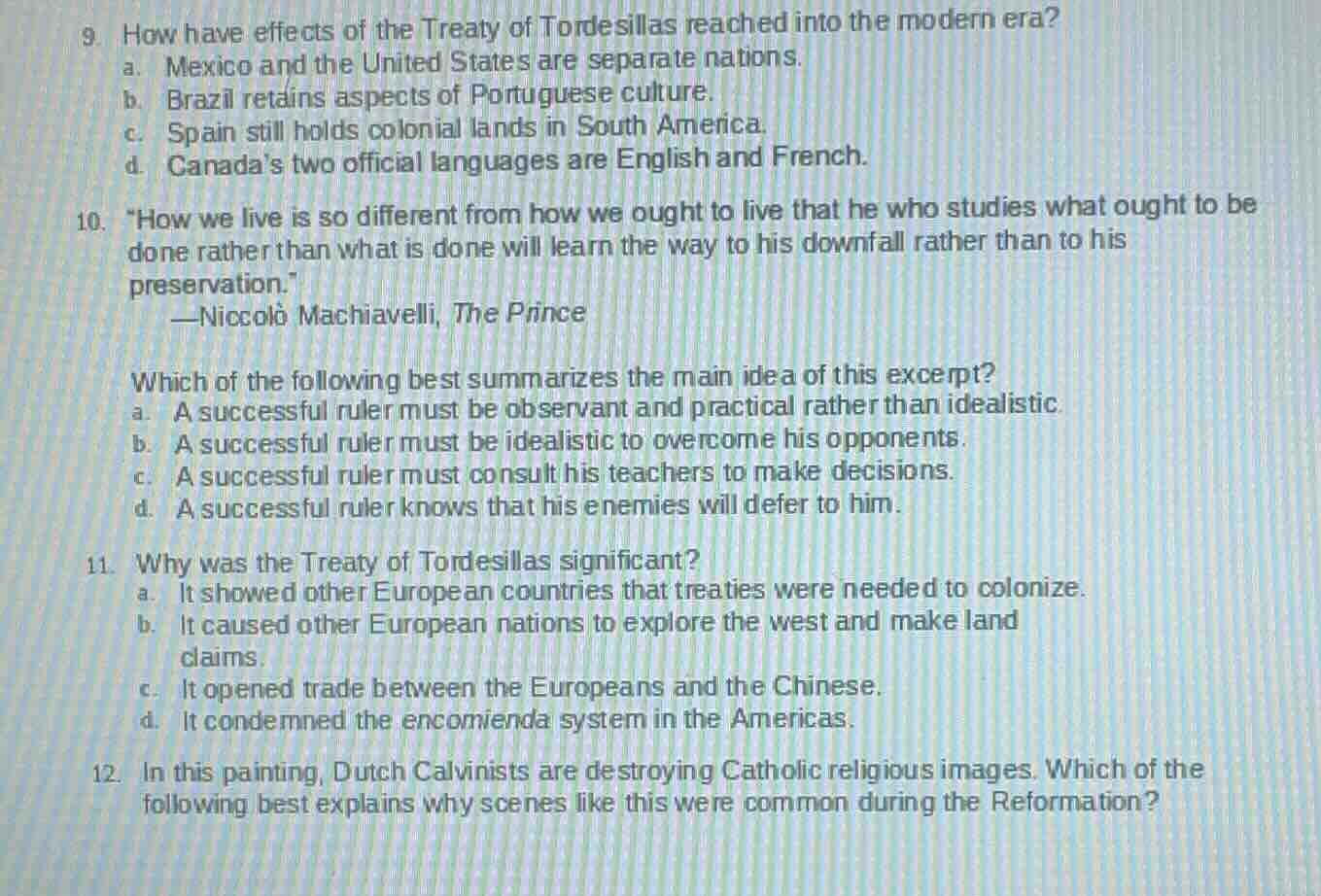
- how have effects of the treaty of tordesillas reached into the modern era?
a. mexico and the united states are separate nations.
b. brazil retains aspects of portuguese culture.
c. spain still holds colonial lands in south america.
d. canadas two official languages are english and french.
- \how we live is so different from how we ought to live that he who studies what ought to be done rather than what is done will learn the way to his downfall rather than to his preservation.\
—niccolò machiavelli, the prince
which of the following best summarizes the main idea of this excerpt?
a. a successful ruler must be observant and practical rather than idealistic.
b. a successful ruler must be idealistic to overcome his opponents.
c. a successful ruler must consult his teachers to make decisions.
d. a successful ruler knows that his enemies will defer to him.
- why was the treaty of tordesillas significant?
a. it showed other european countries that treaties were needed to colonize.
b. it caused other european nations to explore the west and make land claims.
c. it opened trade between the europeans and the chinese.
d. it condemned the encomienda system in the americas.
- in this painting, dutch calvinists are destroying catholic religious images. which of the following best explains why scenes like this were common during the reformation?
- The Treaty of Tordesillas divided the Americas between Spain and Portugal; Brazil was in Portugal's zone, so it retains Portuguese cultural traits. Option a relates to later border conflicts, c is false (Spain has no colonial lands in South America now), d is unrelated to the treaty.
- Machiavelli's quote argues focusing on idealistic "ought to be" instead of real "is" leads to ruin, meaning rulers must be practical, not idealistic.
- The Treaty of Tordesillas established Spanish/Portuguese colonial claims, prompting other European powers to explore and make their own land claims in the Americas to avoid being shut out. Options a, c, d do not reflect the treaty's core significance.
- (Note: No options provided for this question, but the core reason is that Calvinists (and many Protestant groups) rejected Catholic religious images as idolatry, a key theological disagreement during the Reformation that led to iconoclasm.)

Snap & solve any problem in the app
Get step-by-step solutions on Sovi AI
Photo-based solutions with guided steps
Explore more problems and detailed explanations
- b. Brazil retains aspects of Portuguese culture.
- a. A successful ruler must be observant and practical rather than idealistic.
- b. It caused other European nations to explore the west and make land claims.
- (No answer possible without provided options; the key context is Protestant rejection of Catholic iconography as idolatry during the Reformation.)