QUESTION IMAGE
Question
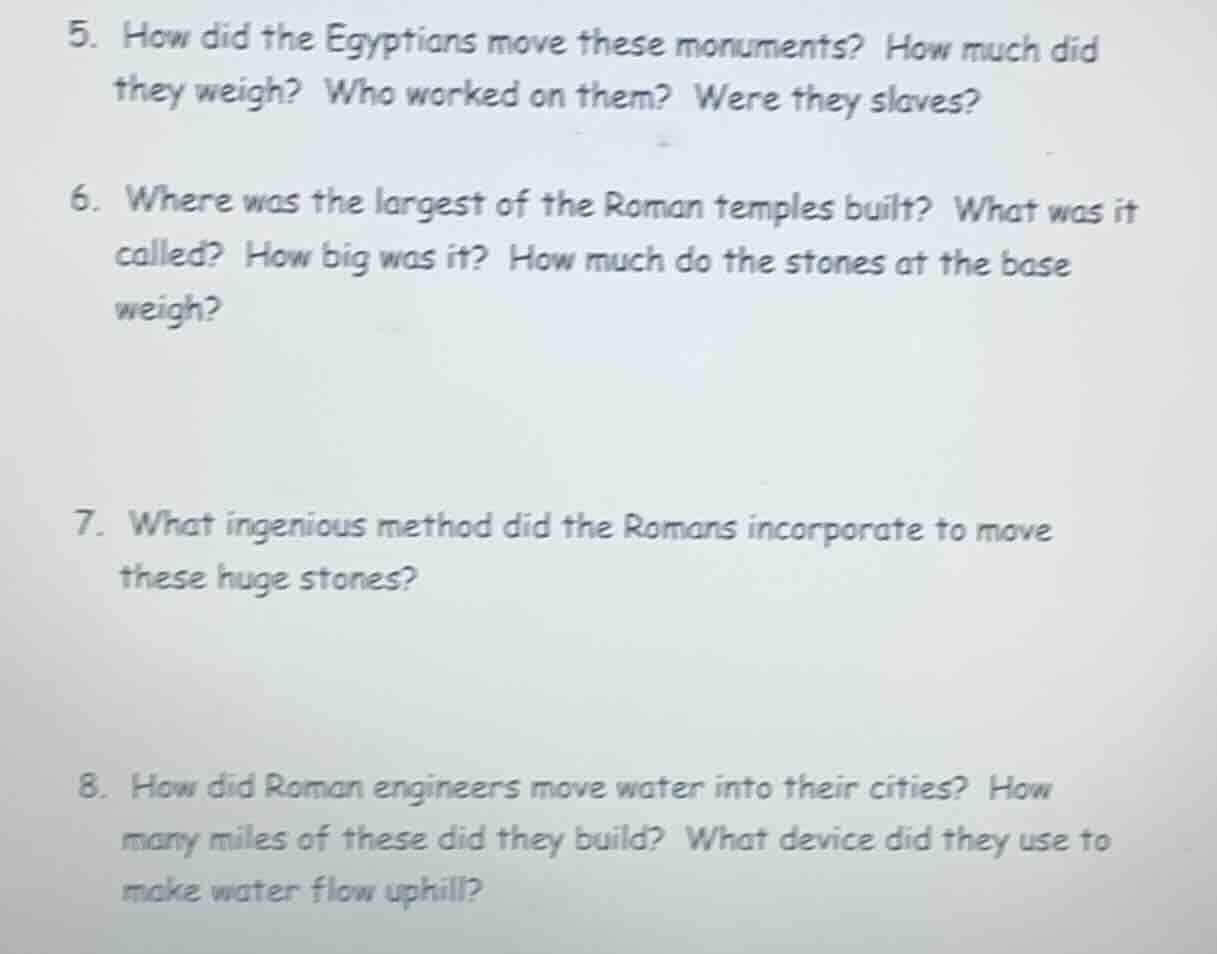
- how did the egyptians move these monuments? how much did they weigh? who worked on them? were they slaves?
- where was the largest of the roman temples built? what was it called? how big was it? how much do the stones at the base weigh?
- what ingenious method did the romans incorporate to move these huge stones?
- how did roman engineers move water into their cities? how many miles of these did they build? what device did they use to make water flow uphill?
Brief Explanations
For Question 5:
- Moving monuments: Egyptians used sleds pulled by workers, wet the sand under sleds to reduce friction, and used ramps to lift stones to higher levels.
- Weight of monuments: Large pyramids (like the Great Pyramid) weighed ~6 million tons, with individual blocks averaging 2.5 tons, some up to 80 tons.
- Workers: They were skilled laborers (farmers during flood seasons, artisans, and supervisors), not slaves. Evidence includes worker villages with decent living conditions and burial sites with honorific graves.
For Question 6:
- Location: The largest Roman temple was built in Baalbek, modern-day Lebanon.
- Name: It was called the Temple of Jupiter Optimus Maximus Heliopolitanus (often shortened to Temple of Jupiter at Baalbek).
- Size: It measured ~88 meters long, ~44 meters wide, with columns 19 meters tall and 2.5 meters in diameter.
- Base stone weight: The largest base stones (the "Trilithon") weigh an estimated 800-1000 tons each.
For Question 7:
Romans used wooden rollers under stone blocks to reduce friction, along with teams of oxen or laborers to pull the stones. They also built earthen ramps to move stones to elevated construction sites, and sometimes used pulleys and cranes for lifting.
For Question 8:
- Moving water into cities: Roman engineers built aqueducts, a network of channels, tunnels, and bridges.
- Total length: At the peak of the Roman Empire, over 500 miles (800+ kilometers) of aqueducts supplied water to Rome alone; the empire-wide network was far larger.
- Uphill water device: They used inverted siphons, which used water pressure to force water uphill through lead or stone pipes between two lower elevation points.

Snap & solve any problem in the app
Get step-by-step solutions on Sovi AI
Photo-based solutions with guided steps
Explore more problems and detailed explanations
Question 5
- Egyptians used sleds on wet sand and ramps to move monuments.
- Large monuments like the Great Pyramid weighed ~6 million tons, with blocks 2.5–80 tons each.
- Workers were skilled laborers, not slaves.
Question 6
- Built in Baalbek, modern Lebanon.
- Temple of Jupiter Optimus Maximus Heliopolitanus.
- ~88m long, ~44m wide, with 19m tall columns.
- Base Trilithon stones weigh 800–1000 tons each.
Question 7
Romans used wooden rollers, labor/ox teams, ramps, and pulleys/cranes.
Question 8
- They built aqueducts to move water into cities.
- Rome alone had over 500 miles of aqueducts.
- They used inverted siphons to move water uphill.