QUESTION IMAGE
Question
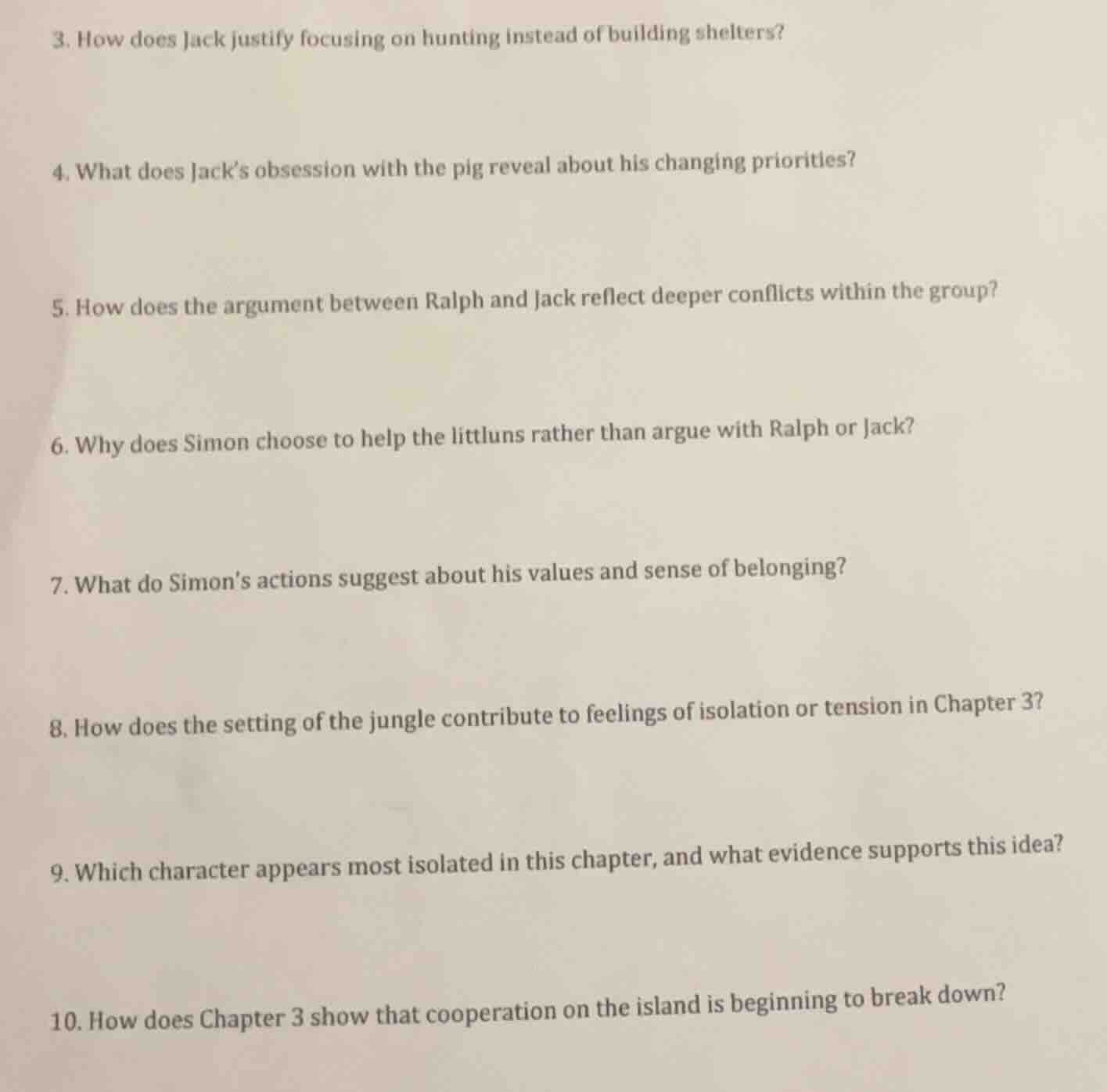
- how does jack justify focusing on hunting instead of building shelters?
- what does jacks obsession with the pig reveal about his changing priorities?
- how does the argument between ralph and jack reflect deeper conflicts within the group?
- why does simon choose to help the littluns rather than argue with ralph or jack?
- what do simons actions suggest about his values and sense of belonging?
- how does the setting of the jungle contribute to feelings of isolation or tension in chapter 3?
- which character appears most isolated in this chapter, and what evidence supports this idea?
- how does chapter 3 show that cooperation on the island is beginning to break down?
Brief Explanations
- Jack frames hunting as critical for providing meat, which he argues is a more immediate, tangible need than shelters. He dismisses shelter-building as less urgent, prioritizing the group's physical sustenance (and his own desire for dominance through hunting success) over long-term safety.
- Jack’s obsession with the pig shows he has abandoned the group’s initial focus on rescue and order (represented by Ralph’s priorities like shelters and the signal fire). His priority now is proving his hunting prowess, gaining power over the other boys, and indulging in primal, violent impulses instead of civilized survival.
- Their argument mirrors a clash between two opposing ideologies: Ralph represents civilized order, prioritizing rescue and group safety; Jack represents primal, authoritarian power, prioritizing immediate gratification and dominance. This reflects a split in the group between those who want to maintain civilization and those who are drawn to chaos and brute strength.
- Simon is inherently empathetic and kind, and he recognizes the littluns are vulnerable and in need of care. He also avoids conflict because he is more attuned to the group's underlying tension and does not wish to escalate it, preferring to act on his moral instincts rather than engage in power struggles.
- Simon’s actions reveal he values compassion, empathy, and care for the vulnerable over power or group politics. His sense of belonging is not tied to aligning with Ralph or Jack’s factions; instead, he feels connected to the most marginalized members of the group and acts on a personal moral code rather than peer pressure.
- The jungle's dense, tangled vegetation creates physical isolation, separating characters from one another. Its unknown, threatening elements (like the unseen pig, dark shadows, and oppressive heat) foster paranoia and tension, making the boys feel vulnerable and disconnected from any sense of safety or civilization.
- Simon appears most isolated. He often wanders alone in the jungle, separate from both Ralph’s shelter-building group and Jack’s hunting party. When Ralph and Jack argue, he withdraws to help the littluns but still remains on the fringes of the main group, and he seeks solitude in the jungle's quiet spaces, showing he does not fit into either emerging faction.
- Chapter 3 shows cooperation breaking down as the boys split into competing groups: Ralph and Simon work on shelters while Jack and his hunters focus solely on hunting, ignoring their agreed-upon responsibilities. Jack openly defies Ralph’s authority, and the boys fail to uphold shared goals like maintaining the signal fire, demonstrating a growing lack of unity and commitment to the group's collective survival.

Snap & solve any problem in the app
Get step-by-step solutions on Sovi AI
Photo-based solutions with guided steps
Explore more problems and detailed explanations
- He argues hunting for meat is a more urgent, tangible need for the group than shelters, framing it as critical sustenance while dismissing shelter-building as less important.
- It reveals he has abandoned civilized priorities (rescue, group safety) for primal desires: proving his hunting skill, gaining power, and indulging violent, instinctual impulses.
- It reflects a clash between civilization (Ralph's focus on order/rescue) and primal authoritarianism (Jack's focus on power/immediate gratification), splitting the group into those favoring order and those drawn to chaos.
- He is inherently empathetic, prioritizes caring for vulnerable littluns, and avoids escalating the group's growing tension, acting on moral instinct over power struggles.
- His actions show he values compassion and care for the vulnerable over power; his belonging is tied to his own moral code, not aligning with Ralph or Jack's factions.
- Its dense, isolating vegetation separates characters, while its unknown, threatening elements (shadows, heat, unseen animals) foster paranoia and tension, eroding a sense of safety.
- Simon is most isolated. Evidence includes him wandering alone in the jungle, staying separate from both Ralph's and Jack's groups, and seeking solitude rather than joining the power struggles between the leaders.
- Cooperation breaks down as boys split into competing groups (Ralph/Simon build shelters, Jack's hunters only hunt), Jack defies Ralph's authority, and the group neglects shared responsibilities like the signal fire, showing growing disunity.