QUESTION IMAGE
Question
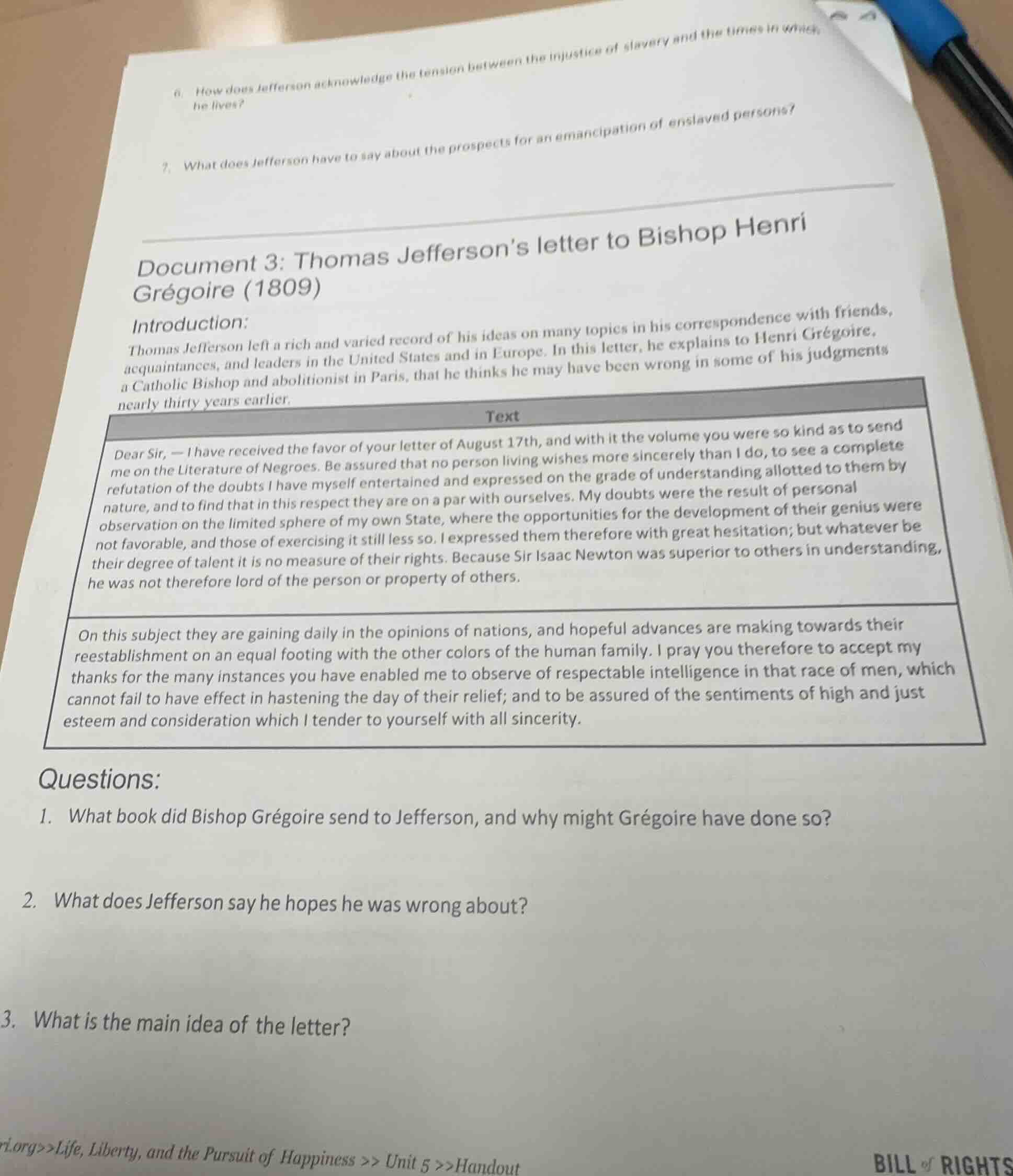
- how does jefferson acknowledge the tension between the injustice of slavery and the times in which he lives?
- what does jefferson have to say about the prospects for an emancipation of enslaved persons?
document 3: thomas jefferson’s letter to bishop henri grégoire (1809)
introduction:
thomas jefferson left a rich and varied record of his ideas on many topics in his correspondence with friends, acquaintances, and leaders in the united states and in europe. in this letter, he explains to henri grégoire, a catholic bishop and abolitionist in paris, that he thinks he may have been wrong in some of his judgments nearly thirty years earlier.
text
dear sir, — i have received the favor of your letter of august 17th, and with it the volume you were so kind as to send me on the literature of negroes. be assured that no person living wishes more sincerely than i do, to see a complete refutation of the doubts i have myself entertained and expressed on the grade of understanding allotted to them by nature, and to find that in this respect they are on a par with ourselves. my doubts were the result of personal observation on the limited sphere of my own state, where the opportunities for the development of their genius were not favorable, and those of exercising it still less so. i expressed them therefore with great hesitation; but whatever be their degree of talent it is no measure of their rights. because sir isaac newton was superior to others in understanding, he was not therefore lord of the person or property of others.
on this subject they are gaining daily in the opinions of nations, and hopeful advances are making towards their reestablishment on an equal footing with the other colors of the human family. i pray you therefore to accept my thanks for the many instances you have enabled me to observe of respectable intelligence in that race of men, which cannot fail to have effect in hastening the day of their relief; and to be assured of the sentiments of high and just esteem and consideration which i tender to yourself with all sincerity.
questions:
- what book did bishop grégoire send to jefferson, and why might grégoire have done so?
- what does jefferson say he hopes he was wrong about?
- what is the main idea of the letter?
Question 1
From the text, "I have received the favor of your letter of August 17th, and with it the volume you were so kind as to send me on the Literature of Negroes." So the book is on the Literature of Negroes. Grégoire, being an abolitionist, likely sent it to influence Jefferson's views on the intellectual capacity of enslaved people (Negroes) to support abolition, as Jefferson had doubts about their understanding grade.
Jefferson states, "Be assured that no person living wishes more sincerely than I do, to see a complete refutation of the doubts I have myself entertained and expressed on the grade of understanding allotted to them by nature, and to find that in this respect they are on a par with ourselves." So he hopes he was wrong about the "grade of understanding" (intellectual capacity) he thought nature allotted to Black people—he hopes they are intellectually equal to white people.
The letter centers on Jefferson’s reflection: he acknowledges his past doubts about Black people’s intellect were based on limited observation, expresses hope those doubts are wrong, notes growing global support for racial equality, and thanks Grégoire for evidence of Black intelligence (to hasten emancipation). The main idea is Jefferson’s evolving view on Black intellectual capacity, support for racial equality’s progress, and gratitude to Grégoire for challenging his prior beliefs.

Snap & solve any problem in the app
Get step-by-step solutions on Sovi AI
Photo-based solutions with guided steps
Explore more problems and detailed explanations
The book Bishop Grégoire sent to Jefferson was a volume on the Literature of Negroes. Grégoire (an abolitionist) likely sent it to challenge Jefferson’s prior doubts about the intellectual capacity of Black people, aiming to persuade Jefferson of their equal intellectual potential to support the abolitionist cause (and advance racial equality).