QUESTION IMAGE
Question
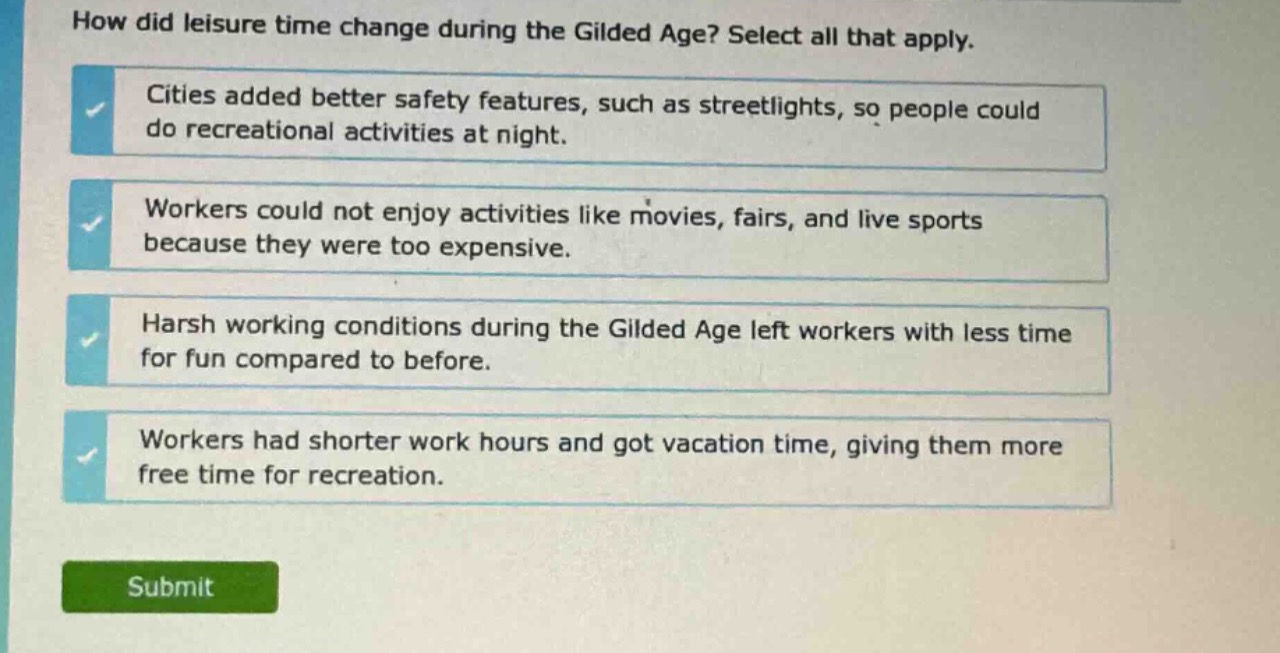
how did leisure time change during the gilded age? select all that apply.
cities added better safety features, such as streetlights, so people could do recreational activities at night.
workers could not enjoy activities like movies, fairs, and live sports because they were too expensive.
harsh working conditions during the gilded age left workers with less time for fun compared to before.
workers had shorter work hours and got vacation time, giving them more free time for recreation.
submit
- For "Cities added better safety features, such as streetlights, so people could do recreational activities at night": During the Gilded Age, urban infrastructure improved, including streetlights, which extended safe recreational time into the night. This is correct.
- For "Workers could not enjoy activities like movies, fairs, and live sports because they were too expensive": Many leisure activities like these were actually affordable or became more accessible (e.g., vaudeville, nickelodeons), so this is incorrect.
- For "Harsh working conditions during the Gilded Age left workers with less time for fun compared to before": The Gilded Age had long work hours, dangerous conditions, and little leisure time for many workers, so this is correct.
- For "Workers had shorter work hours and got vacation time, giving them more free time for recreation": By the late Gilded Age and into the Progressive Era, some workers (especially in skilled trades or with labor union gains) saw reduced hours and vacation, but for most unskilled workers, harsh conditions persisted. However, the trend toward shorter hours (from 10 - 12 hour days to 8 - 10 in some cases) and vacation for some did start, so this can be correct in the context of changing leisure over time (though unevenly). Wait, no—actually, the first, third, and let's re - evaluate:
Wait, the correct ones should be:
- "Cities added better safety features, such as streetlights, so people could do recreational activities at night": Correct, as urban development supported night leisure.
- "Harsh working conditions during the Gilded Age left workers with less time for fun compared to before": Correct, as long hours (often 10 - 12 hours a day, 6 days a week) limited leisure.
- "Workers had shorter work hours and got vacation time, giving them more free time for recreation": Over time, as labor movements progressed, some workers gained shorter hours (toward 8 - hour day movements) and vacation, so this is a correct trend in the change of leisure (even if not universal).
The option "Workers could not enjoy activities like movies, fairs, and live sports because they were too expensive" is incorrect because many leisure activities were affordable (e.g., fairs were often free or low - cost, nickelodeons for movies were cheap).
So the correct options are:
A. Cities added better safety features, such as streetlights, so people could do recreational activities at night.
C. Harsh working conditions during the Gilded Age left workers with less time for fun compared to before.
D. Workers had shorter work hours and got vacation time, giving them more free time for recreation.
(Note: The second option is incorrect as explained.)

Snap & solve any problem in the app
Get step-by-step solutions on Sovi AI
Photo-based solutions with guided steps
Explore more problems and detailed explanations
A. Cities added better safety features, such as streetlights, so people could do recreational activities at night.
C. Harsh working conditions during the Gilded Age left workers with less time for fun compared to before.
D. Workers had shorter work hours and got vacation time, giving them more free time for recreation.