QUESTION IMAGE
Question
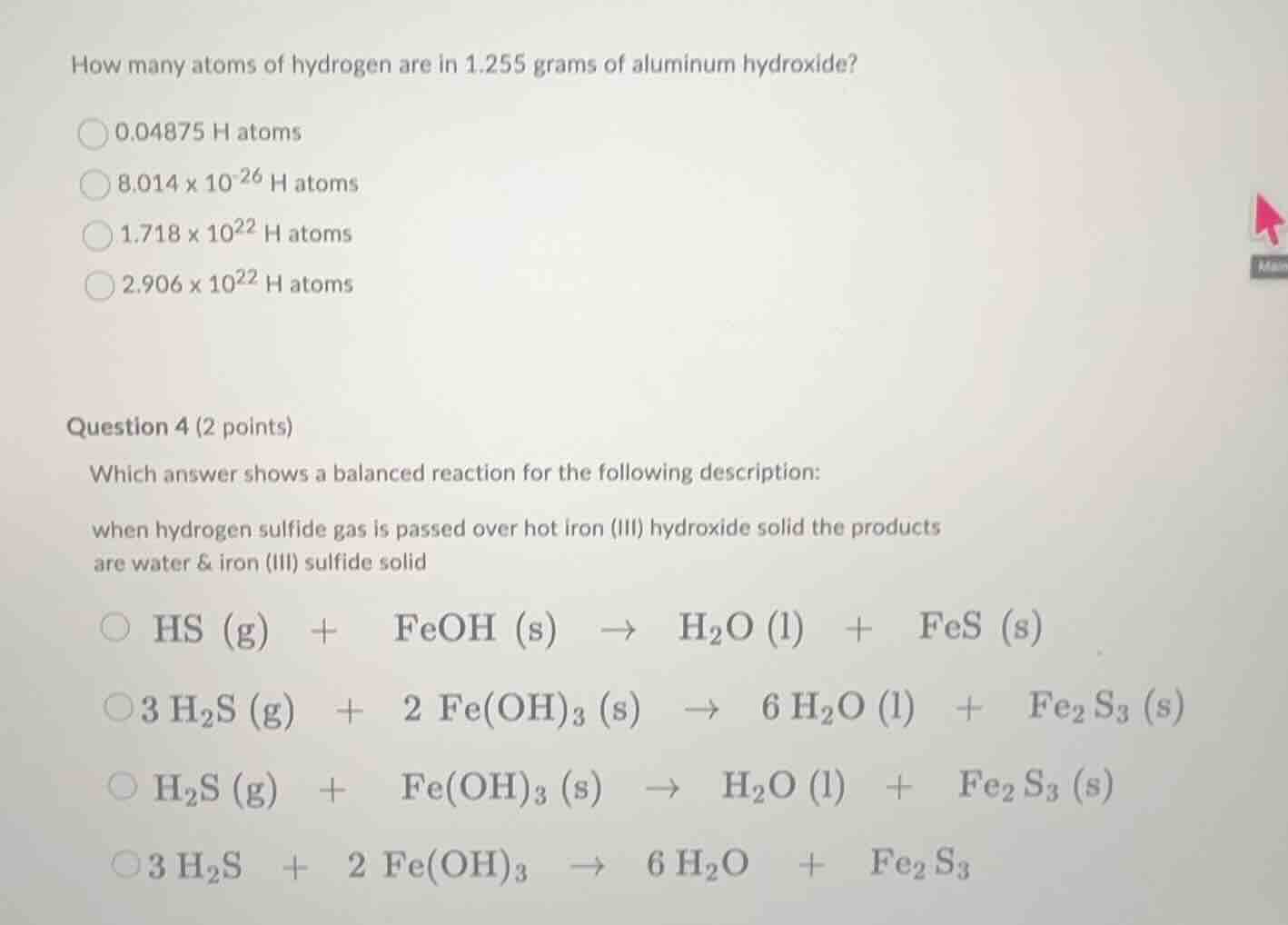
how many atoms of hydrogen are in 1.255 grams of aluminum hydroxide?
0.04875 h atoms
8.014 x 10⁻²⁶ h atoms
1.718 x 10²² h atoms
2.906 x 10²² h atoms
question 4 (2 points)
which answer shows a balanced reaction for the following description:
when hydrogen sulfide gas is passed over hot iron (iii) hydroxide solid the products
are water & iron (iii) sulfide solid
hs (g) + feoh (s) → h₂o (l) + fes (s)
3 h₂s (g) + 2 fe(oh)₃ (s) → 6 h₂o (l) + fe₂s₃ (s)
h₂s (g) + fe(oh)₃ (s) → h₂o (l) + fe₂s₃ (s)
3 h₂s + 2 fe(oh)₃ → 6 h₂o + fe₂s₃
First Question (Hydrogen Atoms in Aluminum Hydroxide)
Step1: Determine formula and molar mass
Aluminum hydroxide is $\ce{Al(OH)3}$. Molar mass: $Al$ (26.98) + 3×($O$ (16.00) + $H$ (1.008)) = 26.98 + 3×(17.008) = 78.004 g/mol.
Step2: Calculate moles of $\ce{Al(OH)3}$
Moles = mass / molar mass = 1.255 g / 78.004 g/mol ≈ 0.01609 mol.
Step3: Moles of H atoms
In $\ce{Al(OH)3}$, 3 H per formula unit. So moles of H = 3 × 0.01609 mol ≈ 0.04827 mol.
Step4: Atoms of H (Avogadro's number: $6.022×10^{23}$)
Atoms = moles × $6.022×10^{23}$ = 0.04827 mol × $6.022×10^{23}$ ≈ $2.906×10^{22}$? Wait, no—wait, 0.01609 mol $\ce{Al(OH)3}$ × 3 H = 0.04827 mol H. 0.04827 × $6.022×10^{23}$ ≈ 2.906×10²²? Wait, no, wait: 0.01609 × 3 = 0.04827. 0.04827 × 6.022e23 ≈ 2.906e22? Wait, but let's recalculate: 1.255 / 78.004 = 0.01609. 0.01609 × 3 = 0.04827. 0.04827 × 6.022e23 = 0.04827×6.022e23 ≈ 2.906e22? Wait, but the option is 2.906×10²²? Wait, no, wait: 78.004 g/mol. 1.255 / 78.004 = 0.01609 mol. 0.01609 × 3 = 0.04827 mol H. 0.04827 × 6.022e23 = 2.906e22? Wait, but let's check again. Wait, 78.004 g/mol. 1.255 g / 78.004 g/mol = 0.01609 mol. 3 H per molecule: 0.01609 × 3 = 0.04827 mol H. 0.04827 × 6.022×10²³ = 2.906×10²². Wait, but the option is 2.906×10²²? Wait, no, the options: 0.04875 (no, moles), 8.014e-26 (too small), 1.718e22 (no), 2.906e22 (yes). Wait, maybe my calculation: 1.255 / 78.004 = 0.01609. 0.01609 × 3 = 0.04827. 0.04827 × 6.022e23 = 2.906e22. So the answer is 2.906×10²² H atoms.
- Identify reactants: $\ce{H2S}$ (hydrogen sulfide gas) and $\ce{Fe(OH)3}$ (iron(III) hydroxide solid). Products: $\ce{H2O}$ (water) and $\ce{Fe2S3}$ (iron(III) sulfide solid).
- Check each option:
- First option: Formulas wrong (HS, FeOH incorrect).
- Second option: $3\ce{H2S(g)} + 2\ce{Fe(OH)3(s)} → 6\ce{H2O(l)} + \ce{Fe2S3(s)}$. Check atoms: S: 3 (left) = 3 (right, in $\ce{Fe2S3}$? Wait, $\ce{Fe2S3}$ has 3 S. 3 $\ce{H2S}$ has 3 S. Fe: 2 (left, 2 $\ce{Fe(OH)3}$) = 2 (right, $\ce{Fe2S3}$). O: 2×3=6 (left, 2 $\ce{Fe(OH)3}$) = 6 (right, 6 $\ce{H2O}$). H: 3×2=6 (left, 3 $\ce{H2S}$) + 2×3=6 (left, 2 $\ce{Fe(OH)3}$) = 12? Wait, no: 3 $\ce{H2S}$ has 6 H, 2 $\ce{Fe(OH)3}$ has 6 H (2×3×1), total 12 H. Products: 6 $\ce{H2O}$ has 12 H. Correct.
- Third option: Unbalanced (Fe: 1 left, 2 right; S: 1 left, 3 right; H: 2 + 3 = 5 left, 2 right).
- Fourth option: Missing states (but formulas are correct, but states are important, but the second option has correct formulas and states, and is balanced. Wait, the fourth option: 3 $\ce{H2S}$ + 2 $\ce{Fe(OH)3}$ → 6 $\ce{H2O}$ + $\ce{Fe2S3}$. It's balanced, but missing states. The second option includes states (g, s, l, s) and is balanced. So the second option is correct.

Snap & solve any problem in the app
Get step-by-step solutions on Sovi AI
Photo-based solutions with guided steps
Explore more problems and detailed explanations
2.906 × 10²² H atoms (the last option)