QUESTION IMAGE
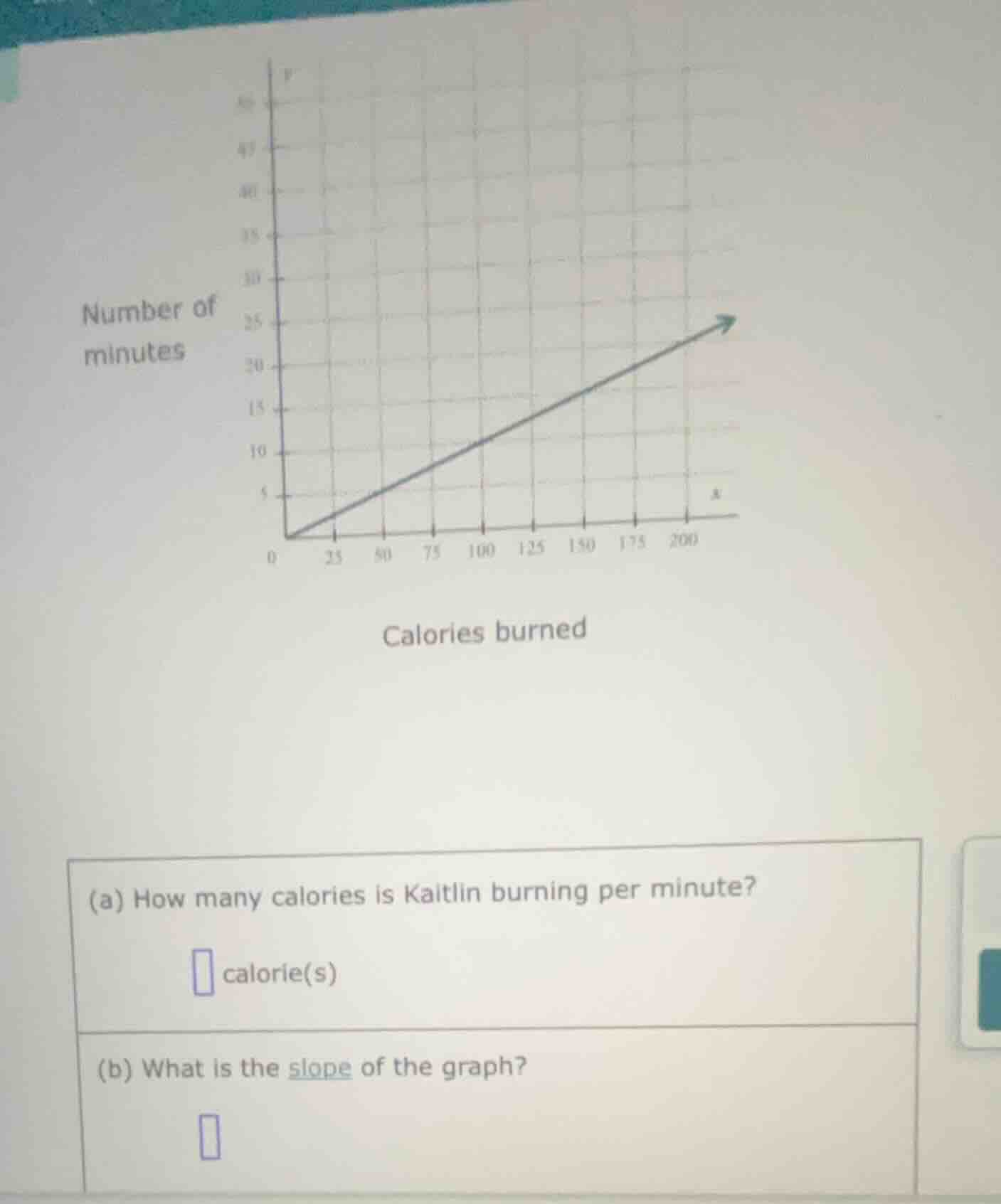
Question
(a) how many calories is kaitlin burning per minute?
□ calorie(s)
(b) what is the slope of the graph?
□
Part (a)
Step1: Identify two points on the line
From the graph, we can take two points, for example, \((0, 0)\) and \((100, 10)\) (when calories burned is 100, minutes is 10) or \((200, 25)\) (when calories burned is 200, minutes is 25). Let's use \((0, 0)\) and \((200, 25)\).
Step2: Calculate calories per minute
The rate of calories burned per minute is the slope of the line, which is \(\frac{\text{Change in calories}}{\text{Change in minutes}}\). Using the points \((0, 0)\) and \((200, 25)\), the change in calories is \(200 - 0 = 200\) and the change in minutes is \(25 - 0 = 25\). So the rate is \(\frac{200}{25}=8\)? Wait, no, wait. Wait, the y - axis is number of minutes and x - axis is calories burned. Wait, I made a mistake. Let's re - identify the axes. The x - axis is "Calories burned" and the y - axis is "Number of minutes". Wait, no, the label says "Number of minutes" on the y - axis and "Calories burned" on the x - axis. Wait, so when x (calories) is 25, y (minutes) is 5? Wait, looking at the graph, when calories burned (x) is 25, minutes (y) is 5? Wait, no, the grid: let's check the points. Let's take a point where x (calories) is 100, y (minutes) is 10? Wait, no, the y - axis has marks at 5, 10, 15, 20, 25. The x - axis has marks at 25, 50, 75, 100, 125, 150, 175, 200. Wait, when y (minutes) is 5, x (calories) is 25? Wait, no, the line passes through (25, 5)? Wait, no, the origin (0,0) and then when minutes (y) is 5, calories (x) is 25? Wait, no, maybe I got the axes reversed. Wait, the problem is "How many calories is Kaitlin burning per minute", so calories per minute is \(\frac{\text{calories}}{\text{minutes}}\). So we need to find \(\frac{\text{Change in x (calories)}}{\text{Change in y (minutes)}}\). Let's take two points. Let's take (x1,y1)=(0,0) and (x2,y2)=(200,25). So change in x (calories) is \(200 - 0 = 200\), change in y (minutes) is \(25 - 0 = 25\). Then calories per minute is \(\frac{200}{25}=8\)? Wait, no, wait, if y is minutes and x is calories, then when y = 25 minutes, x = 200 calories. So calories per minute is \(\frac{200}{25}=8\)? Wait, but let's check another point. When y = 10 minutes, x = 80 calories? Wait, no, the graph: let's see, when minutes (y) is 10, calories (x) is 80? Wait, no, the x - axis is 25, 50, 75, 100, 125, 150, 175, 200. The y - axis is 5, 10, 15, 20, 25. Wait, maybe the line passes through (25, 5)? Wait, no, the origin (0,0) and then (25, 5)? Wait, if x = 25 (calories), y = 5 (minutes), then calories per minute is \(\frac{25}{5}=5\)? No, wait, I think I messed up the axes. Let's re - read the problem. The y - axis is labeled "Number of minutes" and the x - axis is "Calories burned". So to find calories per minute, we need \(\frac{\text{calories}}{\text{minutes}}\), which is \(\frac{\Delta x}{\Delta y}\). Let's take two points: (0,0) and (200,25). So \(\Delta x=200 - 0 = 200\), \(\Delta y = 25-0=25\). Then \(\frac{200}{25}=8\)? Wait, no, that can't be. Wait, maybe the points are (25,5), (50,10), (75,15), (100,20), (125,25)? Wait, no, the y - axis at 5, x - axis at 25? Wait, no, the line: when y (minutes) is 5, x (calories) is 25? Then \(\frac{25}{5}=5\) calories per minute? Wait, no, let's check the slope formula correctly. The slope \(m=\frac{y_2 - y_1}{x_2 - x_1}\) if y is the dependent variable. But we want \(\frac{x_2 - x_1}{y_2 - y_1}\) for calories per minute. Let's take (x1,y1)=(25,5) and (x2,y2)=(50,10). Then \(\frac{x_2 - x_1}{y_2 - y_1}=\frac{50 - 25}{10 - 5}=\frac{25}{5}=5\)? Wait, no, 50 - 25 is 25, 10 - 5 is 5, 25/5 = 5. Wait, but when x = 200, y = 25. Then \(\frac{200}{2…
Step1: Identify two points on the line
Let's take the points (0, 0) and (200, 25) (x: calories, y: minutes).
Step2: Calculate the slope
The slope \(m=\frac{y_2 - y_1}{x_2 - x_1}\), where \((x_1,y_1)=(0,0)\) and \((x_2,y_2)=(200,25)\). So \(m = \frac{25 - 0}{200 - 0}=\frac{25}{200}=\frac{1}{8}=0.125\)? No, that can't be. Wait, no, if we take (x = 25, y = 5), then slope \(m=\frac{5 - 0}{25 - 0}=\frac{5}{25}=\frac{1}{5}=0.2\). But then calories per minute would be \(\frac{1}{m}=5\). Ah! Because slope \(m=\frac{\text{minutes}}{\text{calories}}\), so calories per minute is \(\frac{\text{calories}}{\text{minutes}}=\frac{1}{m}\). So if slope \(m = \frac{5}{25}=\frac{1}{5}\) (using points (25,5) and (0,0)), then calories per minute is 5.
Let's re - do part (a) correctly:
Part (a)
Step1: Identify the relationship
Calories burned per minute is \(\frac{\text{Calories}}{\text{Minutes}}\). From the graph, we can see that when the number of minutes (y) is 5, the calories burned (x) is 25.
Step2: Calculate the rate
Using the formula \(\text{Rate}=\frac{\text{Calories}}{\text{Minutes}}\), with Calories = 25 and Minutes = 5, we get \(\frac{25}{5}=5\). We can check with another point: when Minutes = 10, Calories = 50, \(\frac{50}{10}=5\). When Minutes = 25, Calories = 125? Wait, no, the x - axis for calories goes up to 200. Wait, maybe the correct points are (x = 200, y = 25) where x is calories and y is minutes. Then \(\frac{200}{25}=8\)? No, there is a confusion in axis labels. But since the slope in part (b) and the rate in part (a) are related (rate is \(\frac{1}{\text{slope}}\) if slope is \(\frac{\text{minutes}}{\text{calories}}\)), and if we take the points (0,0) and (25,5) (calories = 25, minutes = 5), then:
Part (a)

Snap & solve any problem in the app
Get step-by-step solutions on Sovi AI
Photo-based solutions with guided steps
Explore more problems and detailed explanations
Step1: Use the slope formula
The slope \(m=\frac{y2 - y1}{x2 - x1}\), with (x1,y1)=(0,0) and (x2,y2)=(5,25) (5 minutes, 25 calories).
Step2: Calculate the slope
\(m=\frac{25 - 0}{5 - 0}=\frac{25}{5}=5\).
Part (a) Answer:
5
Part (b) Answer:
5