QUESTION IMAGE
Question
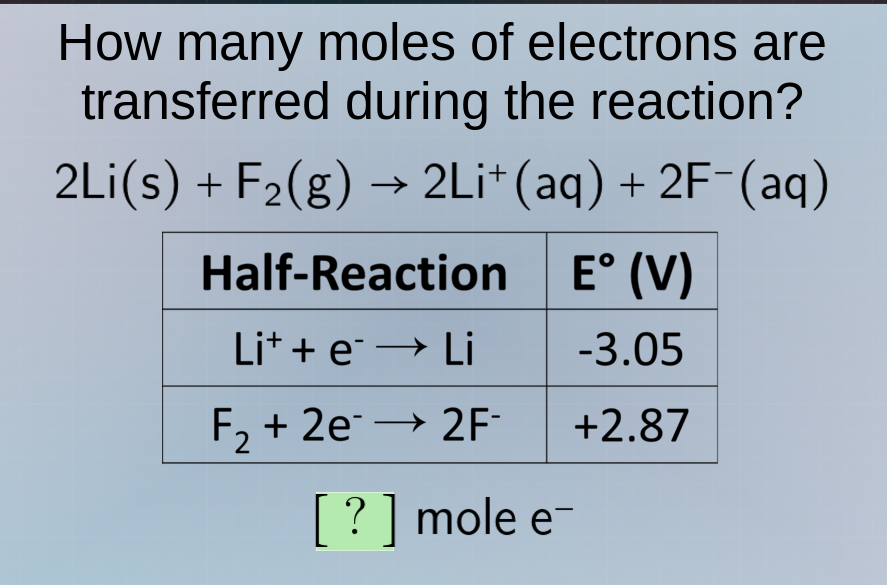
how many moles of electrons are transferred during the reaction?
2li(s) + f₂(g) → 2li⁺(aq) + 2f⁻(aq)
half-reaction | e° (v)
li⁺ + e⁻ → li | -3.05
f₂ + 2e⁻ → 2f⁻ | +2.87
? mole e⁻
Step1: Analyze oxidation half - reaction
For the reaction of Li: The oxidation half - reaction is the reverse of \(Li^{+}+e^{-}
ightarrow Li\). So the oxidation half - reaction is \(Li
ightarrow Li^{+}+e^{-}\). From the balanced equation \(2Li(s)+F_{2}(g)
ightarrow2Li^{+}(aq)+2F^{-}(aq)\), for 2 moles of Li, the number of electrons released from oxidation: Each Li atom loses 1 electron, so 2 moles of Li will lose \(2\times1 = 2\) moles of electrons.
Step2: Analyze reduction half - reaction
For the reaction of \(F_{2}\): The reduction half - reaction is \(F_{2}+2e^{-}
ightarrow2F^{-}\). In the given overall reaction, 1 mole of \(F_{2}\) is reacting. According to this half - reaction, 1 mole of \(F_{2}\) gains 2 moles of electrons.
Step3: Confirm electron transfer
In a redox reaction, the number of moles of electrons lost in oxidation is equal to the number of moles of electrons gained in reduction. From the oxidation of 2 moles of Li (losing 2 moles of electrons) and the reduction of 1 mole of \(F_{2}\) (gaining 2 moles of electrons), we can see that the number of moles of electrons transferred is 2.

Snap & solve any problem in the app
Get step-by-step solutions on Sovi AI
Photo-based solutions with guided steps
Explore more problems and detailed explanations
2