QUESTION IMAGE
Question
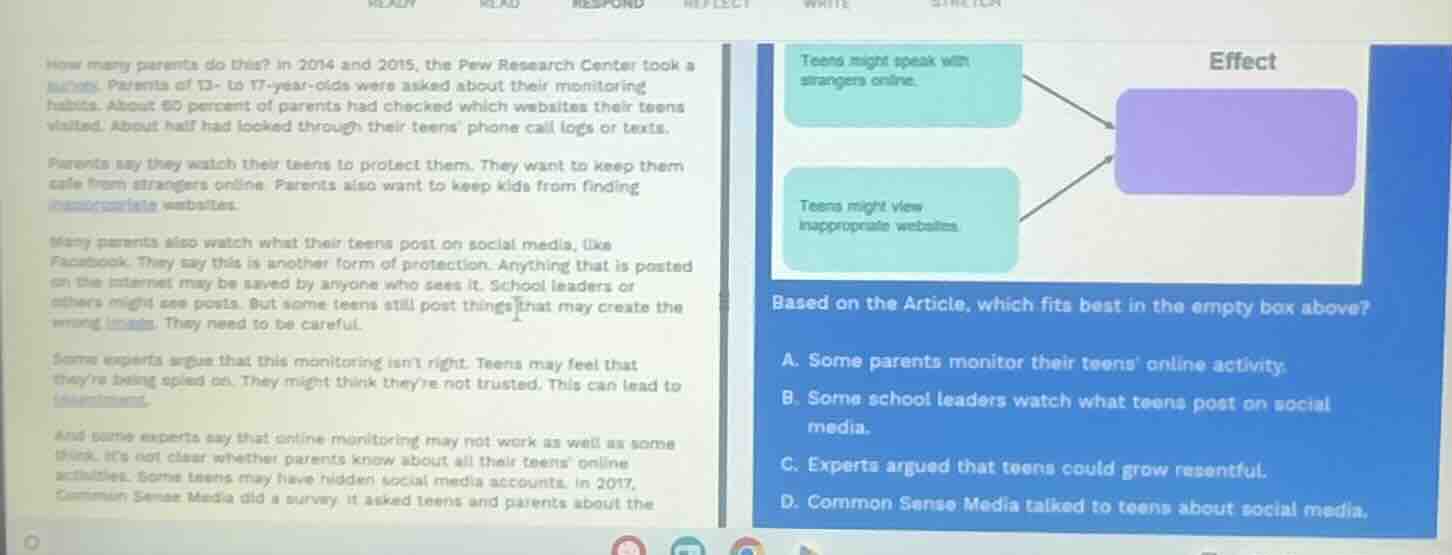
how many parents do this? in 2014 and 2015, the pew research center took a survey. parents of 13- to 17-year-olds were asked about their monitoring habits. about 60 percent of parents had checked which websites their teens visited. about half had looked through their teens phone call logs or texts.
parents say they watch their teens to protect them. they want to keep them safe from strangers online. parents also want to keep kids from finding inappropriate websites.
many parents also watch what their teens post on social media, like facebook. they say this is another form of protection. anything that is posted on the internet may be saved by anyone who sees it. school leaders or others might see posts. but some teens still post things that may create the wrong image. they need to be careful.
some experts argue that this monitoring isnt right. teens may feel that theyre being spied on. they might think theyre not trusted. this can lead to resentment.
and some experts say that online monitoring may not work as well as some think. its not clear whether parents know about all their teens online activities. some teens may have hidden social media accounts. in 2017, common sense media did a survey. it asked teens and parents about the
effect
teens might speak with strangers online.
teens might view inappropriate websites.
based on the article, which fits best in the empty box above?
a. some parents monitor their teens online activity.
b. some school leaders watch what teens post on social media.
c. experts argued that teens could grow resentful.
d. common sense media talked to teens about social media.
The empty box is the "Effect" that results from the two listed risks (teens talking to online strangers, viewing inappropriate websites). We analyze each option:
- Option A describes the parent monitoring action, not an effect of the risks.
- Option B focuses on school leaders, which is unrelated to the two listed teen behaviors and their effect.
- Option D refers to a survey, which does not fit as an effect of the teen behaviors.
- Option C aligns: the risks (strangers, inappropriate sites) lead parents to monitor, which can make teens feel spied on/untrusted, resulting in resentment, which is the effect linking the causes to the outcome.

Snap & solve any problem in the app
Get step-by-step solutions on Sovi AI
Photo-based solutions with guided steps
Explore more problems and detailed explanations
C. Experts argued that teens could grow resentful.