QUESTION IMAGE
Question
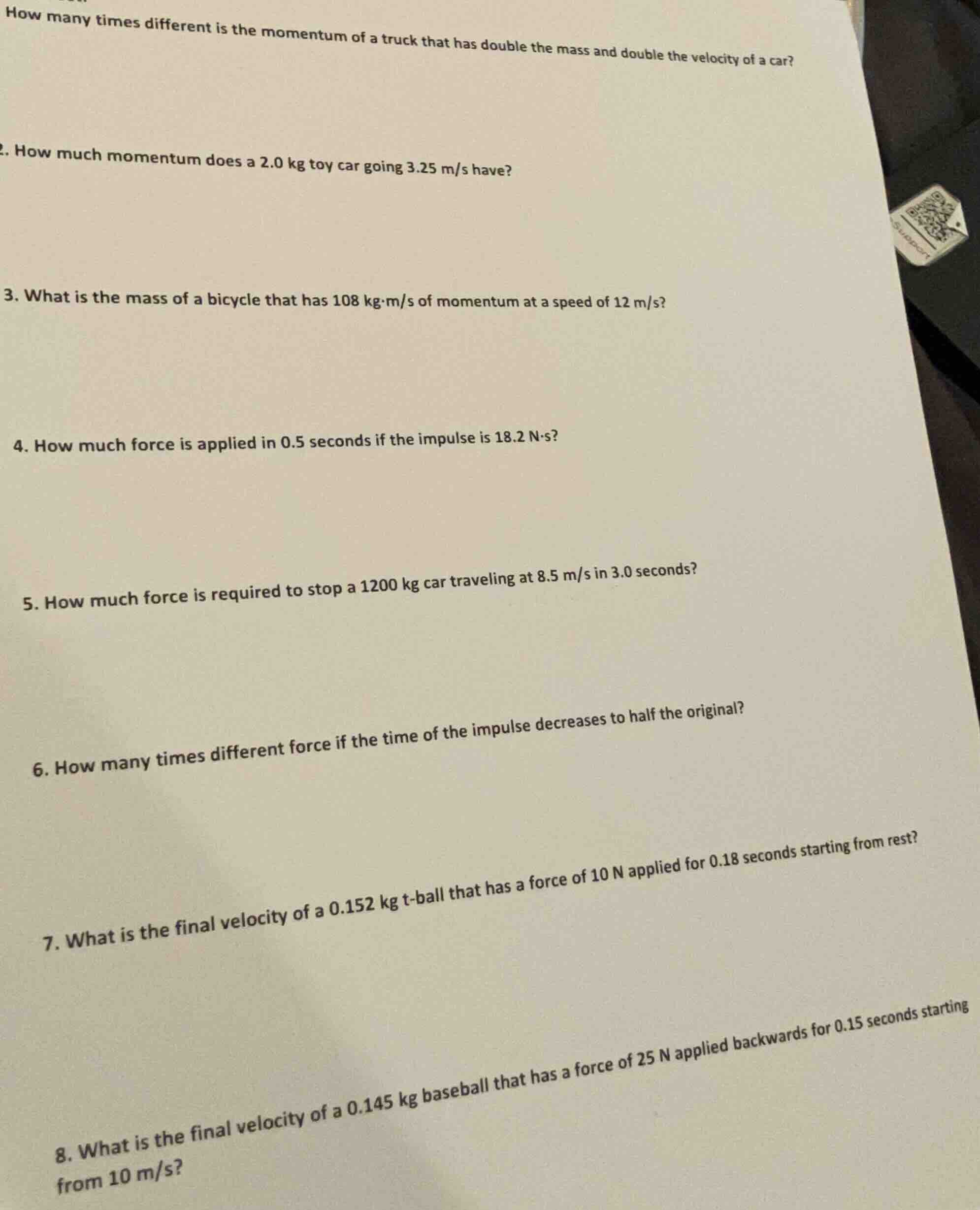
how many times different is the momentum of a truck that has double the mass and double the velocity of a car?
- how much momentum does a 2.0 kg toy car going 3.25 m/s have?
- what is the mass of a bicycle that has 108 kg·m/s of momentum at a speed of 12 m/s?
- how much force is applied in 0.5 seconds if the impulse is 18.2 n·s?
- how much force is required to stop a 1200 kg car traveling at 8.5 m/s in 3.0 seconds?
- how many times different force if the time of the impulse decreases to half the original?
- what is the final velocity of a 0.152 kg t - ball that has a force of 10 n applied for 0.18 seconds starting from rest?
- what is the final velocity of a 0.145 kg baseball that has a force of 25 n applied backwards for 0.15 seconds starting from 10 m/s?
Problem 1:
Step1: Define car momentum
Let car mass = $m$, velocity = $v$. Momentum $p_c = m \cdot v$
Step2: Define truck momentum
Truck mass = $2m$, velocity = $2v$. Momentum $p_t = 2m \cdot 2v = 4mv$
Step3: Find ratio
$\frac{p_t}{p_c} = \frac{4mv}{mv} = 4$
Problem 2:
Step1: Use momentum formula
Momentum $p = m \cdot v$, $m=2.0\ \text{kg}$, $v=3.25\ \text{m/s}$
Step2: Calculate value
$p = 2.0 \times 3.25 = 6.5\ \text{kg·m/s}$
Problem 3:
Step1: Rearrange momentum formula
$m = \frac{p}{v}$, $p=108\ \text{kg·m/s}$, $v=12\ \text{m/s}$
Step2: Calculate mass
$m = \frac{108}{12} = 9\ \text{kg}$
Problem 4:
Step1: Rearrange impulse formula
Impulse $J = F \cdot t \implies F = \frac{J}{t}$, $J=18.2\ \text{N·s}$, $t=0.5\ \text{s}$
Step2: Calculate force
$F = \frac{18.2}{0.5} = 36.4\ \text{N}$
Problem 5:
Step1: Find change in momentum
$\Delta p = m \cdot \Delta v$, $m=1200\ \text{kg}$, $\Delta v = 0 - 8.5 = -8.5\ \text{m/s}$
$\Delta p = 1200 \times (-8.5) = -10200\ \text{kg·m/s}$
Step2: Calculate force
$F = \frac{\Delta p}{t} = \frac{-10200}{3.0} = -3400\ \text{N}$ (negative = opposite direction)
Problem 6:
Step1: Relate force and time
Impulse $J=F_1t_1=F_2t_2$, $t_2=\frac{1}{2}t_1$
Step2: Solve for force ratio
$F_2 = \frac{F_1t_1}{t_2} = \frac{F_1t_1}{0.5t_1} = 2F_1$
Problem 7:
Step1: Relate impulse to momentum
$J=F \cdot t = m \cdot \Delta v$, $F=10\ \text{N}$, $t=0.18\ \text{s}$, $m=0.152\ \text{kg}$, initial $v_0=0$
Step2: Solve for final velocity
$v_f = \frac{F \cdot t}{m} = \frac{10 \times 0.18}{0.152} \approx 11.84\ \text{m/s}$
Problem 8:
Step1: Calculate impulse
$J=F \cdot t = -25 \times 0.15 = -3.75\ \text{N·s}$ (negative = backward)
Step2: Find change in velocity
$\Delta v = \frac{J}{m} = \frac{-3.75}{0.145} \approx -25.86\ \text{m/s}$
Step3: Calculate final velocity
$v_f = v_0 + \Delta v = 10 + (-25.86) = -15.86\ \text{m/s}$ (negative = backward direction)

Snap & solve any problem in the app
Get step-by-step solutions on Sovi AI
Photo-based solutions with guided steps
Explore more problems and detailed explanations
- The truck's momentum is 4 times the car's.
- $6.5\ \text{kg·m/s}$
- $9\ \text{kg}$
- $36.4\ \text{N}$
- $-3400\ \text{N}$ (or 3400 N opposite to motion)
- The force is 2 times the original.
- $\approx 11.8\ \text{m/s}$ (rounded)
- $\approx -15.9\ \text{m/s}$ (rounded, negative indicates backward direction)