QUESTION IMAGE
Question
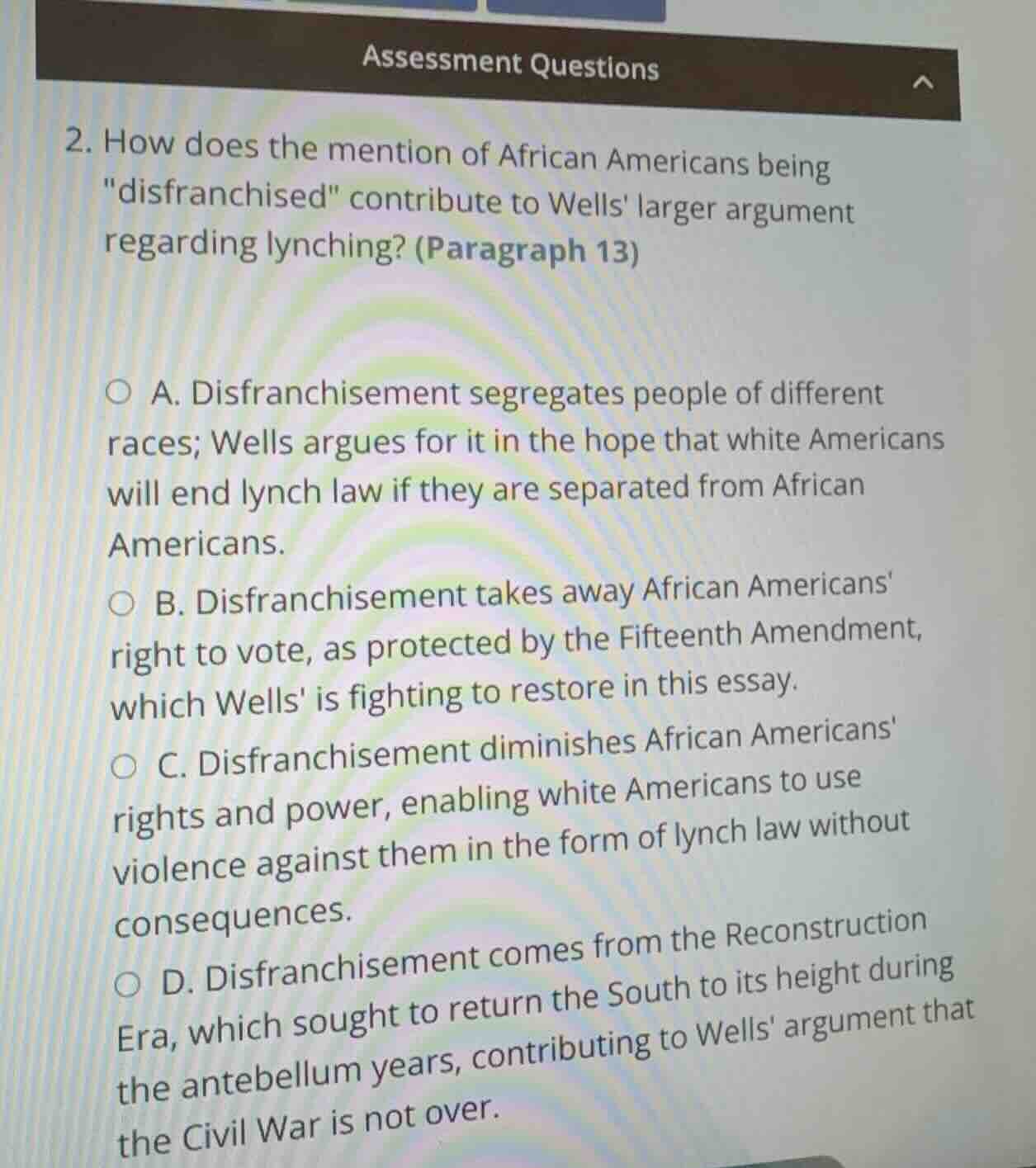
- how does the mention of african americans being \disfranchised\ contribute to wells larger argument regarding lynching? (paragraph 13)
a. disfranchisement segregates people of different races; wells argues for it in the hope that white americans will end lynch law if they are separated from african americans.
b. disfranchisement takes away african americans right to vote, as protected by the fifteenth amendment, which wells is fighting to restore in this essay.
c. disfranchisement diminishes african americans rights and power, enabling white americans to use violence against them in the form of lynch law without consequences.
d. disfranchisement comes from the reconstruction era, which sought to return the south to its height during the antebellum years, contributing to wells argument that the civil war is not over.
To solve this, we analyze each option:
- Option A: Wells was against disenfranchisement and didn't argue for segregation to end lynching. Eliminate A.
- Option B: The question is about how disenfranchisement relates to lynching, not about restoring voting rights. Eliminate B.
- Option C: Disenfranchisement reduces African Americans' rights/power, making them vulnerable to lynching without legal consequences. This connects disenfranchisement to lynching, supporting Wells' argument.
- Option D: The focus is on lynching, not the Civil War's end. Eliminate D.

Snap & solve any problem in the app
Get step-by-step solutions on Sovi AI
Photo-based solutions with guided steps
Explore more problems and detailed explanations
C. Disfranchisement diminishes African Americans' rights and power, enabling white Americans to use violence against them in the form of lynch law without consequences.