QUESTION IMAGE
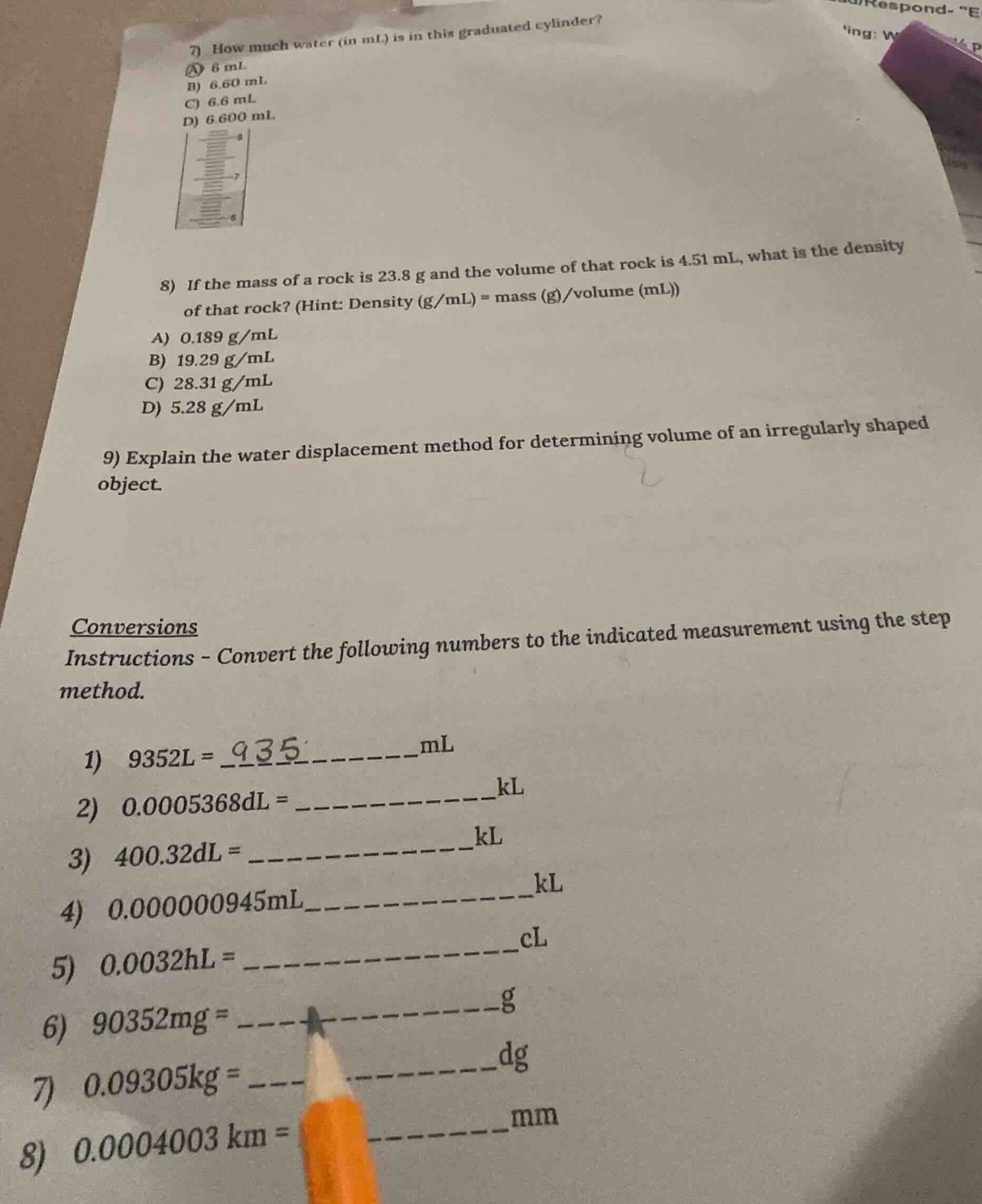
Question
- how much water (in ml) is in this graduated cylinder?
a) 6 ml
b) 6.60 ml
c) 6.6 ml
d) 6.600 ml
image of graduated cylinder
- if the mass of a rock is 23.8 g and the volume of that rock is 4.51 ml, what is the density of that rock? (hint: density (g/ml) = mass (g)/volume (ml))
a) 0.189 g/ml
b) 19.29 g/ml
c) 28.31 g/ml
d) 5.28 g/ml
- explain the water displacement method for determining volume of an irregularly shaped object.
conversions
instructions - convert the following numbers to the indicated measurement using the step method.
- 9352l = ______ml
- 0.0005368dl = ______kl
- 400.32dl = ______kl
- 0.000000945ml = ______kl
- 0.0032hl = ______cl
- 90352mg = ______g
- 0.09305kg = ______dg
- 0.0004003 km = ______mm
Question 7
Step1: Analyze graduated cylinder reading
Graduated cylinder readings: The scale has major marks (e.g., 6, 7, 8 mL) and minor divisions. Assume between 6 and 7, there are 10 minor divisions (so each is 0.1 mL). The meniscus is at 6.6 mL (the trailing zero in 6.60 or 6.600 is not needed here as the precision is to the tenths place if each minor division is 0.1 mL; but if the cylinder has two decimal places, but the options: 6.6 mL is appropriate (6.60 would imply hundredths, but if the scale is 0.1 mL per division, 6.6 is correct). Wait, let's check: if the cylinder has marks at 6, 6.1, 6.2,...6.6...7, then the reading is 6.6 mL (option C). Option B (6.60) would be if there are 100 divisions between 6 and 7 (0.01 mL each), but usually, for a cylinder, the precision is to the tenths or hundredths. But the options: 6 mL is too low, 6.600 is too many zeros. So the correct reading is 6.6 mL.
Step1: Recall density formula
Density $(
ho) = \frac{\text{mass (g)}}{\text{volume (mL)}}$
Step2: Plug in values
Mass = 23.8 g, Volume = 4.51 mL. So $
ho = \frac{23.8}{4.51} \approx 5.28$ g/mL (calculation: 23.8 ÷ 4.51 ≈ 5.277, which rounds to 5.28)
The water displacement method: 1. Fill a graduated cylinder with a known volume of water (V₁). 2. Submerge the irregular object completely in the water (without splashing or air bubbles). 3. Measure the new water volume (V₂). 4. The volume of the object is $V_2 - V_1$, as the object displaces a volume of water equal to its own volume (Archimedes' principle).

Snap & solve any problem in the app
Get step-by-step solutions on Sovi AI
Photo-based solutions with guided steps
Explore more problems and detailed explanations
C) 6.6 mL