QUESTION IMAGE
Question
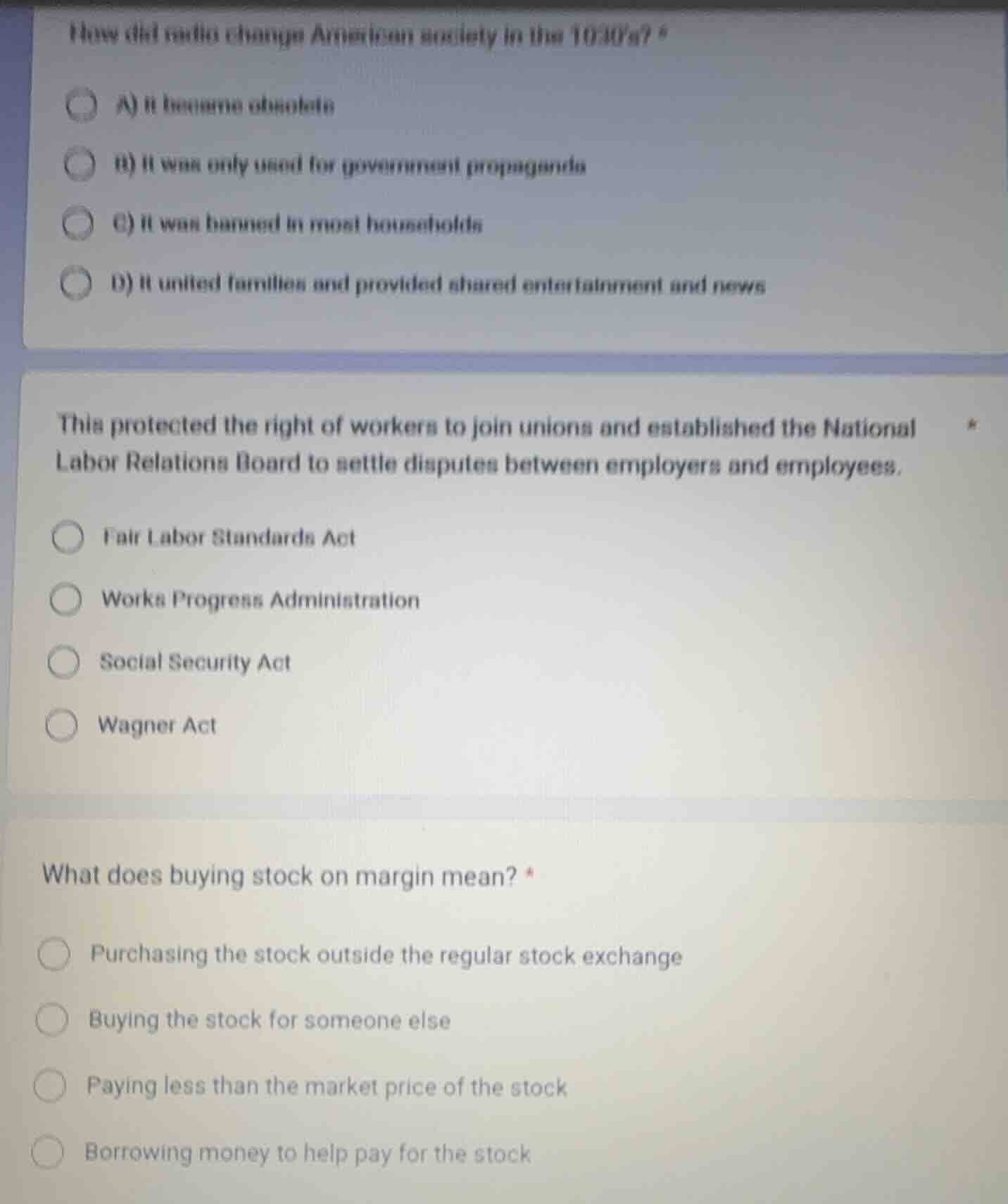
how did radio change american society in the 1930s?
a) it became obsolete
b) it was only used for government propaganda
c) it was banned in most households
d) it united families and provided shared entertainment and news
this protected the right of workers to join unions and established the national labor relations board to settle disputes between employers and employees.
fair labor standards act
works progress administration
social security act
wagner act
what does buying stock on margin mean?
purchasing the stock outside the regular stock exchange
buying the stock for someone else
paying less than the market price of the stock
borrowing money to help pay for the stock
First Question (How did radio change American society in the 1930’s?):
- Option A: Radio was popular in the 1930s, not obsolete. Eliminate A.
- Option B: Radio was used for entertainment, news, etc., not just government propaganda. Eliminate B.
- Option C: Radio was widely used in households, not banned. Eliminate C.
- Option D: Radio brought families together with shared entertainment (like shows) and news, which matches its 1930s impact.
- Fair Labor Standards Act: Focuses on wages, hours, child labor, not union rights/NLRB. Eliminate.
- Works Progress Administration: A New Deal work program, not labor - union - related legislation. Eliminate.
- Social Security Act: Deals with old - age, unemployment insurance, not union rights. Eliminate.
- Wagner Act (National Labor Relations Act): Protected workers' right to unionize and established the NLRB. This matches the description.
- Option A: Buying outside regular exchanges is not margin buying. Eliminate A.
- Option B: Buying for someone else is not margin buying. Eliminate B.
- Option C: Margin buying isn't about paying less than market price. Eliminate C.
- Option D: Buying stock on margin means borrowing money (from a broker) to help pay for the stock, which is the correct definition.

Snap & solve any problem in the app
Get step-by-step solutions on Sovi AI
Photo-based solutions with guided steps
Explore more problems and detailed explanations
D. It united families and provided shared entertainment and news