QUESTION IMAGE
Question
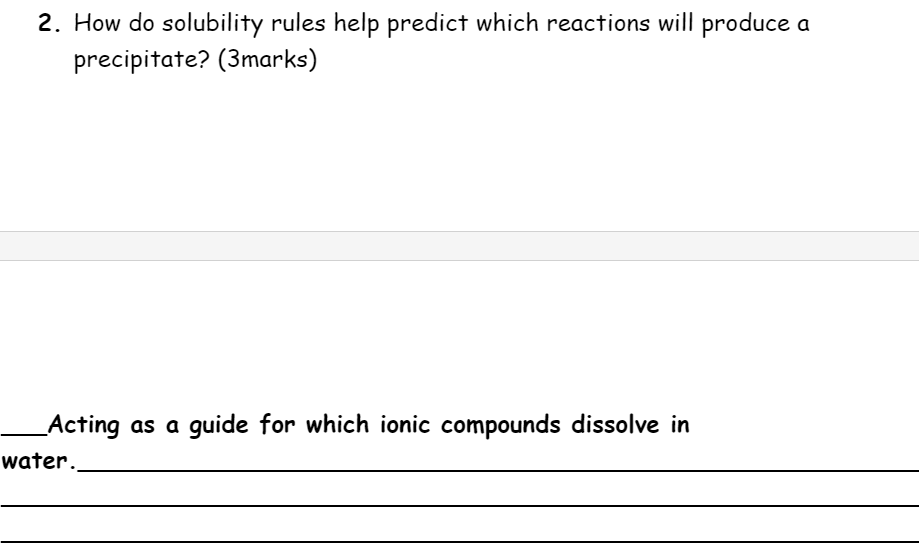
- how do solubility rules help predict which reactions will produce a precipitate? (3marks)
acting as a guide for which ionic compounds dissolve in water.
- First, identify the reactants (ionic compounds) in a reaction.
- Then, apply solubility rules to each product formed from the reaction. If a product is insoluble (as per solubility rules), it will form a precipitate. For example, in a double - displacement reaction \(AB + CD
ightarrow AD+CB\), we check the solubility of \(AD\) and \(CB\). If one of them is insoluble (e.g., most carbonates are insoluble except those of Group 1 metals and ammonium), that compound will precipitate out of the solution. The initial statement about solubility rules being a guide for which ionic compounds dissolve in water is part of this process, as we use the knowledge of what dissolves (and what doesn't) to find the insoluble product (precipitate).

Snap & solve any problem in the app
Get step-by-step solutions on Sovi AI
Photo-based solutions with guided steps
Explore more problems and detailed explanations
Solubility rules help in predicting precipitation reactions as follows:
- For a reaction (usually double - displacement) involving ionic compounds, determine the possible products.
- Use solubility rules to check the solubility of each product. If a product is insoluble (e.g., most sulfides, hydroxides of transition metals are insoluble), it will form a precipitate. The rules tell us which ionic compounds dissolve in water (soluble) and which do not (insoluble); the insoluble ones precipitate. For example, in the reaction \(AgNO_3(aq)+NaCl(aq)
ightarrow AgCl(s)+NaNO_3(aq)\), using solubility rules (chlorides of \(Ag^+\) are insoluble), we predict that \(AgCl\) precipitates.