QUESTION IMAGE
Question
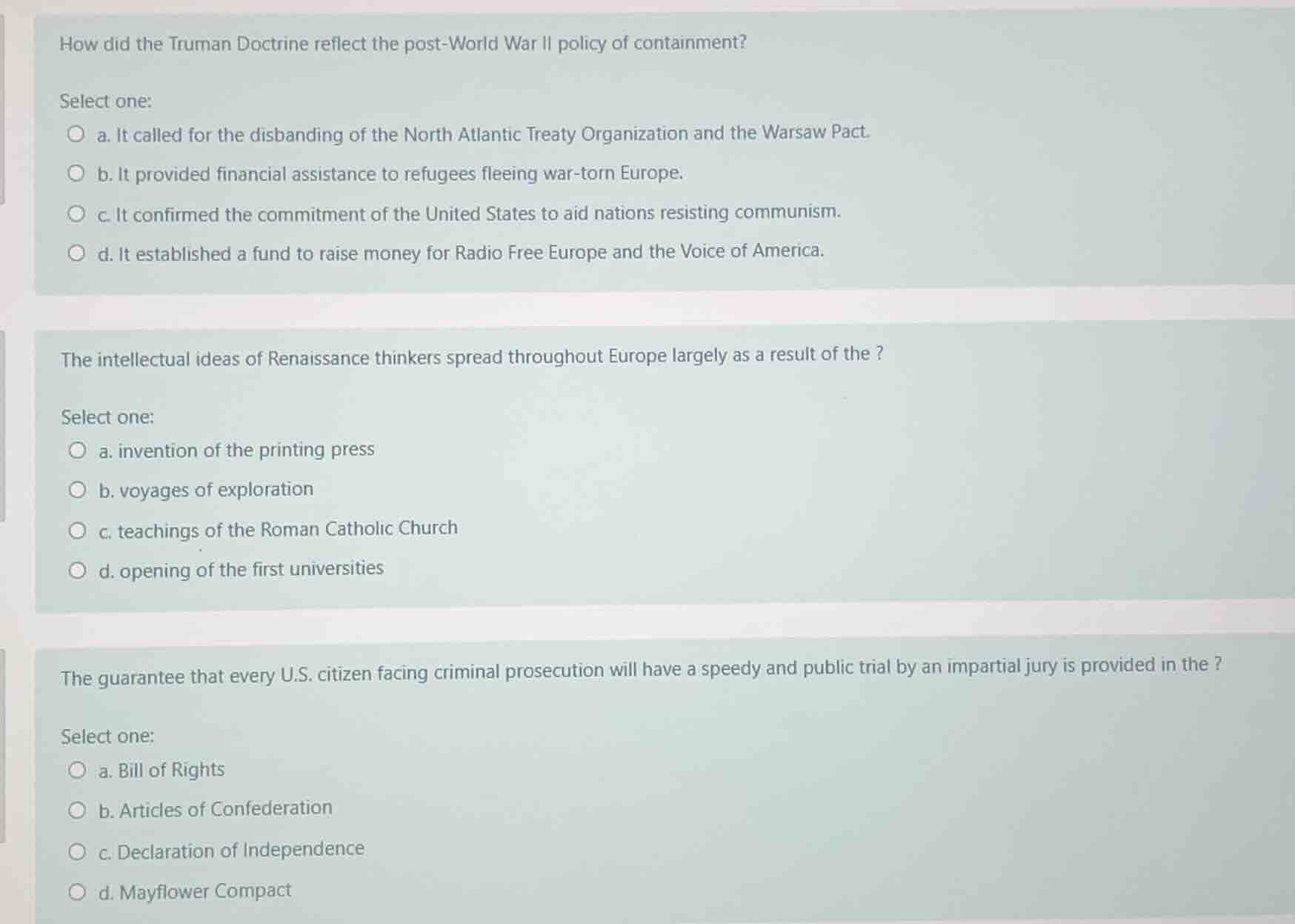
how did the truman doctrine reflect the post-world war ii policy of containment?
select one:
a. it called for the disbanding of the north atlantic treaty organization and the warsaw pact.
b. it provided financial assistance to refugees fleeing war-torn europe.
c. it confirmed the commitment of the united states to aid nations resisting communism.
d. it established a fund to raise money for radio free europe and the voice of america.
the intellectual ideas of renaissance thinkers spread throughout europe largely as a result of the ?
select one:
a. invention of the printing press
b. voyages of exploration
c. teachings of the roman catholic church
d. opening of the first universities
the guarantee that every u.s. citizen facing criminal prosecution will have a speedy and public trial by an impartial jury is provided in the ?
select one:
a. bill of rights
b. articles of confederation
c. declaration of independence
d. mayflower compact
- For the Truman Doctrine question: The containment policy aimed to stop the spread of communism. The Truman Doctrine pledged U.S. aid to nations threatened by communist takeovers, directly embodying this policy. Options a, b, and d do not align with the core of containment.
- For the Renaissance ideas question: The printing press (invented by Gutenberg) allowed mass production of texts, making Renaissance thinkers' works widely available across Europe, which drove their rapid spread. Other options did not have this direct, large-scale impact on intellectual dissemination.
- For the U.S. trial rights question: The right to a speedy, public trial by an impartial jury is outlined in the 6th Amendment, which is part of the Bill of Rights. The other documents listed do not contain this specific guarantee.

Snap & solve any problem in the app
Get step-by-step solutions on Sovi AI
Photo-based solutions with guided steps
Explore more problems and detailed explanations
- c. It confirmed the commitment of the United States to aid nations resisting communism.
- a. invention of the printing press
- a. Bill of Rights