QUESTION IMAGE
Question
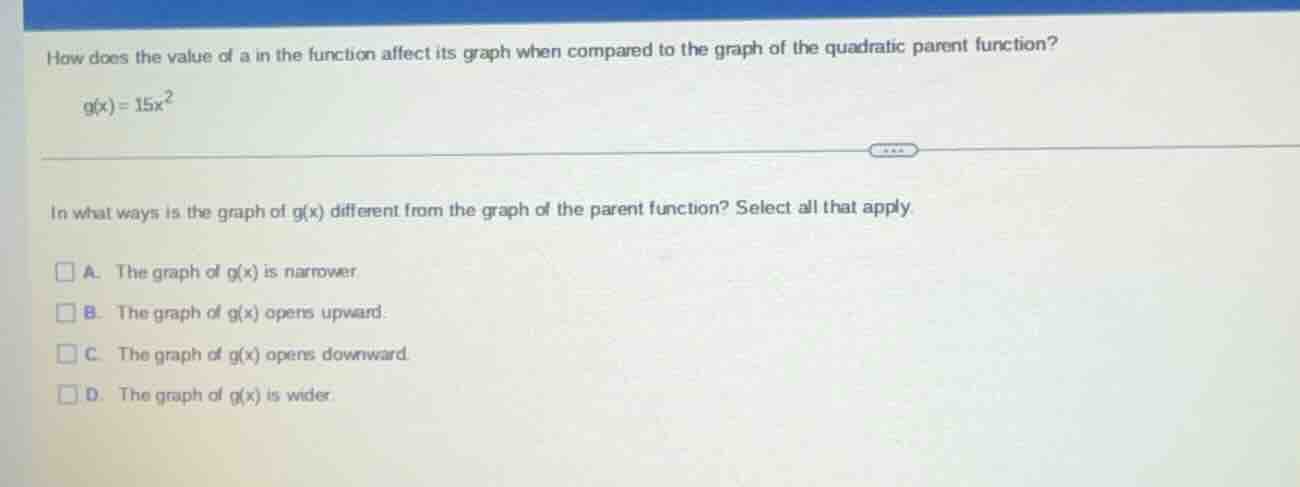
how does the value of a in the function affect its graph when compared to the graph of the quadratic parent function?
( g(x) = 15x^2 )
in what ways is the graph of ( g(x) ) different from the graph of the parent function? select all that apply
a. the graph of ( g(x) ) is narrower
b. the graph of ( g(x) ) opens upward.
c. the graph of ( g(x) ) opens downward.
d. the graph of ( g(x) ) is wider.
- The quadratic parent function is \( y = x^2 \), which opens upward (since the coefficient of \( x^2 \) is positive). For \( g(x)=15x^2 \), the coefficient of \( x^2 \) (15) is positive, so it also opens upward. But this is the same as the parent function, so option B is not a difference.
- The coefficient \( a \) in \( y = ax^2 \) affects the width: if \( |a|>1 \), the graph is narrower than the parent function; if \( 0<|a|<1 \), it's wider. Here, \( |15| = 15>1 \), so the graph of \( g(x) \) is narrower than the parent function.
- Since the coefficient 15 is positive, the graph opens upward, so option C (opens downward) is incorrect. Option D (wider) is incorrect because \( |a|>1 \) makes it narrower. Option A is correct as \( |15|>1 \) narrows the graph, and option B is a property shared with the parent function (not a difference), but wait, actually, the question is about how it's different. Wait, the parent function \( y = x^2 \) also opens upward. So the difference is in the width. So \( a = 15 \), \( |a|>1 \), so the graph is narrower (A is correct). And since \( a>0 \), it opens upward, but the parent function also opens upward, so B is not a difference. Wait, maybe I misread. Let's re-express:
Quadratic parent function: \( f(x) = x^2 \), \( a = 1 \), opens upward, width is standard.
For \( g(x) = 15x^2 \), \( a = 15 \).
- Direction: \( a>0 \), so opens upward (same as parent function, so B is not a difference from parent).
- Width: \( |a| = 15>1 \), so the graph is narrower than the parent function (so A is correct, D is incorrect).
- C is incorrect because \( a>0 \), so it opens upward, not downward.
So the correct option is A. Also, wait, does B count? Wait, the parent function opens upward, and \( g(x) \) also opens upward. So is B a difference? No, because it's the same as the parent. So the differences are in the width (A) and direction? No, direction is same. So only A is correct. Wait, but let's check again:
The question is "In what ways is the graph of \( g(x) \) different from the graph of the parent function?"
Parent function: opens upward, width is standard (since \( a = 1 \)).
\( g(x) \): opens upward (same as parent), but width is narrower (since \( a = 15>1 \)). So the difference is that it's narrower (A) and it opens upward (same as parent, so B is not a difference). So A is correct, B is not a difference, C is wrong, D is wrong. Wait, but maybe I made a mistake. Let's recall the rules:
- If \( a > 0 \), parabola opens upward; if \( a < 0 \), opens downward. So both parent (\( a = 1 \)) and \( g(x) \) (\( a = 15 \)) open upward, so B is a property they share, not a difference. So the only difference is the width: since \( |15| > |1| \), the graph is narrower (A is correct). So the correct option is A. Also, wait, maybe the question considers "opens upward" as a difference? No, because the parent also opens upward. So the answer is A.

Snap & solve any problem in the app
Get step-by-step solutions on Sovi AI
Photo-based solutions with guided steps
Explore more problems and detailed explanations
A. The graph of \( g(x) \) is narrower