QUESTION IMAGE
Question
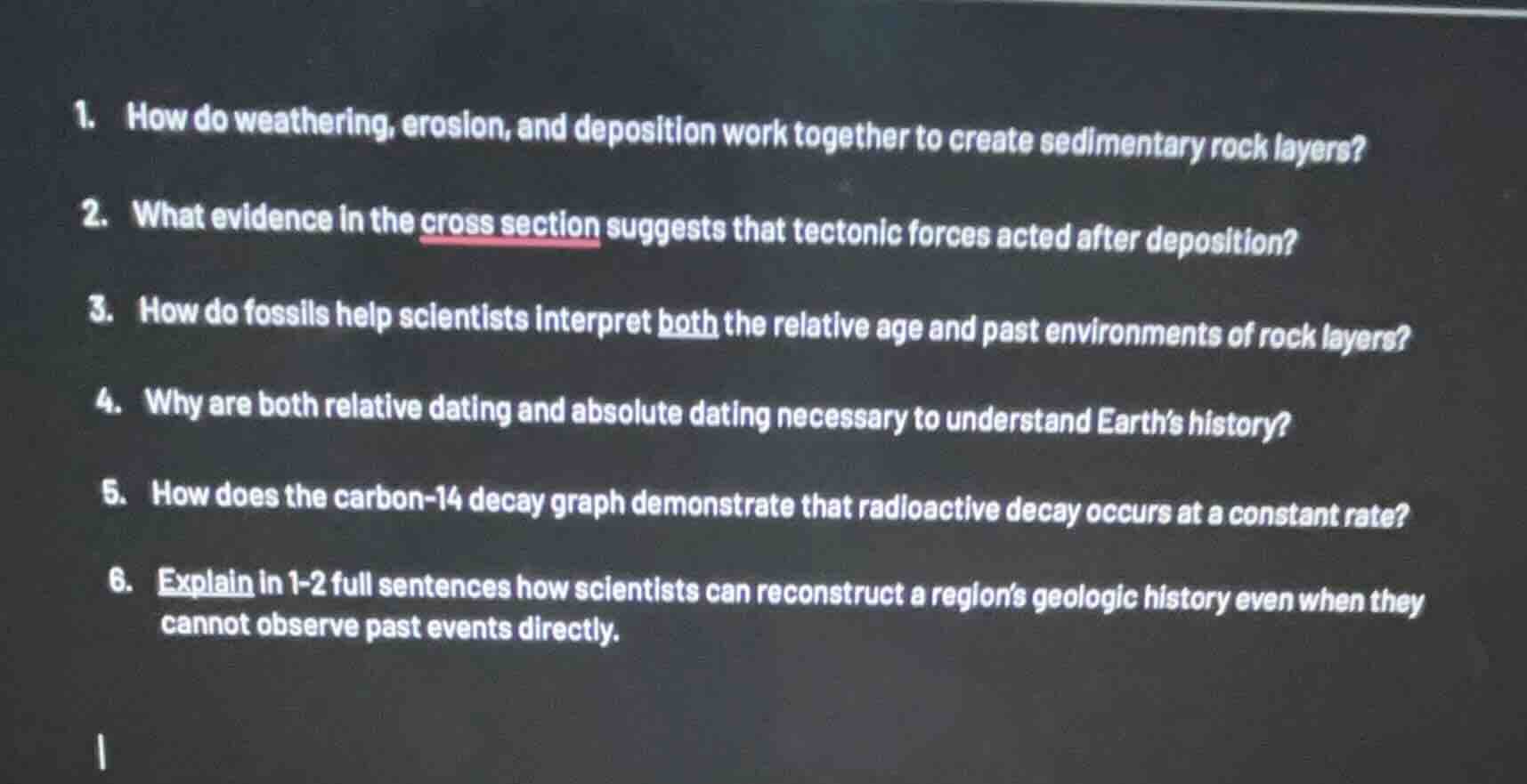
- how do weathering, erosion, and deposition work together to create sedimentary rock layers?
- what evidence in the cross section suggests that tectonic forces acted after deposition?
- how do fossils help scientists interpret both the relative age and past environments of rock layers?
- why are both relative dating and absolute dating necessary to understand earths history?
- how does the carbon-14 decay graph demonstrate that radioactive decay occurs at a constant rate?
- explain in 1-2 full sentences how scientists can reconstruct a regions geologic history even when they cannot observe past events directly.
Brief Explanations
- Weathering breaks bedrock into sediments; erosion moves these sediments; deposition layers them over time. Compaction and cementation turn layered sediments into sedimentary rock.
- Evidence includes tilted/folded rock layers, faults cutting through existing layers, or intrusions that cross deposited layers (all formed after the layers were laid down).
- For relative age: Index fossils show rock layers are the same age across locations, and the law of superposition uses fossil positions to order layers. For past environments: Fossil types match known habitats (e.g., marine fossils mean the area was once ocean).
- Relative dating orders geologic events without exact ages, while absolute dating provides numerical ages for rocks/fossils. Together, they create a complete timeline of Earth's history.
- The carbon-14 decay graph is a curve with a consistent half-life: the time for half the isotope to decay is constant, regardless of the initial amount, showing a fixed decay rate.
- Scientists use principles like superposition, cross-cutting relationships, and fossil correlation, along with radiometric dating, to piece together events from rock layers, fossils, and geologic features, even without direct observation.

Snap & solve any problem in the app
Get step-by-step solutions on Sovi AI
Photo-based solutions with guided steps
Explore more problems and detailed explanations
- Weathering breaks down bedrock into sediment, erosion transports the sediment to a new location, deposition drops the sediment in horizontal layers over time, and compaction/cementation of these layered sediments forms sedimentary rock layers.
- Tilted, folded, or faulted rock layers, or igneous intrusions that cut through existing deposited layers, indicate tectonic forces acted after deposition.
- For relative age: Index fossils and the law of superposition let scientists order rock layers by age. For past environments: Fossil organisms' known habitat requirements reveal the environmental conditions when the rock formed (e.g., coral fossils mean a warm, shallow marine environment).
- Relative dating establishes the sequence of geologic events, while absolute dating provides specific numerical ages for rocks and events. Combining them creates a complete, contextualized timeline of Earth's history.
- The carbon-14 decay graph shows a consistent exponential curve where the half-life (time for 50% of the isotope to decay) is constant, meaning the rate of decay does not change over time.
- Scientists use geologic principles (like superposition and cross-cutting relationships), fossil evidence, and radiometric dating to infer and reconstruct a region's geologic history by analyzing rock layers and features that record past events.